
About IMPROVE
...is driving forward the digitalization of central administrative processes. With systems such as SAP, Fiori and the document management system d.velop documents, processes are designed efficiently and transparently without media discontinuity. Structured project management with clear roles and suitable agile and traditional methods ensures smooth implementation. At the same time, IMPROVE is oriented towards important legal requirements such as the OZG and the E-Government Act in order to create a future-proof and legally compliant digital administration.
1. is there a defined client?
The client of a project is just as important as a project manager. Why is that? A project manager needs someone to turn to when it comes to the context of the project. When goals or scope or the necessary resources need to be adjusted. A captain has the task of steering the project ship, but it is rarely his ship. There must be someone who makes the necessary decisions about this context. Someone who says where the ship should go and who equips it with all the resources it needs. The following criteria are decisive for the right choice of client:
- Sufficient authority to make decisions alone
- High personal involvement in the results of the project and
- Availability to be able to make necessary decisions quickly
Another note: Experience shows that projects always work better when there is only one person as the client.
2. is the trigger for the project clear?
Projects need a starting point. To be able to estimate how far it will take to reach the destination, you need to know where you are starting from. What is the environment from which the project is setting out? How good are you already? What is already in place? These questions create a clear starting position for your project.
3. why should the project start now?
Every project needs a certain urgency. It must therefore be clear to everyone involved why now is the right time for the upcoming project. Without urgency, a project will otherwise quickly fall victim to changing priorities. If there is no urgency, other projects will come to the fore over time and demand resources. Create the necessary stability by making it clear how urgent it is to start the journey now and set course for the goal.
4. which parties have an interest in the project?
A project needs a secure environment. A project brings together the interests of many different parties. If the project team manages to take all interests into account and deliver results that take all stakeholders into account, then the project's chances of success increase dramatically. The prerequisite for this is to have recognized at the beginning who is affected by the project and should be involved in the course of the project.
5. is the benefit of the project clear?
Your project needs a driver so that it can develop enough momentum to stay on course even in stormy times. There are 2 different drivers that can give your project its purpose: 1. a pain that is to be avoided. This means that your project leads to an improvement that needs to be achieved urgently, or 2. the project is motivated by a reward for the client. In this case, new products or the successful entry into new markets are created. You and your team should know what the client's motivator is, because it is the compass and driving force behind every project.
6. what results should the project deliver?
A project needs a clear picture of what is to be achieved. It must be clear to all project participants which target port is to be reached. To this end, the target state that the project team should have created should be described as clearly as possible. It is important that the goal to be achieved should always be a stable state that enables routine day-to-day business. If this target state is clear, then the course to be taken is easy to determine and the necessary project activities are easy to derive.
7. customer / requester defined?
A project needs someone to assess whether the project is on the right course. Without a strong party who knows exactly what the deliverables should be, a project is disoriented. It needs a counterpart to the delivering party. It needs someone who continuously defines, requests, evaluates and gives constructive feedback. This is the only way the project team can ensure that they are on the right track and that what is delivered can actually be used in the best possible way. So make sure that competent people are also appointed to the project team who are continuously on board and take on this customer role.
8. identified uncertainties?
Just as a captain studies nautical charts for shoals and obtains a weather forecast, a project needs a risk forecast. The implementation of a project is always characterized by uncertainties. Of course, things will happen that nobody had expected. But things can also happen that were foreseeable before the project started. And at least this second category of uncertainties can be actively countered in advance. Together with the project team, identify the difficulties that are already visible and work out possible solutions.
9. resources promised?
The project needs a team. Without the availability of the necessary resources in the form of a powerful team, your project is a ghost ship with you alone on board as captain. Many companies are characterized by their day-to-day business, which is often very dynamic, and it means a loss for the day-to-day business to provide employees for the crew of the project ship. From the start of the project, it must be 100% clear which people belong to the project team and to what extent they are available for the project. This is the only way to ensure that both the project and the day-to-day business function with the planned resources.
10. does the project manager have sufficient capacity?
A project always needs a captain on the bridge. Every project must have a project manager who knows the position at all times, who can assess the environmental conditions and make decisions at any time. It would be fatal to appoint someone as captain who is already working at 100% capacity. And because the bridge must always be manned, appointing a deputy is also a good decision.
In my opinion, these are the most important questions that need to be answered before a project can be launched. If you clarify these 10 points before your project ship leaves the port of departure, then we have created good conditions for a successful journey to the destination. Do you have any other points that need to be clarified before you set sail on the high seas with your project? I look forward to your feedback.
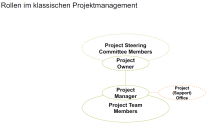
The company-wide PM organizational structure should be adapted to the importance of project work. In some companies, projects are only used as a supplementary form of work and relatively rarely, while other companies generate a large part of their added value in projects and can therefore be described as a "project-oriented company".
Equivalent to the importance of project work, the following organizational forms can also be mentioned in connection with projects:
1. PM in the line
The organizational concept of PM in the line is used when project management is of relatively minor importance. PM in the line can be described as follows:
- The personnel and management responsibility for the project staff remains with the line managers.
- The project manager generally has only limited authority over his project staff.
- Line work tends to take priority.
- Projects are done "on the side".
2. matrix project organization
The matrix project organization is used when both line and project tasks need to be managed. However, this organizational concept can only work if the responsibilities and competencies of line managers and project managers are clearly defined.
- Project managers and employees perform line and project tasks in parallel.
- Within the framework of the project, the employee reports to the project manager.
- As soon as the employee fulfills his or her specialist function, the line manager is responsible.
- Responsibility for personnel usually remains with the line manager.
3. pure project organization
The pure project organization is only used in highly project-oriented companies that generate a large part of their added value in projects.
- The project manager has extensive authority within the project.
- The project team members are formally subordinate to the project manager.
- Project staff are usually assigned 100% to the project for the duration of the project.
- Projects function like "temporary companies" within the organization.
There are various measures for project support. Ideally, these should be tried out early on in the project, ideally before the project starts - especially if the project does not want to start or if it has been recognized from previous projects which stumbling blocks can arise that have influenced the success of the project.
RACI as a project support method
Approach to the project and its U-processes
- Project meetings with a focus on the organization of the project (no content)
- Joint adaptation of the blueprint as a guideline for the PL in the meeting
Identification of the tasks that will take place in the project (rough outline)
Assignment of the roles (upper area) to the identified tasks using RACI (responsibility matrix) can be assigned together with the stakeholders, e.g. in a project kick-off.
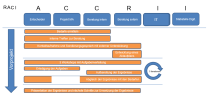
The RACI method and its rules are applied here.
- 1xResponsible (R)
- 1xResponsible (A)
- >1xAdvisory (C)
- >1xInformed (I)
As soon as this assignment has been made for all roles / persons / project participants, it applies to the project.
If there is more than one A or R in the respective task, a problem is possibly pre-programmed, which must be solved in any case before the project starts.
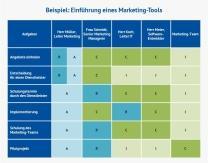
In this example, the classic project tasks have been assigned to the required persons.
Attention: The point "Implementation" is too broadly defined in this example; it would be advisable to divide the point more finely, as there are very likely to be too many important and overarching subtasks behind it, which the IT manager described here will not solve all of them.
Furthermore, depending on the size of the project, it is also advisable to identify other operational people (who actually carry out the implementation)
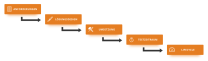
Waterfall as project support
The classic project method for large projects with its project components that run "one after the other" with deadlines and milestones.
What is agility?
Agility is neither a strategy nor a project. Rather, agility is a mindset and mentality from the world of software to make developments and processes more flexible. The proximity to digitalization is no coincidence: agility is the corporate culture's response to digital change. The number of hierarchical levels is being reduced and interdisciplinary team constellations are replacing silos.
Agility as a tool for project support
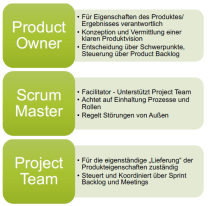
- Scrum:
2ND KANBAN
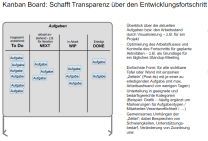
TIP: The KANBAN Board is offered with the help of the wrike project software
- High willingness of the project manager / team to communicate
- Create transparency
- Emphasize the added value
- Stay on schedule
- Carry out change management
- Take the employees with you
- Use simple language
- Create a training offer
- The goals are SMART
- Use the right project management method
The cloud-based solution WRIKE was introduced in 2020 to support project and project-related team tasks. This enables cross-departmental collaboration in the project
The software offers the following options
- Planning overview via Gantt chart
- Listing of tasks in a Kanban board
- Collaborative multi-user capability
- Browser-based (without installation)
- Responsive design (platform-dependent display on various end devices)
- DMS functionalities (editing, versioning and approval of documents)
- EU-DSGVO compliant
The application, activation and instruction is carried out by the Digitization Unit, the license fees are booked to the user units.
Everything at a glance
-

Objective
Digital transformation of administration at the University of Siegen -

Target group
Employees in technology and administration -

Laws
E-Government Act (EGovG)
Online Access Act (OZG)
Project roadmap


