Evolution in the Public Eye (1859–2009). The Debate Over a Scientific Theory from Charles Darwin to the Present Day
International and Interdisciplinary Conference at the University of Siegen
September 3–5, 2009, at the Artur-Woll-Haus at the University of Siegen
Organized by the Chair of Modern and Contemporary History, Prof. Dr. Angela Schwarz
This conference is sponsored by the Fritz Thyssen Foundation

In 1859, Charles Darwin published his book on the theory of the origin of species. Shortly after the sensational public debate on the theory in Oxford in 1860, the theory of evolution began to spread to the general public, where it has been discussed ever since in ever-changing contexts and with, in some cases, new and, in some cases, familiar arguments—and continues to be discussed to this day. This has taken place—and continues to take place—across a broad thematic spectrum, ranging from the natural sciences to politics, society, and culture; from the debate over a theory to today’s discussions on biotechnology and genetic engineering; and is conducted in all forms and media and at all levels of society, from circles of scientific experts to the local pub.
The Darwin Year 2009 offers a good opportunity to reflect on this debate—which has been highly controversial and multifaceted for over 150 years now—as well as its theses and its course. Following a major international conference in Siegen, an examination of its historical and contemporary manifestations will be presented to a broad audience. This will be achieved through a bilingual publication for a general readership and a bilingual, permanently accessible presentation of the topic on a dedicated website.
The conference will take place from September 3–5, 2009, in rooms AE-A 102/103 at the Artur-Woll-Haus of the University of Siegen. It begins on Thursday (September 3, 2009) and Friday (September 4, 2009) at 10 a.m. each day, and on Saturday (September 5, 2009) at 9:30 a.m. The conference will conclude on September 5 at approximately 4 p.m.
The conference will focus on the following topics:
- Enter Evolution – Introducing a Field of Debate
- Issues and Arguments of an Emerging Public Debate
- Evolution and Religion – A Controversy Without End?
- Images of Scientists and the Public
- Eugenics: Defining an Ideal
- From Darwinism to Social Darwinism
- The Debate on Evolution in the Age of the Human Genome
- The Public’s Changing Views and the Future of the Debate
The individual presentations and the panel discussion on Friday will take place in Room AE-A 102/3. For the presentations taking place in the sections, the room will be divided. Section A sessions will always take place in Room AE-A 103, and Section B sessions in Room AE-A 102.
Attendance at the conference is free of charge, but registration via the conference website is required. Coffee, cake, and cold beverages will be provided free of charge to all registered conference attendees. Visitors may participate in lunch on all three days for a fee. You can sign up for meals directly during registration. The fee of approximately 10 to 15 € per meal is to be paid on-site at the start of the conference. Meals are free for the conference speakers and moderators. The guided city tour on Thursday evening and the reception at Siegen City Hall are also reserved for speakers and moderators.
If you have any further questions, the organizers will be happy to assist you by email at evolution@geschichte.uni-siegen.de or by phone at 0049-(0)271-740-4623 (Tim Bernshausen) or (0)271-740-4502 (Susanne Schmitt).
Thursday, September 3, 2009
| 10:00 – 10:15 a.m. | Welcome |
|
Plenary Session (Room AE-A 102/103) Enter Evolution – Introducing a Field of Debate
Moderator: Angela Schwarz, Siegen |
|
| 10:15 – 10:30 a.m. | Introduction Angela Schwarz, Siegen |
| 10:30 – 11:15 a.m. | Evolution and Public Debates since 1859 Peter Bowler, Belfast |
| 11:15 a.m. – 12:00 p.m. | On the Origin of Art: A Darwinian Explanation Thomas Junker, Tübingen |
| 12:00 – 1:00 p.m. | Lunch |
|
Section A (Room AE-A 103) Issues and Arguments in an Emerging Public Debate
Moderator: Angela Schwarz, Siegen |
|
| 1:00 – 1:45 p.m. | The Missing Link: Understanding an Evolutionary Icon Peter C. Kjærgaard, Cambridge |
| 1:45 – 2:30 p.m. | Darwinism as a Bellum Omnium Contra Omnes? Origin and Consequences of a Misconception Dirk Solies, Mainz |
| 2:30 – 3:15 p.m. | Unraveling a Dual Revolution: Darwinian Thought and Human Prehistory, 1859–1900 Chris Manias, London |
|
Section B (Room AE-A 102) Evolution and Religion—A Controversy Without End?
Moderator: Heike Petermann, Münster |
|
| 1:00 – 1:45 p.m. | Symbioses as a Provocation: Franz Unger’s Visualization of Plant Evolution and Geological ‘Periods’ Marianne Klemun, Vienna |
| 1:45 – 2:30 p.m. | Evolution versus Intelligent Design and Scientific Creation: An Unnecessary Conflict? Jeffrey H. Schwartz, Pittsburgh, PA |
| 2:30 – 3:15 p.m. | Creation and Evolution—Controversy or Convergence? Josef Bordat, Berlin |
| 3:15 – 3:45 p.m. | Coffee Break |
|
Section A (Room AE-A 103) Issues and Arguments in an Emerging Public Debate
Moderator: Angela Schwarz, Siegen |
|
| 3:45 – 4:30 p.m. | Darwin’s Genealogy of Morality Mario Brandhorst, Göttingen |
| 4:30 – 5:15 p.m. | Darwinizing Homosexuality: Problems and Prospects Pieter R. Adriaens, Leuven |
| 5:15 – 6:00 p.m. | Darwin and German National Identity Rebecca Ayako Bennette, Middlebury, VT |
|
Section B (Room AE-A 102) Evolution and Religion – A Never-Ending Controversy?
Moderator: Heike Petermann, Münster |
|
| 3:45 – 4:30 p.m. | Rational versus Religious Thinking: What’s Wrong with the Intelligent Design “Theory”? Chong-Fuk Lau, Hong Kong |
| 4:30 – 5:15 p.m. | Evolutionary Theory and Religion in Russia – Old and New Controversies Mikhail Borisovich Konachev, St. Petersburg |
| 5:15 – 6:00 p.m. | The Growth of Creationism in Britain Since 1969 and Its Influence on Churches and Education Michael Roberts, Lancaster |
| 6:00 – 6:30 p.m. | Transfer to downtown Siegen (for speakers and moderators) |
| 6:30 – 7:30 p.m. | Guided tour of Siegen’s Old Town (for speakers and moderators) |
| 7:30 p.m. | Reception at Siegen City Hall (for speakers and moderators) |
Friday, September 4, 2009
|
Section A (Room AE-A 103) Images of Scientists and the Public
Moderator: Mita Banerjee, Siegen |
|
| 10:00 a.m. – 10:45 a.m. | Representations of Women Scientists in Fiction Films Eva Flicker, Vienna |
| 10:45 – 11:30 | Animating Darwin in the Public Sphere: Max Fleischer’s “Darwin’s Theory of Evolution” (1925) Scott MacKenzie, Toronto |
|
Section B (Room AE-A 102) Eugenics: Defining an Ideal
Moderator: Eckart Voigts-Virchow, Siegen |
|
| 10:00 a.m. – 10:45 a.m. | The Politics of Negative Eugenics: A Global Comparative Approach, 1900–1950 Michael Schwartz, Berlin |
| 10:45 a.m. – 11:30 a.m. | "Blood Will Tell": The Eugenics Movement in Canada Prior to World War II Lukasz Albanski, Kraków |
| 11:30 a.m. – 12:00 p.m. | Coffee break |
|
Section A (Room AE-A 103) Images of Scientists and the Public
Moderator: Barbara Korte, Freiburg |
|
| 12:00 – 12:45 | Darwin and Photography Monika Pietrzak-Franger, Siegen |
| 12:45 – 1:30 p.m. | Portrait Photography and Physiognomic Theory from Darwin to the Third Reich Leesa L. Rittelmann, Fredonia, NY |
|
Section B (Room AE-A 102) Eugenics: Defining an Ideal
Moderator: Peter Alter, Duisburg-Essen |
|
| 12:00 – 12:45 | Eugenics, Race, and Psychiatry in the Baltic States, 1900–1945 Björn Michael Felder, Marburg |
| 12:45 – 1:30 p.m. | The Implementation of Eugenic Ideals in Heinrich Himmler’s SS Amy Beth Carney, Tallahassee, FL |
| 1:30 – 2:30 p.m. | Lunch |
|
Section A (Room AE-A 103) The Debate on Evolution in the Age of the Human Genome
Moderator: Marianne Sommer, Zurich |
|
| 2:30 – 3:15 p.m. | The Origin of Higher Categories in Cynips: Alfred Kinsley’s Contributions to the Study of Evolution Donna J. Drucker, Indianapolis, IN |
|
Section B (Room AE-A 102) Eugenics: Defining an Ideal
Moderator: Peter Alter, Duisburg-Essen |
|
| 2:30 – 3:15 p.m. | Teaching the History of Eugenics in the Multicultural Classroom Aaron Gillette, Houston, TX |
| 3:15 – 3:45 p.m. | Coffee break |
|
Section A (Room AE-A 103) The Debate on Evolution in the Age of the Human Genome
Moderator: Marianne Sommer, Zurich |
|
| 3:45 – 4:30 p.m. | Gould as a Third Culture Thinker: Revising Darwinism Curtis D. Carbonell, Jersey City, NJ |
| 4:30 – 5:15 p.m. | Tracing "Descent" as Popular History in Contemporary Britain Barbara Korte and Ulrike Pirker, Freiburg |
|
Section B (Room AE-A 102) From Darwinism to Social Darwinism
Moderator: Eckart Voigts-Virchow, Siegen |
|
| 3:45 – 4:30 p.m. | An Unbroken Strain of Defectives: The Social Articulation of Mental Disability in New York City in the Early Twentieth Century Yoshiya Makita, Boston, MA |
| 4:30 – 5:15 p.m. | Herbert Spencer and the Discourse of Evolution Michael Beetz, Jena |
| 5:15 – 5:30 p.m. | Break |
5:30 – 7:00 p.m. |
Plenary Session (Room AE-A 102/103)
|
| 8:00 p.m. | Dinner at the Park Hotel in Siegen (for speakers and moderators) |
Saturday, September 5, 2009
|
Section A (Room AE-A 103) The Debate on Evolution in the Age of the Human Genome
Moderator: Marianne Klemun, Vienna |
|
| 9:30 – 10:15 a.m. | Reflections on the Role of Utopias and Their Public Understanding in the History of Human Genetics Heike Petermann, Münster |
| 10:15 – 11:00 | The Aesthetics of Eugenicist Thinking in 19th- and 20th-Century American Literature and Film Mita Banerjee, Siegen |
|
Section B (Room AE-A 102) The Debate on Evolution in the Age of the Human Genome
Moderator: Daniela Fleiß, Siegen |
|
| 9:30 – 10:15 a.m. | Darwin, Zoos, and the Natural Understanding of Bourgeois Modernity Utz Anhalt, Hanover |
| 10:15 – 11:00 | Reconstructions of Hominids in Natural History Museums Oliver Hochadel, Barcelona |
| 11:00 – 11:15 a.m. | Coffee break |
|
Section A (Room AE-A 103) The Debate on Evolution in the Age of the Human Genome
Moderator: Marianne Klemun, Vienna |
|
| 11:15 a.m. – 12:00 p.m. | "A Dream Come True?": Creating the Ideal Human Being in Science Fiction Literature and Film (1945–2009) Angela Schwarz, Siegen |
|
Section B (Room AE-A 102) The Debate on Evolution in the Age of the Human Genome
Moderator: Daniela Fleiß, Siegen |
|
| 11:15 a.m. – 12:00 p.m. | Darwin’s Jim Knopf: How Jemmy Button Became a Star of German Children’s Book Literature Julia Voss, Frankfurt/Main |
| 12:00 – 1:00 p.m. | Lunch |
|
Section A (Room AE-A 103) The Debate on Evolution in the Age of the Human Genome
Moderator: Donna J. Drucker, Indianapolis, IN |
|
| 1:00 – 1:45 p.m. | The Meme Meme. Remarks on the Popularization of Meme Theory (1976–2005) Sibylle Marti, Zurich |
| 1:45 – 2:30 p.m. | Human Evolution in the Genomic Age: A Case of Genetic History and Its Commercialization Marianne Sommer, Zurich |
|
Section B (Room AE-A 102) Evolution of the Public and the Future of the Debate
Moderator: Peter Kjærgaard, Cbridge |
|
| 1:00 – 1:45 p.m. | Controversies on Evolution in the Italian Daily Press (1995–2009) Lorenzo Beltrame, Trento |
| 1:45 – 2:30 p.m. | Media Coverage of Evolution: A Case Study of a German National Newspaper Hendrik Bullens, Breitenbrunn |
| 2:30 – 2:45 p.m. | Coffee Break |
|
Plenary Session (Room AE-A 102/103) The Evolution of the Public and the Future of the Debate
Moderator: Angela Schwarz, Siegen |
|
| 2:45 – 3:30 p.m. | The Future of Evolution and the Evolution of the Future Franz Wuketits, Vienna |
| 3:30 – 4:00 p.m. | Closing Discussion Moderator: Angela Schwarz, Siegen |
When Charles Darwin published his theory of evolution by natural selection, scientists and the general public were aware that this concept was more than just a scientific explanation for natural phenomena. They already sensed what we know today, after 150 years of debate: The theory of evolution raises a large number of fundamental questions of a theological, philosophical, moral, social, and political nature that touch on the very core of human existence and society. It opens up new freedoms and possibilities for humanity, yet at the same time gives rise to new dangers stemming from human intervention in the evolutionary process.
At the beginning of the twenty-first century, developments in biotechnology and genetic engineering, in particular, are at the center of controversial debates. Shortly after its publication, Darwin’s theory sparked sensational discussions about the compatibility of religion and evolution, which show no signs of abating to this day. The application of Darwin’s ideas to other fields revealed new possibilities and risks for individuals, for specific social and national groups, and for society in general. In particular, social Darwinism, eugenics, and the idea of influencing creation have captured—and continue to capture—the human imagination.
The conference will examine this public debate on the theory of evolution in all its diversity, with a regional focus on Europe and North America. It will consider all levels of society, from discussions in academic circles to informal conversations among laypeople. Furthermore, the debate will be examined as it unfolds in the various media of popular and high culture (literature, press, radio, television, film, the Internet, museums, etc.). By analyzing the public debate on evolution, the focus will also be directed toward the question of the associated transformations of the public sphere itself—the evolution of the public sphere.
The conference presentations and discussions will be held in English and are organized into seven thematic areas:
- The Birth of a Public Debate
- Evolution and Religion
- Scientists in the Public Eye: From Darwin to the Present
- From Darwinism to Social Darwinism
- Eugenics in Europe and North America: Definitions of the Ideal Human and Attempts to Realize Them
- The Debate in the Age of the Genome: Biotechnology, Genetic Engineering, and Humans as Creators
- Evolution in the Public Eye: Darwin’s Theories as Part of Popular Culture
Shortly after the publication of Charles Darwin’s *On the Origin of Species*, controversial discussions arose regarding the book’s content. The view presented therein—that humans evolved from animal species—cast doubt on the biblical account of a creator God. 150 years later, the debate over the theory of evolution—both in the scientific community and among the general public—still shows no signs of abating. However, this debate is by no means limited to the question of the compatibility of religion and evolution; rather, it touches on numerous political, scientific, social, and cultural spheres.
Building on the scientific discussions held during the conference in September 2009, editor Angela Schwarz and approximately 40 scientists from eleven countries embarked on the journey toward publishing a book—a process that, at times, took on characteristics reminiscent of evolution itself. The goal was to produce a book that, on a scientifically sound basis, would address as broad a spectrum of topics related to evolution as possible for a diverse readership of both laypeople and scholars alike. From religion to eugenics and social Darwinism, all the way to the reception of biotechnology and human-induced genetic modifications in contemporary media, the book examines the various debates surrounding evolution—spanning more than 150 years—from diverse disciplinary perspectives. On October 16, 2017, the approximately 800-page volume, featuring more than 460 illustrations, was published under the title *Streitfall Evolution: Ein Kulturgeschichte* by Böhlau-Verlag at a price of 50 euros.
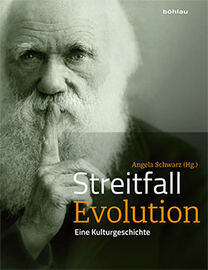
A summary of the workshop’s findings can be found in four different conference reports:
-
Conference report from the Association of Historical Research Institutions (AHF)
- Conference report on H-Soz-u-Kult
- Conference report on Change by Evolution. Charles Darwin Year 2009, an initiative of the City of Vienna for Charles Darwin Year 2009
- Conference report in the journal *Studies in the History of Biology*, Volume 2, No. 1 (2010), pp. 112–116