Interconnected Automation Systems (IAS)
At the Chair of Interconnected Automation Systems (IAS) at the University of Siegen, we drive basic and applied research on design automation of software and hardware to improve the reliability, efficiency and sustainability of modern cyber-physical infrastructures - from industrial and mechatronic systems to energy conversion applications and electrical power systems.


Mission statement
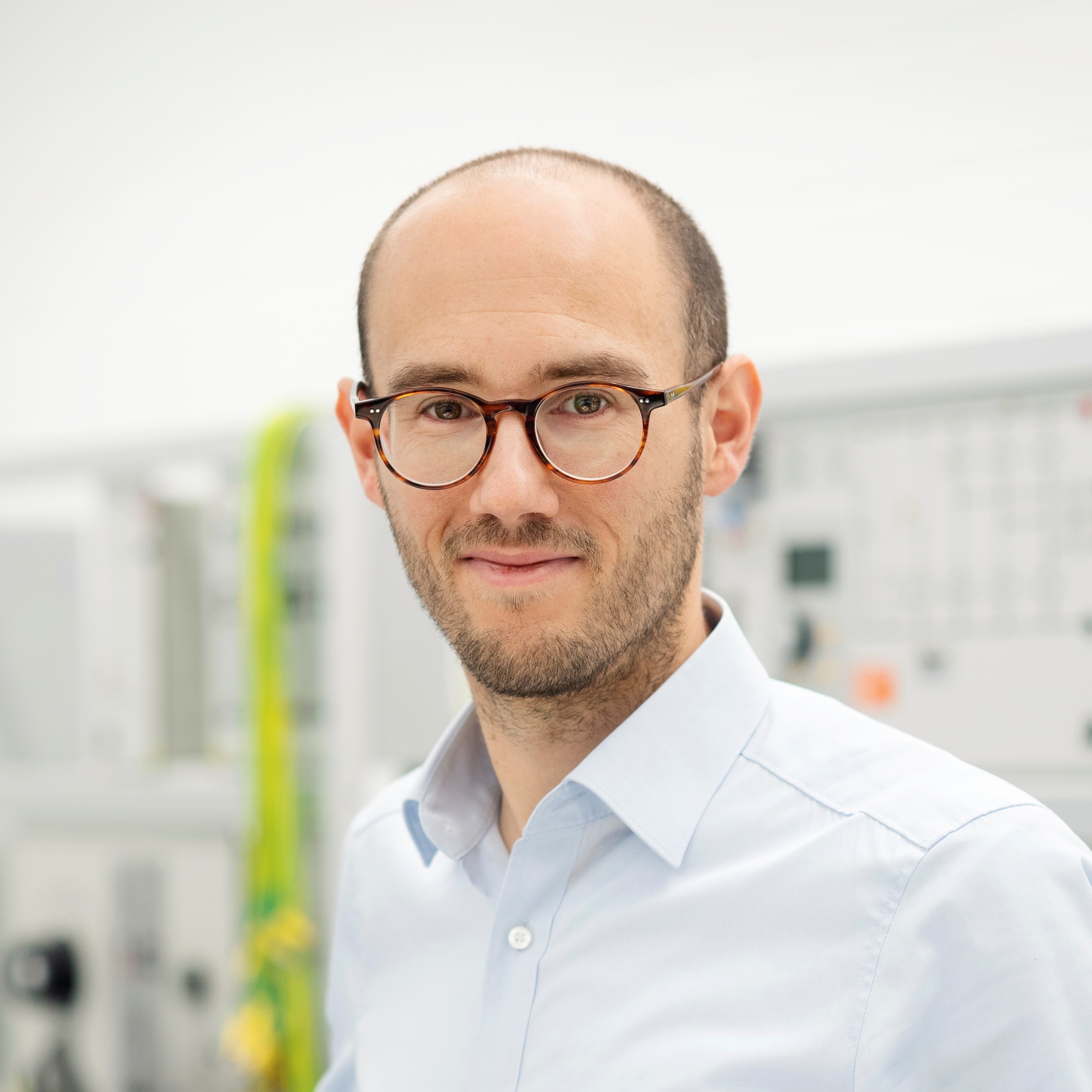
We conduct rigorous, open and responsible research on interconnected automation systems and translate sound modeling, control and data-driven methods into trustworthy technologies that increase safety and reliability, reduce energy plus resource consumption and strengthen resilient infrastructures for the benefit of society. In teaching, we qualify engineers and researchers to combine a physical-analytical understanding of systems with computer-aided and data-oriented tools so that they can actively shape future generations of automation and energy systems.
Chair's head
Research profile
We research networked cyber-physical systems in industrial automation and mechatronics as well as in electrified energy technologies. Central fields of application are electric drives, power electronic converters, energy storage systems and charging infrastructures as well as networked electrical energy systems such as microgrids - with the aim of enabling more reliable, efficient and resilient operation under real operating conditions.
Our work covers the entire innovation chain from basic research to industrial transfer. A particular focus is on translating theoretical concepts into practical proof-of-concepts, supported by rapid software and hardware prototyping. Experimental validation, including targeted measurement campaigns on relevant test benches, is an integral part of our research process.
Open science is a cornerstone of our research practice. We publish open source software, reproducible workflows and other open resources to enable transparent evaluation, benchmarking and rapid knowledge transfer for students, researchers and industry partners. Our open source contributions can be found on GitHub: https://github.com/IAS-Uni-Siegen
Focus areas
- Optimal control methods (e.g., reinforcement learning, differential predictive control)
- Hardware design, optimization and testing of power electronic converters (component and system level)
- Hybrid modeling and system identification (combination of expert and data knowledge)
- Condition monitoring, diagnostics and digital twins (e.g. using fault and anomaly detection)
- State and parameter estimation (observer, co-estimator)
- Software-driven automation (reproducible design toolchains, verification and benchmarking)
Latest publications
Bridging the Gaps in Smart Inverter Technologies for PV Systems: A Review of Global R&D Projects
Bridging the Gaps in Smart Inverter Technologies for PV Systems: A Review of Global R&D Projects
Differentiable Predictive Current Control of Permanent Magnet Synchronous Motors
Differentiable Predictive Current Control of Permanent Magnet Synchronous Motors
Reinforcement Learning-based Direct Torque Control of Externally Excited Synchronous Motors: A Proof of Concept
Reinforcement Learning-based Direct Torque Control of Externally Excited Synchronous Motors: A Proof of Concept
Universal Direct Torque Controller for Permanent Magnet Synchronous Motors via Meta-Reinforcement Learning
Universal Direct Torque Controller for Permanent Magnet Synchronous Motors via Meta-Reinforcement Learning
DRIVER CIRCUIT FOR ONE OR MORE POWER SEMICONDUCTORS
DRIVER CIRCUIT FOR ONE OR MORE POWER SEMICONDUCTORS
An intelligent battery management system (BMS) with end-edge-cloud connectivity – a perspective
An intelligent battery management system (BMS) with end-edge-cloud connectivity – a perspective
Develop a Versatile ECM Framework Capable of Accurately Representing Multiple Cell Types
Develop a Versatile ECM Framework Capable of Accurately Representing Multiple Cell Types
Optimal System Excitation of a Permanent Magnet Synchronous Motor Using Differentiable Model Predictive Excitation
Optimal System Excitation of a Permanent Magnet Synchronous Motor Using Differentiable Model Predictive Excitation
Thermal Neural Networks for Temperature Estimation of Traction Inverters in Electric Vehicles
Thermal Neural Networks for Temperature Estimation of Traction Inverters in Electric Vehicles
Earth Grid: Toward a low-carbon energy infrastructure.
Earth Grid: Toward a low-carbon energy infrastructure.
Optimal Control of Voltage Forming Grid Inverters by Model Predictive Control and Reinforcement Learning - Part II: Real-Time Implementation and Experimental Investigations
Optimal Control of Voltage Forming Grid Inverters by Model Predictive Control and Reinforcement Learning - Part II: Real-Time Implementation and Experimental Investigations
A Year of Impact: PELS S&YP Committee in 2024 and Beyond
A Year of Impact: PELS S&YP Committee in 2024 and Beyond


Opening hours secretariat
Opening hours
Postal address
University of Siegen
Chair of Interconnected Automation Systems (IAS)
Hölderlinstraße 3
57076 Siegen
Visitor address
University of Siegen
Chair of Interconnected Automation Systems (IAS)
H-A Level 4
Room: H-A 4106/3
Hölderlinstraße 3
57076 Siegen
Secretariat
Secretary: Lada Lübke
Phone: +49 (0)271 / 740-3305
Fax: +49 (0)271 / 740-13305
Room: H-A 4106/3
E-Mail: IAS-office@eti.uni-siegen.de