Drone logistics set to become safer – millions in funding for the University of Siegen

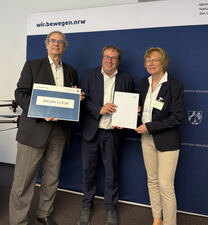
Grant presentation at the Ministry of the Environment, Nature Conservation, and Transportation of the State of North Rhine-Westphalia in Düsseldorf: Dr. Philipp Köhn, Dr. Jürgen Daub (University of Siegen), Minister Oliver Krischer (MUNV-NRW), Lukas Ostermann, Dirk Vogelsang (Morpheus Logistik), Prof. Dr. Stefanie Reese (Rector of the University of Siegen), Prof. Dr.-Ing. Giuseppe Strina (University of Siegen), Christophe Said (University of Siegen), Annika Schmitt (Project Management Jülich) (from left)
The University of Siegen is developing new infrastructure for drone logistics and has received just under one million euros in funding for this purpose. The CODROMO project, “Cooperative Drone Mobility,” aims to demonstrate how drones can be coordinated in urban areas in the future without different operations interfering with one another. Drones are among the key technologies for urban mobility of the future—and North Rhine-Westphalia is positioning itself as a leading location for their testing and practical application. The Siegen project is funded by the Ministry for the Environment, Nature Conservation, and Transportation of North Rhine-Westphalia (MUNV NRW).
“This funding demonstrates once again the immense potential of strong collaboration between academia and industry,” says Prof. Dr. Stefanie Reese, Rector of the University of Siegen. “Together with the company Morpheus, we at the University of Siegen are working on innovative solutions for the future of civilian mobility.”
A Mobile Control Center for Safe Airspace
The CODROMO project is developing a central, mobile control center. At its core is a container-based solution. The container is compact and light enough to be transported on a truck. The plan is to initially set it up near the “Unteres Schloss” campus for the duration of the research. During the research phase and for five years afterward, the Ministry wants it to be clearly visible in the city so that people can become familiar with the system.
Drone flights operated by various providers will be coordinated from this control center. The researchers are developing a system for monitoring and collision avoidance. It is intended to reduce risks and defuse conflicts in airspace as automatically as possible—or prevent them from arising in the first place. Humans will continue to monitor the system, as rules, safety, and responsibility remain crucial from both a technical and organizational standpoint. The system is being tested in the Siegen and Kreuztal area for research purposes. It is intended to be transferable to other municipalities. The infrastructure is primarily intended for transport operations where speed and reliability are critical. These include, for example, industrial spare parts to prevent production downtime, samples that need to be transported from hospitals to laboratories, or medications for rapid care that must be delivered in emergencies. Until now, such rapid transports have often not been possible in the required form.
Safety, Regulatory Authorities, and the Outlook for the Coming Years
Today, the volume of traffic from logistics drones is still low. At the same time, individual operators, such as the project partner Morpheus Logistik GmbH, are already using drone routes. Over the next ten years or so, however, project partners and experts expect more drones to be in operation. That is precisely when robust, scalable systems will be needed to ensure airspace remains controllable and to help prevent collisions.
A significant part of the work focuses on cooperation with various civil protection agencies. Their requirements must be understood and implemented in such a way that drone logistics do not interfere with rescue helicopters, for example. The Siegen Fire Department, the German Life Saving Association (DLRG), and the Federal Agency for Technical Relief (THW) are therefore involved as associate partners. They will help test which safety conditions are necessary in real-world scenarios. An initial workshop with the participants has already taken place.
“The city, the district, and the authorities are working with us to develop solutions. This demonstrates the region’s innovative strength,” emphasizes Prof. Dr. Giuseppe Strina, Professor of Service Development in SMEs and the Skilled Trades at the University of Siegen. “The goal is to develop a system that can be transferred to other areas and implemented by small businesses. If drone logistics thereby becomes attractive to small businesses, they can expand their business models and gain a significant competitive advantage.”
The project launched in May 2026 and will run for two and a half years. The project coordinator is Dr. Jürgen Daub from Prof. Strina’s team. The project is supported by an interdisciplinary consortium: the University of Siegen is responsible for coordination, system integration, and scientific leadership. Morpheus Logistik GmbH contributes operational drone expertise and safety management. The City of Siegen’s Economic Development Agency provides support for testing in real-world laboratory settings and for the transfer of findings into municipal practice. Karl Koerschulte GmbH, as an associated partner, assists with regulatory issues and ground infrastructure.