Welcome to the Didactics of Mathematics page


Conference: STEM-Education in the Era of AI
Artificial intelligence is becoming increasingly important across education, including schools, higher education, and vocational education and training. At the same time, AI is raising fundamental questions about teaching, learning, assessment, professional practice, and educational innovation in STEM fields.
STEM-Education in the Era of AI is an international conference dedicated to the role of AI in STEM education. It aims to bring together researchers, teachers, teacher educators, university lecturers, policy actors, school administrators, EdTech professionals, industry representatives, and others interested in shaping the future of STEM education.
Dates: 8-10 March 2027
Venue: University of Siegen, Campus Unteres Schloss, Siegen, Germany
Format: In-person conference
Conference language: English
Organizer: Mathematics Education Research Group, University of Siegen
Conference participation: Free of charge (except for the optional conference dinner)


Administrative office

Silke Steinhorst
Contact
Opening hours
Employees
Here you will find an overview of former staff members of the Department of Mathematics Education, whose expertise and commitment have made valuable contributions to our work.
The MatheWerkstatt
The MatheWerkstatt is the university learning workshop for the didactics of mathematics at the University of Siegen. It offers students, teachers, researchers and teaching staff an open and inspiring space for mathematical and mathematics didactic work.
During the designated opening hours, all interested parties are welcome to use the wide range of analog and digital materials, textbooks and specialist literature, develop new ideas and experience mathematics in a engaging atmosphere.
In addition to the curriculum-based seminars, various events are held regularly to promote creative mathematical work and constructive exchange with others.
To the website

Are you studying to become a mathematics teacher?
- Discover useful resources and digital learning tools.
- Get support with problem sets and subject-related questions.
- Connect with fellow students and exchange ideas.
-
Take part in a variety of workshops on different topics.
Opening Hours of the MatheWerkstatt
Tuesdays: 2:00 p.m. – 4:00 p.m.
Wednesdays: 2:00 p.m. – 5:00 p.m.
Thursdays: 2:00 p.m. – 5:00 p.m.
Mathematics Education Colloquium
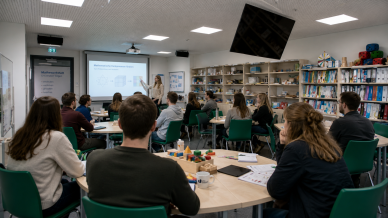
As part of the Mathematics Education Colloquium at the University of Siegen, invited speakers provide insights into current research projects and key issues related to the teaching and learning of mathematics. The presentations cover theoretical approaches, empirical findings, and innovative instructional concepts from mathematics education research. Participants are invited to engage in discussion and academic exchange following each presentation. The colloquium is open to students, lecturers, researchers, and all interested members of the public.
Upcoming Events:
Our research projects

Adapt AI
Project team:

AI & Robotics Explorer Camps
Combine vocational orientation and extracurricular education in the field of computer science and mathematics with real problems and application scenarios from companies - implementing intelligent automation with the help of robotics, programming and AI.
Project team:

AMAICE
As part of the AMAICE project, a platform for AI-supported digital escape games in mathematics education is being developed in collaboration with European partners. In addition, professional development opportunities for teachers are being created, along with an intuitive AI-powered game editor that enables users to adapt existing games and design their own escape games.
Project team:

ASSIST-ME
An AI-supported tutor is being developed and researched in the ASSIST-ME project. The aim is to provide learners - especially in heterogeneous learning groups - with individual support when working on mathematical tasks. A special feature of the project is the integration of interactive visualizations that illustrate mathematical relationships.
Project team:

BASE
The BASE project is developing the Math-GO-app for independent testing of basic arithmetic skills. The app uses interactive visualizations, automatic feedback and adaptive task assignment to enable comprehension-oriented self-diagnosis and targeted support.
Project team:

ISAA
The ISAA project investigates approaches that combine self-assessment with automated assessment. The aim is to foster learning processes focused on conceptual understanding and to stimulate rich mathematical discourse in the classroom.
Project team:

KI@school
In KI@school, 18 Bavarian schools are working together with the Stiftung Bildungspakt Bayern and the University of Siegen to develop innovative concepts for data-driven, individual learning support. The aim is to use generative AI to promote mathematical thinking and prepare teachers and learners for the digital future.
Project team:

KIMADU
The KIMADU pilot project of the Didactics of Mathematics and Didactics of the German Language, funded by the Ministry of Schools and Education of the State of North Rhine-Westphalia, is investigating the use of generative AI at 25 lower secondary schools. The focus is on the promotion of basic skills and the development of future-oriented skills in the subjects German and mathematics.
Project team:

MINTco@NRW
In the MINTco@NRW project, students work together with US students for several months on realistically situated problems from companies. They not only develop mathematical and technical approaches to real-world challenges, but also acquire 21st century skills such as collaboration, communication, critical thinking and problem solving.
Project team:

MINTelligence
The MINTelligence project is establishing a nationwide digital STEM escape game competition in Germany. The aim is to inspire students to engage with STEM subjects and to foster problem-solving skills through game-based learning formats.
Project team:

SMART
SMART is a comprehension-oriented digital diagnostic and support tool for lower secondary level. Teachers gain insights into pupils' thought processes as well as specific tips for lessons in order to design learning processes in a pupil-oriented and adaptive way.