The former "auxiliary hospital" in Fludersbach
- An architectural monument to forced labor in Siegen during the "Third Reich"
In Fludersbach, on the south-western outskirts of Siegen, a so-called auxiliary hospital for sick "Eastern workers" was built during the "Third Reich". This barrack camp was nothing like a modern-day hospital and there was hardly any medical help available. Hundreds of people - men, women and children - died and were buried in a specially established cemetery.
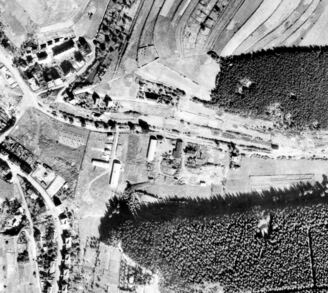
Aerial photo from 1951, showing the former "auxiliary hospital" and the cemetery
Source: Gauß-Krüger coordinates 3432/5636, Siegen Südost aerial survey from 15.9.
or 22.9.1951, RW 230 No. 1
Hardly anything of this "auxiliary hospital" can be seen today and no one remembers the victims there: the cemetery (plot 2130) is hidden and only known to a few, the barracks were partially destroyed during the Second World War. After 1945, several buildings were still standing (see aerial photo from 1951). In the 1960s, a supermarket was built on the site of the barracks, which integrated parts of the "auxiliary hospital". Some of the cellar rooms of the barracks - apparently with original furnishings - have been preserved to this day.
With the planned demolition of the Kaufland building, there is a risk that the last structural evidence of this site will be destroyed. The LWL Archaeology for Westphalia has classified the area, including the preserved building components, as so-called presumed ground monuments, the preservation and use of which is in the public interest. In the opinion of the specialist authority, it is an important "site of the culture of remembrance of forced labor during the Nazi era" (assessment of the LWL archaeology on 21.6.2024).
To this day, there is no evidence in the city of the mass deployment of forced laborers in Siegen between 1941 and 1945. Against this background, the few surviving testimonies in the Fludersbach are of particular importance. They alone still refer to this place and should be preserved in order to prevent the events from being forgotten and to establish a memorial site. The question of how to deal appropriately with the cellar rooms and any other structural remains of the "auxiliary hospital" needs to be discussed in urban society. Discussions were held as part of the teaching in the summer semester 2024 in the master's seminar "Denkmalpflege" (including the guest lecture by Anke Binnewerg on the protection, preservation and mediation of forced camps) and in the seminar "Stätten des Nationalsozialismus in Siegen".
On the discourse: You can find a position paper here