Digital Engineering - Electrical Engineering
Master of Science (B.Sc.)
Matching the 7-semester Bachelor's degree courses in Digital Engineering, 3-semester Master's degree courses are offered. It may also be possible to study this Master's course if you have completed another comparable 6-semester course, subject to certain conditions.
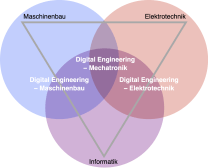
The Master's program gives students the opportunity to study this highly topical field, which combines classical engineering and computer science, in greater depth. The focus of the Master's course between engineering and computer science can be set by the students themselves by choosing the appropriate specialization modules.

Your future begins in Siegen

The Master's degree course in Digital Engineering - Mechanical Engineering is offered exclusively in German, while the Master's degree course in Digital Engineering - Electrical Engineering includes courses taught in both English and German, depending on the specialization chosen.
Bachelor's degree course with 6 semesters ... And now?

Graduates of a 6-semester Bachelor's degree course in Electrical Engineering, Mechatronics, etc. also have the option of choosing the Master's degree course in Digital Engineering - Electrical Engineering. Individual requirements of approximately one semester (30 CP) are then issued, which cover the missing content, typically in the field of computer science. In principle, the Master's degree program in Digital Engineering - Mechanical Engineering also requires the completion of a programming internship of at least 6 credit points (CP).
The following overview provides orientation for a possible 4-semester Master's degree course plan in Digital Engineering - Electrical Engineering for graduates of a 6-semester Bachelor's degree course. The requirements are outlined in red and fit seamlessly into the course of study. As you can easily see, the requirements cover a large part of the computer science content of a Bachelor's degree program in Digital Engineering. This means that a graduate of a traditional electrical engineering course, for example, can take off into the digital era with a Master's degree.
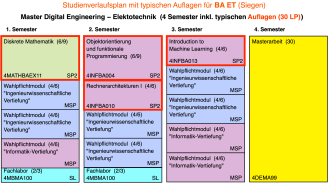
Specialization options for Digital Engineering - Electrical Engineering
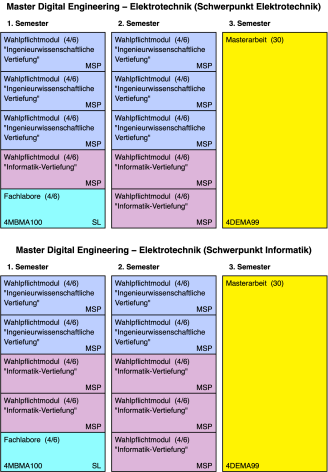
The Master's degree course in Digital Engineering - Electrical Engineering allows maximum flexibility. In addition to the Master's thesis and a module from specialist laboratories, there is a large selection of compulsory elective modules from electrical engineering and computer science with different specializations. In electrical engineering, modules of 6 CP are offered which cover topics from the following specializations:
- Automation technology (German)
- Communication and Information Technology (German)
- Electronic Systems (English)
- Image Sensing and Processing (English)
- Embedded Systems (English)
All computer science modules are 6 CP in size and cover the areas of software development, image processing, machine learning and embedded systems in particular.
At least 3 modules (or 18 CP) each must be selected from Electrical Engineering and Computer Science. Students are free to choose a further specialization (36 CP). The following overviews show examples of possible courses of study with different specializations between Mechanical Engineering and Computer Science:

Advice and contact
Responsible examination office
The Examinations Office is responsible for all questions relating to examinations: From registration and dates to examination regulations.
Contact
-

Bettina Neite
Janine Ising -
+49 271 / 740-4609
-

-

PB-A 242
-

Paul-Bonatz-Straße 9-11
57076 Siegen -
Сontact time
Responsible internship office
The Internship Office offers support with all questions relating to the industrial internship. It is also responsible for the recognition of the internship.
Contact
-
Dr.-Ing. Nicolas Sänger
Janine Ising -
+49 271 / 740 - 2570
-
-
PB A-242/1
-
Paul-Bonatz-Straße 9-11
57076 Siegen


