
Welcome to our Science Forum
School groups in the Science Forum
The Science Forum is the student chemistry laboratory at the University of Siegen. Founded over 25 years ago, it is one of the first school laboratories of its kind. It is a special extracurricular place of learning for school groups from the region. They can complete over twenty different experimental practicals in an authentic laboratory environment. They are closely supervised, learn about laboratory work and experience a motivating approach to scientific work.
Students in the Science Forum
The Science Forum is also an integral part of teacher training at the University of Siegen. All chemistry teacher training students supervise learning groups in the school laboratory for at least one semester. In this way, they gain their first practical experience in conducting experimental chemistry lessons and put the theoretical knowledge they have acquired during their studies directly into practice.
Procedure of the lab day
The student groups are registered by their teacher for a suitable topic and visit the student laboratory in the morning. After a short theoretical introduction and a safety briefing, the lab day begins with a thematically coordinated show experiment carried out by a lecturer. The pupils then work largely independently at the experimental stations with the support of the students. The practical day concludes with a joint discussion of the experiments carried out.


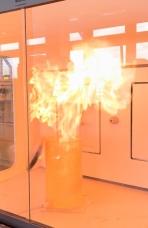
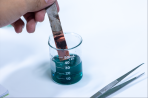
In simple, illustrative experiments (e.g. formation of gases during chemical reactions, separation of a mixture of three solids, combustion of various substances in air or in pure oxygen, color changes during chemical reactions), students experience a wide variety of chemical phenomena.
This practical course is suitable for pupils in years 7 to 8.
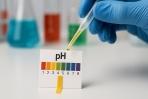
The basics of the chemistry of acids and bases are developed in interesting experiments (e.g. investigation of the properties of acidic and basic solutions, red cabbage indicator challenge, reaction of hydrochloric acid with caustic soda, reaction of hydrogen chloride and ammonia).
This practical course is suitable for pupils in years 7 to 10.
The Grätzel cell, a plant dye-based solar cell, impressively demonstrates how chemical energy can be converted into electrical energy. The pupils produce such a solar cell themselves according to Grätzel's principle and examine various plant dyes and light sources with regard to their handling and efficiency.
The learning units in the "Gamify your Lab" section are experimental practicals that focus on independent experimentation by students. In contrast to traditional laboratory units, however, playful elements were integrated to varying degrees when developing these formats. These can positively support the students' motivation, flow experience and learning process. And, of course, they are a lot of fun!
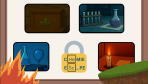
In a fictitious competition, the pupils take part in exciting experiments involving the four"elements" of fire (e.g. flame coloration), water (acids and alkalis), air (gases) and earth (including electrochemistry). Through clever combinations, solving puzzles and successfully carrying out the laboratory experiments, they earn codes and keys that can be used to continue the game. The focus is on practical laboratory work - the digitally supported escape game provides the motivating framework and offers helpful support.
This escape game is particularly suitable for playful repetition of key content from secondary level I. The basics of acid-base chemistry and electrochemistry are assumed!
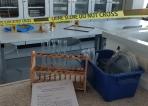
In this internship, the students take on the role of forensic scientists: they are tasked with solving a fictitious painting robbery in a local art gallery. To do this, they use chemical methods to analyze various traces left by the perpetrator at the crime scene. Step by step, they uncover the real culprit.
