New School of Architecture Siegen
The term "New Siegen School of Architecture N_AS" subsumes the department's efforts to become part of Siegen's transformation since 2023 as part of the University of Siegen's plans to move to the city center, initially by relocating its own courses to the so-called "Interimscampus Innenstadt Nord" and in the medium term by transforming the former printing house of the Siegener Zeitung newspaper into a prototypical experimental building of ecologically and socially sustainable university architecture.

What has happened so far
Nomination for New School of Architecture Siegen
Fri, April 11, 2025
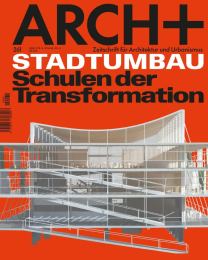
The New School of Architecture Siegen (NAS) of the University of Siegen has been nominated for the polis Award 2025 in the category "Impulse-Giving Phase Zero". The award has been honoring committed and cooperative urban development projects throughout Germany for ten years.
Great success for the "Neue Architekturschule Siegen" (NAS) project: The Department of Architecture at the University of Siegen has been nominated for the polis Award 2025 for urban and project development with its plans for the New School of Architecture. The award has been honoring committed and cooperative urban development projects throughout Germany for ten years. The New School of Architecture at the University of Siegen is to be built in the former printing house of the Siegen newspaper in the heart of the city center. The project has made it into the nominees in the "Initiating Phase Zero" award category: this category recognizes projects that focus on preparatory planning processes.
"We are very pleased about this nomination and hope that it will in turn provide an impetus for the realization of this new, exemplary university building," explains Prof. Dr. Thorsten Erl from the Department of Architecture at the University of Siegen.
The winners of the polis Award in a total of eight different categories will be decided by a jury of 15 experts from the fields of urban planning, architecture, the real estate industry and the trade press. The award ceremony will take place on May 7 at the nationwide trade fair for urban and project development, polis Convention. The winning projects as well as the runners-up will then be able to present themselves at the trade fair.
Interested parties have the opportunity to vote online for their favorite projects among all nominees:
https://www.polis-forum.com/award/nominees#impulsgebende-phase-null
Note: Voting takes place via the Polis forum, for which registration is required. Voting was open until April 17, 2025.
Contact: Prof. Dr. Thorsten Erl (Department of Architecture at the University of Siegen)
Email: erl@architektur.uni-siegen.de
Phone: 0271 / 740 2363
Summer School 2024 - New perspectives for the further development of the inner city campus
Tue, August 27, 2024
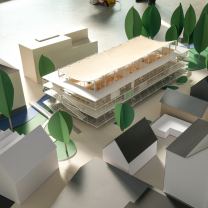
How could the surroundings of the future New Siegen School of Architecture be designed in the former Siegen newspaper printing house? Architecture students from Siegen and all over Germany explored this question together with five renowned architecture firms at the second Siegen Summer School.
Creating new connections between buildings. Making the various campus areas more accessible - as barrier-free as possible and for everyone. Revitalize small squares and use them as social spaces where university members, residents and the city's population can meet: These and other ideas for the further development of the inner city campus of the University of Siegen were developed by students at the second Siegen Summer School of the Department of Architecture. The topic of this year's event was how a campus feeling can be created in the area between the Lower Castle in Siegen, the New School of Architecture, which will be built in the former printing house of the Siegener Zeitung newspaper, and Häutebachweg all the way to Löhrtor.
After the successful first round last year, the team from the Department of Architecture led by Prof. Dr. Thorsten Erl invited students to a summer school again this year. Around 50 students from Siegen, the whole of Germany and beyond accepted the invitation. They spent a week at the Druckhaus working in different teams with architects from five renowned architecture firms from Cologne, Hamburg, Berlin and Cartagena (Spain). In terms of content, the second summer school followed on from the first: After focusing on concepts for the design of the New School of Architecture in the Druckhaus a year ago, the focus was now on the design of the surrounding area in the Häutebachweg/Löhrtor area, where the university's Department of Education could find a new home in the future. The guiding principle of "Reset, Reshape, Reuse" still applied: The focus of the considerations was not on demolition and new construction, but on incorporating, redesigning and reusing existing buildings and structures.
"The students investigated the location and existing structures from a wide range of different perspectives and took a very broad approach. They gathered information, conducted interviews with those responsible, local residents, neighboring institutions and the future users of the site and walked the grounds. This resulted in a wide range of ideas and concepts for the expansion of the inner city campus," explains Prof. Dr. Thorsten Erl. The teams presented their results to the interested public as part of an exhibition and tour. University Chancellor Ulf Richter and Jonas Tratz from the architecture firm FAKT, under whose direction the winning design for the New School of Architecture was created, commented on the concepts. Richter was impressed by the variety of ideas and perspectives for the further development of the inner city campus: "The presentations have shown what potential can still be leveraged here. My takeaway is that meeting places and barrier-free paths in between are central to the campus concept from the students' and architects' point of view. The teams have developed very exciting ideas for this."
The five teams and their concepts:
- Team Urban Mining, architectural office "Baukreisel" (Berlin) The students looked beyond the immediate neighborhood into the region to identify two thematic strands: 1) What spatial potential is there? 2) What material flows are there? With regard to the use of space, the idea arose to build a bridge to Löhrtor-Gymnasium in order to create an extended campus feeling. In order to recycle materials as much as possible, the team proposed a local "component exchange", through which demolition materials could be collected and put to new use.
- Team Mapping, architectural office "Projektbüro" (Hamburg) The "Team Mapping" approached the topic using the situation analysis method. The students first looked at the current qualities of the area, as well as the areas of disruption. On this basis, they then took a closer look at individual locations. Specifically, the team developed the idea of turning the corner of Häutebachweg/Löhrtor into a meeting place for university members and city residents - including seating and a table tennis table.
- Team Urban Ecology, architects Pedro Garcia Martinez + Antonio Curezuela Motos (Cartagena, Spain) How can barriers be overcome and how could smaller squares be used as social spaces? These questions were at the heart of the Urban Ecology team's considerations. Based on this, the students developed a whole range of possible measures: A wide flight of steps that could lead from Häutebachweg up to Unteres Schloss, modular seating for Schlossplatz, breaking up the white bank in the Häutebachweg area and creating a market and meeting place on the roof of the Löhrtor parking garage.
- Team Inclusion, architecture firm coopdisco + Ana Bisbicus (Berlin) The students dealt intensively with the topic of "inclusion" and took to the streets: they spoke to passers-by as well as local institutions such as the AWO and Frauenhilfe about norms, existing barriers and what is important for people to create places that are accessible to all. The team presented the results of their research in an accessible and transparent way for all citizens along the wall in front of the Druckhaus.
- Team Conversion/New Build, architectural office Demo Working Group (Cologne) With a "radically optimistic" attitude and the demand for "retroactive resilience", concrete design sketches were created for existing buildings such as the Mariengemeinde, the Kreishandwerkerschaft/IKK or the Villa Sauer. Among the concrete proposals was a passageway through the Villa Sauer to create a direct connection between the future campus and the existing canteen.
Text: T.Hoffmann, Press Office University of Siegen
New architecture school in the old printing house
Monday, September 04, 2023

The old Siegener Zeitung printing house is to become the new home for the architecture department at the University of Siegen. During a summer school, students and six renowned architecture firms worked on how the existing building can be transformed, and with it the way it is used for teaching and learning.
At first glance, it is a gray flat-roofed building. A parking lot in front, a river behind. The white ripples are hidden and cannot be seen from the street, Häutebachweg in the middle of Siegen. This building, the old printing house of the Siegen newspaper, is to become the new Siegen School of Architecture. With the relocation of further Schools of the University of Siegen to the city center as part of "Siegen. Knowledge connects", architecture can find a new home in the building from the 1970s. It is the opportunity for a unique architectural project in Germany, which was kicked off by a summer school organized by the Department of Architecture. Students, lecturers and experienced architects spent a week working on concepts for the conversion and extension of the Druckhaus. The aim is to create innovative architecture that serves as a model for new forms of university coexistence, but also for dealing with existing buildings.
"Students can sketch out a building for generations of future architecture students themselves and redefine the culture of teaching and learning," says Prof. Dr. Thorsten Erl. Together with Prof. Dr. Bert Bielefeld (Construction Management and Construction Economics), Prof. Tobias Hönig (Building Theory), Prof. Dr. Tobias Becker (Design and Design Theory) and many dedicated members of staff from the department, the Professor of Architecture and Urban Design developed the concept for the new Siegen School of Architecture and organized the summer school. They chose the "3Rs" as their guiding principle: Reset, Reshape, Reuse. In other words, no demolition and new construction, but the incorporation, redesign and reuse of existing buildings. According to Prof. Erl, the design of the Druckhaus is a kind of lesson in building in existing structures and the Summer School is a unique field of experimentation.
Chancellor Ulf Richter and Rector Prof. Dr. Holger Burckhart were impressed by the concepts and the prospects they offer for the university. "The project shows where our University of Siegen is heading, namely from the mountain to the city," said Rector Burckhart. "And it also shows how young and innovative our university is."
"The fact that the students can work in the building and think about what can be done with what is already there and how it can be developed further is extraordinary," emphasized Chancellor Richter.
Six architecture firms took part in the summer school, selected from 30 applications: ADEPT (Copenhagen), AgwA (Brussels), Assemble (London), FAKT+Düsing (Berlin), ZRS coopdisco (Berlin) and Hütten und Paläste (Berlin). These are "hip" offices with a focus on sustainability, decarbonization and circular construction. A correspondingly large number of students, not only from the University of Siegen, but from universities all over Germany and Austria, wanted to take part in the Summer School. In the end, around 80 people developed six concepts. They dealt with the building, the materials, the embedding in the urban area and the networking with the other university locations.
The approach was diverse. They tried to approach the building, where the rotary machines used to rattle and where parts of the old crane system for the paper rolls weighing tons can still be seen, with all their senses, went on a voyage of discovery in the surrounding area and collected materials. He drew, built models and made collages. A lot of manual work, less digitized. The many visitors were able to see this for themselves at the public presentations during and at the end of the Summer School. People from the neighborhood also attended.
The Summer School was the prelude to a commission within a special planning process. In the coming weeks, a jury will select three designs and commission the offices to develop the concepts in more detail and work out a building design. The prize for the best work will be awarded in the spring of next year. This is the start of the actual planning process.
The six architectural firms and their concepts:
- ADEPT, architecture firm, Copenhagen The students worked with the architects* from the architecture firm ADEPT (Copenhagen) to design a variety of possible urban planning variants for the development of the old printing house. The models could be tried out and fitted into the surroundings as required. The group's motto for the concept was "Re-localize, Re-act, Re-form".
- AgwA, Brussels architecture firm The students' detailed drawings, which they created with the architects from AgwA (Brussels), develop from the large to the small. At the beginning, the focus is on the university buildings in the city, shows the connections and then concentrates on the old printing house.
- Assemble, London architectural group Openness is at the heart of the ideas of the students, who worked together with the Assemble architectural group from London. In a kind of performance, they led interested visitors through and around the old printing house during the presentation to draw attention to the almost idyllic connection to the River White, among other things. The architecture school is intended to symbolize openness: in terms of content and space.
- Hütten und Paläste Architekten, Berlin Gemeinschaft is the basis of the design, which the students realized in a collage with the Berlin architects from Hütten und Palästen, among others. Perhaps it is no longer lecture halls and offices that will be needed in the future. And couldn't the degree course be geared more towards topics than subjects? What should remain? What is missing? The students worked on this with regard to both the building and the concept of the new school of architecture.
- FAKT+Düsing, Berlin The students worked together with architects from the Berlin-based firm FAKT+Düsing to determine whether the rooms of the new school of architecture could be designed in a cross-functional way and what this would mean in terms of energy and air conditioning. They took a close look at the surroundings of the printing house and examined the materials of the existing building, such as the exposed aggregate concrete façade.
- ZRS + coopdisco, Berlin The students designed a step-by-step model with five process-related development levels with the architects from the Berlin offices ZRS and coopdisco. The structure of the new architecture school progresses from level to level, starting with the current brainstorming (level 1) through to the move (level 4) and further developments in terms of content and construction up to level 5. The students built wooden models for this purpose.
The Summer School in the press:
- Uni Siegen in the city: Printing house next in line (Westfalenpost 16.08.2023)
- How the old Siegener Zeitung printing house will play a key role in the City Campus (Siegener Zeitung SZ+, Bezahlschranke)
The Summer School on social media:
WDR Lokalzeit Südwestfalen studio interview
Fri., August 18, 2023
Prof. Thorsten Erl, Vice Dean of Architecture at the University of Siegen explains the project on WDR, the program is available in the WDR media library until 18.08.2025:
https://www1.wdr.de/mediathek/video-studiogespraech-prof-thorsten-erl-prodekan-architektur-universitaet-siegen-100.html


Reset Reshape Reuse - Siegen Summer School
Thursday, July 13, 2023
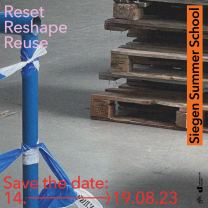
Together with the architecture firms Adept, AgwA, Assemble Studio, Hütten und Paläste, Fakt+Gustav Düsing and ZRS+coopdisco, students of architecture have the opportunity to take part in the competition for the conversion of the former printing house into the "New School of Architecture" from August 14 to 19. The event is worth 3 credit points. Recognition is the responsibility of the respective home university of the participating students.
If you want to get involved in the process of thinking together the existing and the new, then save the date! Current information will be published continuously on Instagram: @architektur.unisiegen
- Background: In the course of massively changing realities of life, new answers are needed for architecture and society. We are responding to this with the idea of a "New School of Architecture Siegen", which not only adapts to the social, sustainable and technical challenges, but is committed to consciously and decisively helping to shape them. The former printing house of the Siegener Zeitung newspaper is to serve as the new location for the architecture. The aim of the conversion of the printing house is to create innovative architecture that will serve as a model for new forms of university coexistence and for dealing with existing buildings as an important resource. The participatory development of a new vision is required. How can architecture teaching and research be designed to be diverse, inspiring and participatory?
- Project: The six architecture firms will each form working groups of 10 students who will develop a design for the "New Siegen School of Architecture" on site.
These designs will be entered into a competition process, at the end of which the best design will be realized. In addition to the design work, the Summer School will be rounded off with input events, lectures and communal evenings. - Application: The number of places is limited. Therefore, please apply by 18.07. by e-mail to: druckhaus@architektur.uni-siegen.de
Show with a medium of your choice (text, drawing, photography, etc.) on a PDF page why the Summer School should not take place without you.
In addition, we need the following information: Degree program, semester, home university, address, contact details.
If you have any questions, please also contact: druckhaus@architektur.uni-siegen.de - Accommodation: To a limited extent, affordable accommodation can be organized through the University of Siegen's student network. If you are interested, please indicate this in your application.
We look forward to welcoming you to Siegen!
Participating offices:
- Adept works across disciplines from urban planning and strategic development to building architecture and public space. Adept designs holistic, sustainable places, spaces and communities. Starting from the site and its physical and immaterial conditions, history and project vision, the office develops projects in dialog with all stakeholders to ensure that the future grows naturally from the present and the context in which it is rooted. The aim of the projects is to create new places for everyone.
- AgwA is an office founded in 2003 that works primarily with a project-specific architectural language. This results from an initial, reflexive process that deals with the existing situation, the urban context and the physical attributes of the building. The projects are guided by principles such as cautious boldness, an experimental approach to construction and structure, economy and criticality. Moreover, for AgwA, the opportunity to build also means the opportunity to research.
- Assemble Studio is a multidisciplinary collective working in the fields of architecture, design and art. Founded in 2010 to realize a single, self-built project, Assemble has since created a diverse and award-winning body of work, maintaining a democratic and collaborative working method that enables built, social and research-based work at multiple scales.
- Hütten und Paläste from Berlin comprises an office that focuses on experimental architecture for urban housing and living. The focus is on solutions for extreme or special locations and building tasks. The focus is on creating active connections between interior and exterior spaces. They understand buildings as open systems that are in constant exchange with their physical and metaphysical surroundings. The reduction to the essentials in terms of space, technology, construction and resources, as well as building with wood, determine the designs.
- FAKT + Gustav Düsing is an association of two young, research-based architecture firms from Berlin. They share an experimental approach to spatial design, production and sustainability strategies. The two offices work both in the academic field and in the realization of experimental architectural projects. Their way of working combines critical theory with architectural practice and aims to find new ways in which architecture can respond to our current ecological and socio-political challenges.
- ZRS + Coopdisco develops architecture that uses resources responsibly and efficiently and serves the user in the long term. ZRS has particular research and construction expertise in the areas of building with clay, wood and bamboo. Coopdisco is a cooperative of architects who are committed to urban development for the common good. Always with the aim of developing places that are used, needed and preserved as common goods.
Siegen Summer School
Wednesday, June 14, 2023
The Department of Architecture is redesigning itself.
The Siegen Summer School is the first step towards a fundamental redesign of the premises in which the "Neue Architekturschule Siegen" will operate. Six international architecture firms will work together with 10 students each to develop concepts on the basis of which the entries for the "New Siegen School of Architecture" architecture competition will be finalized.
Siegen Summer School: August 14-19, 2023
https://www.instagram.com/architektur.unisiegen/
Competition conditions for interested architecture firms:
https://www.evergabe.nrw.de/VMPSatellite/public/company/project/CXPNY56DS7W/de/documents