Dementia: Firsthand Help

The Advisory Board for People with Dementia, featuring Ronja Müller-Späth, Kathinka Beutel, and Celina Sander from the University of Siegen (back row, from left to right), as well as the moderators Brigitte Weber-Wilhelm (back right) and Stefanie Kremer (front right) from the Alzheimer’s Association of Siegen-Wittgenstein.
“It warms my heart a little bit every time,” says doctoral candidate Celina Sander as she talks about her monthly meetings with people living with dementia and their family members. Sander is a research assistant in the Department of Psychological Research on Aging at the University of Siegen and coordinates the two Siegen advisory boards, “People with Dementia” and “Family Members and Caregivers of People with Dementia.” Every four weeks, they come together to exchange ideas with university staff as part of various research projects. For Celina Sander and her colleague Ronja Müller-Späth, these meetings are among the “most beautiful and moving hours” of every month. One result of the advisory board’s work is the recently published third edition of a guide on “Communication with Dementia”—in which people with dementia and their family members were directly involved.

The book offers a wide range of background information and practical guidance on communication for people with dementia, their families, and caregivers. “Together with the advisory board members, we have completely revised the guide, which was first published in 2011. Thanks to the active participation of the advisory board members, the third edition has taken on a whole new quality—people with dementia are now much more at the center of attention; they are the target audience and not just the subject matter of the guide. They have a voice of their own and have actively helped shape the guidebook in accordance with the guiding principle: ‘nothing about us without us,’” says project leader Prof. Dr. Julia Haberstroh.
One piece of advice that the members of the “People with Dementia” advisory board contributed—and which is very important to them—is this: They recommend that those affected be open about their own illness, neither treating dementia as a taboo nor feeling ashamed of it—as this often leads to isolation and loneliness. In contrast, if one openly shares that they have dementia, they receive a great deal of support, according to the advisory board members’ experience.
Experts and those living with dementia alike recommend that family members and caregivers keep communication as open as possible. The strengths of people with dementia should be consciously encouraged, while the weaknesses caused by the disease should be worked around. “For example, people with dementia have difficulty forming new memories. The question ‘What did we have for lunch today?’ is therefore not a good way to start a conversation. Instead of asking for facts, it’s better to focus the conversation on the relational level, which usually works even better,” explains Prof. Haberstroh. Memories of the past and important life themes—connecting to what was and is important to a person—often facilitate better conversations in which people with dementia can also actively participate.
In cases of advanced dementia, experts recommend music as a potential means of communication: Certain songs or melodies can convey moods and provide orientation—even when verbal communication is no longer possible. “I have a large CD collection. Together with my wife, I’ve marked which CDs I like to listen to most. That way, others will know later what kind of music I like and can choose some for me,” reports a member of the “People with Dementia” advisory board in the guide.
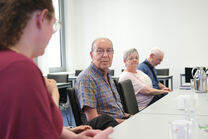
The advisory boards grew out of two self-help groups affiliated with the Alzheimer’s Association of Siegen-Wittgenstein. They consist of people with dementia, their family members and caregivers, as well as two facilitators from the self-help groups and university staff members. An important goal is to enable those affected to participate in a familiar setting. “Sharing our own difficulties and tips with one another gives us the reassurance that we’re not alone. And it also makes us proud to be able to contribute to helping other people,” the two advisory boards state in their foreword to the new edition of the communication guide.
Research also benefits from this collaboration, emphasizes research assistant Ronja Müller-Späth: “People with dementia have an incredible amount to say. The feedback and insights they share with us shape our research—because we want to ensure that what we develop ultimately meets the needs of people with dementia.”
The guide “Communication with Dementia” is now available in bookstores or as a PDF document: https://link.springer.com/content/pdf/10.1007/978-3-662-72305-0.pdf
People with dementia, as well as their family members and loved ones, are cordially invited to participate in the two advisory boards. For more information, please contact: celina.sander@uni-siegen.de
On Saturday, July 11, 2026, the “Demenz Meet” event will also take place for the first time at the Lÿz in Siegen—a gathering for people with dementia, their family members, and anyone interested. For more information, please visit: https://alter-pflege-demenz-nrw.de/das-1-demenz-meet-in-siegen-wittgenstein/


