Inaugural lecture delights audience and review board
Statistics that inspire: Kristian Kleke's inaugural lecture on the value of missing data
With scientific precision, practical examples and a pinch of humor, PD Dr. Kristian Kleinke showed why uncertainty in research is not an obstacle, but an important source of knowledge.
Dr. Kleinke gave his inaugural lecture on "Applied Multiple Imputation - Missing data and what we can still learn from it" and showed impressively that even a supposedly dry topic like statistics can captivate the audience. With a successful mixture of scientific precision, illustrative examples and humorous anecdotes, he guided the audience through the world of missing data - a problem that affects practically every empirical study.
The focus was on the question of how researchers can deal with data gaps. After all, missing values can hardly be completely avoided despite careful planning: Participants skip questions, drop out of studies or are no longer available for later waves of the survey. In psychological ageing research in particular, there are further challenges, for example when people die in the course of long-term studies. The central message of the lecture was therefore: missing data is not an exceptional case, but a scientific reality that must be dealt with responsibly.
Dr. Kleinke vividly explained the process of "multiple imputation", in which missing values are not simply replaced, but estimated several times on the basis of statistical models. He made it clear that this is not "statistical magic", but a theory-led and data-based estimation under uncertainty. It is precisely this uncertainty that must be adequately taken into account in scientific analyses. Multiple imputation makes it possible to transparently incorporate the resulting uncertainties into statistical conclusions.
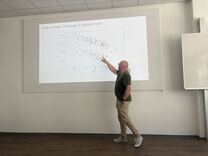
The lecture was made particularly lively by numerous examples from research practice: from questions on toilet paper use to sensitive information on income or criminal offenses to long-term studies with young people and families. Again and again, Dr. Kleinke showed how closely methodological challenges are linked to very specific questions of human behavior.
In the second part, he provided insights into his own research. He presented modern methods for imputing missing data and reported on studies in which the conditions under which different methods work reliably were investigated. His research shows that there is no universal patent solution: Which method is suitable always depends on the characteristics of the data and the respective research question.
This not only gave the audience an insight into a central statistical problem, but also into the scientific attitude that Dr. Kleinke conveys: Uncertainty cannot be completely eliminated, but it can be understood, quantified and communicated transparently. This is precisely the strength of modern statistics.

The enthusiastic response in the lecture hall spoke for itself: an hour flew by, the audience followed the explanations attentively, smiled at the numerous stories from research and teaching and experienced statistics for what it can be at its best - challenging, practical and surprisingly entertaining.
