Bending Technology & Quality
Flexible Bending Methods for Tubes, Profiles, and Sheet Metal
We conduct research on the bending of tubes, profiles, and sheet metal and are further developing both established methods—such as rotary tension bending and swivel bending—as well as entirely new bending technologies. The focus is on scalable and flexible manufacturing that allows even small batch sizes to be produced economically and sustainably.

Scalable bending technology for customized components
Traditional bending processes are typically designed for a fixed bending radius and a fixed tool geometry. With small batch sizes, an increasing variety of components, and the desire for sustainable, resource-efficient manufacturing, this approach quickly reaches its limits. We address these challenges with a broad spectrum of bending methods, ranging from established techniques such as rotary draw bending to newly developed, flexible processes such as free-form roll bending.
Areas for Collaboration
We are seeking partners to address research questions related to flexible tube, profile, and sheet metal bending processes, process control, springback compensation, and quality assurance in bending technology.
A brief look at our work
Our Research Focus Areas
Bending Technology in General
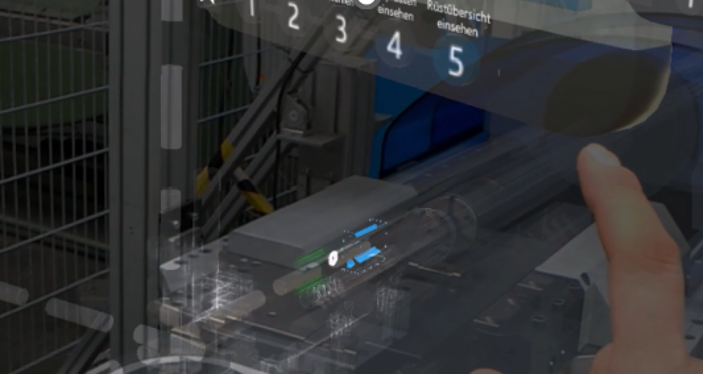
Across all processes, we are working to achieve more reliable component prediction and more precise process control, for example, based on the principle that “the first part is a good part.” This includes integrating the customer into the manufacturing process in the spirit of “production on demand,” the cyber-physical setup of bending machines, process predictions, and the correction of bent components. The department has contributed to the standardization of tube and profile bending, including the VDI Guideline 3430 on rotational tension bending, as well as VDI 3431 and VDI 3432.
Incremental Swivel Bending
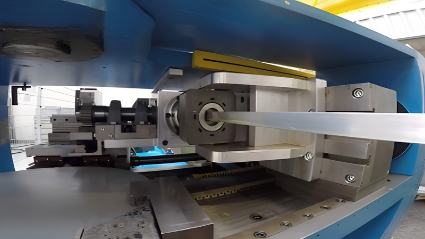
Incremental swivel bending (ISB) is a scalable forming technique that does not require component-specific tooling. Our research focuses on the further development of the process as well as the forming of ultra-high-strength materials that are difficult to process using conventional bending methods. In the “ISB Elektro” project, conducted in collaboration with the EDAG Group and other industry partners, we further developed the process for the flexible production of lightweight structural components made of high-strength steels for electric mobility and tested it under real-world conditions. Research is now underway on the targeted control of the forming zone.
3D Swing Bending
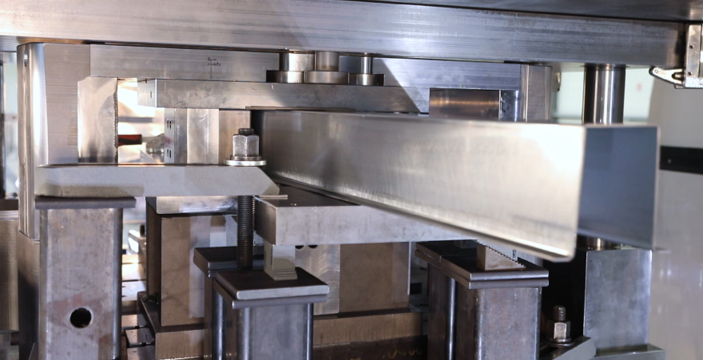
3D swivel bending extends classic swivel bending to include nonlinear, three-dimensional bend edges, thereby enabling components with cross-sections and load-bearing capacities tailored to specific requirements, with significantly greater flexibility and without the need for component-specific tooling. To design and evaluate future component geometries, we have developed a working diagram that takes into account workpiece geometry, material, and springback behavior. Such components are primarily used in body and structural parts for the automotive and aerospace industries.
Free-form bending
In free-form bending, the contour is not defined by a fixed die but kinematically through the controlled movement of the die elements. This allows for different radii using the same set of dies. Our methods include die push bending, for which we have developed, among other things, a
torsion compensation for asymmetrical profiles, as well as three-roll push bending, for which we have developed—in addition to springback compensation—a planning system that supports the production-ready modeling of free-form bent tubes already during the component design phase. In addition, we are conducting research on free-form roll bending (FFAB), which allows any radius to be bent using the same tool and without any profile feed. This also enables the correction and reuse of previously formed components, thereby contributing to a circular economy in bending technology.
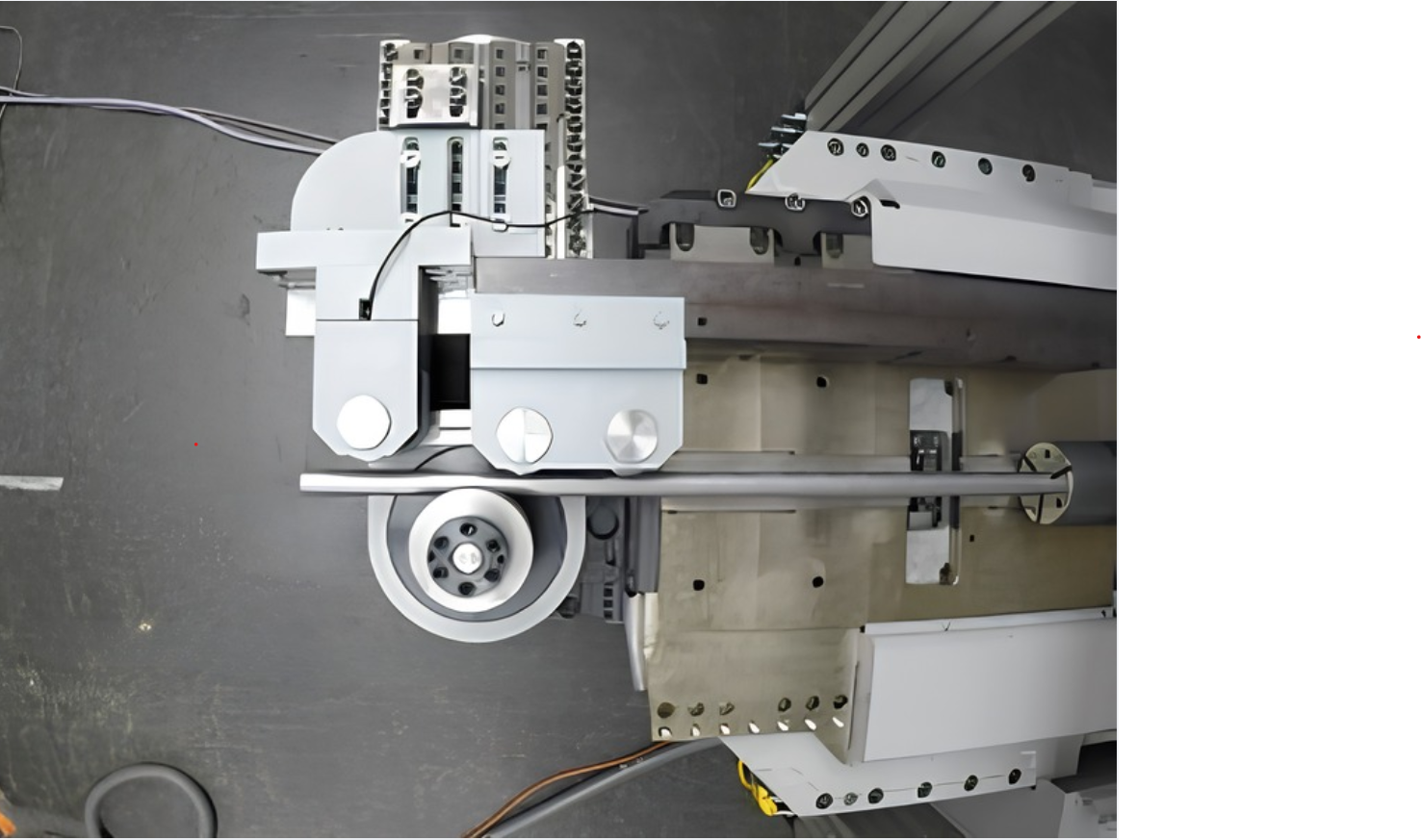
Rotational Tension Bending
Rotational tension bending is one of the most commonly used tube bending processes, but to date it has required a separate bending die for each bending radius. We are researching how the tool surfaces can be reduced to the load-bearing areas to enable additional tool axes and thus greater flexibility, and how robust active surfaces for forming arcs can be derived through targeted process predictions. Another focus is on creasing at the inner bend: We are investigating the interaction between the bending mandrel, crease smoother, and counterholder, and developing process control systems—including those using AI methods—that detect and compensate for creasing already during the bending process. A sensitivity analysis of the process also provides us with the data foundation for digital setup support for machine operators. In addition, work is underway to expand the process limits for bending thin-walled square tubes and to investigate incremental rotational tension bending.


