John Wenck (†1460) at the Crossroads of Scholasticism and Humanism
This PhD project aims to offer a nuanced portrait of John Wenck’s thought and legacy, in which his best-known controversy with Nicholas of Cusa appears as only one aspect within a broader framework that challenges simplistic views of this milieu.

Project Description
A magister artium in Paris, later professor of theology and rector in Heidelberg, an active voice at the Council of Basel, a polemicist against heretics, and an enthusiast of Lullist and Humanist studies, John Wenck of Herrenberg seems to have occupied a complex and ambivalent position in the intellectual turmoil of the 15th century. This PhD project aims to offer a nuanced portrait of John Wenck’s thought and legacy, in which his best-known controversy with Nicholas of Cusa appears as only one aspect within a broader framework that challenges simplistic views of this milieu. Furthermore, by studying Wenck’s documents and personal manuscripts, this research seeks to analyze his working practices as a reader and writer, as well as the network of affiliations to earlier and contemporary figures that shaped the development of his thought.
Everything at a Glance
-

Duration
1 April 2025 – 31 March 2028 (expected) -

Research Area
History of Philosophy -

Funding
Doctoral scholarship from the HYT Young Academy, University of Siegen
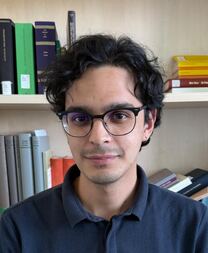
PhD Candidate: Andrés García-Rengifo
Short Vita
- since April 2025: PhD scholarship holder of the HYT Young Academy, University of Siegen.
- March 2025–January 2026: Research assistant at the University of Siegen as part of the DFG project “Nikolaus von Kues als Leser Platons und Aristoteles’: Kritische Edition und Studie der Cusanus-Marginalien.”
- since October 2024: Doctoral candidate in philosophy at the University of Siegen, at the Chair of History of Philosophy (Univ.-Prof. Dr. Mario Meliadò).
- January 2024–February 2025: Visiting researcher and assistant at the Kues Academy for European Intellectual History.
- 2015–2023: Study of Philosophy and Fine Arts at the Universidad del Valle (Colombia).
Research
Philosophy of the 15th Century
Theories of the soul and cognition; philosophy of memory and images; late medieval mysticism; manuscript studies and paleography.
Iberian Neo-Scholasticism
Latin philosophical manuscripts in the Spanish colonies; reception of early modern philosophy in Hispano-America.
Publications
- 2025 – “Nicholas of Cusa's Concept of Imaginatio in the Context of Heymeric of Campo's Tractatus Problematicus,” in: S. Carannante, G. Venturelli (eds.), I campi della sapienza. A partire dal De venatione sapientiae di Nicola Cusano, Mimesis, Milano, 157–170.
- 2024 – “Theology as Poetry in John Wenck's Commentary to the De coelesti hierarchia: Sources of a Quasi-Humanist Idea in 15th-Century Heidelberg,” in: Mario Meliadò (ed.), From Paris to Heidelberg: The Teaching of John Wenck († 1460) in the Mirror of His Unedited Works (Special Issue of Rivista di Storia della filosofia 79/3), 582–610.
Talks
-
2026 – “Notetaking, Patchwork and Mnemonics: John Wenck’s Working Practices through His Manuscripts” (Paratextual Elements: Tables, Indexes, Marginal Notes, Diagrams, etc., Universitatea Babeș-Bolyai, February 27–28, 2026).
-
2026 – “John Wenck of Herrenberg: A Missing Link of 15th-Century German Lullism?” (Forschungs- & Doktorandenkolloquium, Thomas-Institut, Universität zu Köln, February 3, 2026).
-
2025 – “Descartes desfigurado y los santos caníbales. Particularidades de la transmisión de conocimiento en dos cursos de Física neogranadinos” (9th International Congress Sociedad de Filosofía Medieval, Universidad de Córdoba, December 3–5, 2025).
-
2025 – “John Wenck at the Crossroads of Scholasticism and Humanism” (AG Philosophiegeschichte im Gespräch, University of Siegen, October 22, 2025).
-
2025 – “Looking Into Shadows: the Mystical Vocabulary of Vision and Blindness” (Perspectives on Mystical Vision and Aesthetic Experience, Twentieth Biennial Conference of the American Cusanus Society, United Lutheran Seminary, Gettysburg (PA), September 18–21, 2025).
-
2025 – “Cusanus' Annotations to Bonaventure's Collationes in Hexaemeron” (Leeds International Medieval Congress, University of Leeds, July 7–10, 2025).
-
2025 – “Figures that Remember: Reading and Textual Mnemonics in the Tradition of the Lullian Art” (Reading and Philosophizing in the Middle Ages and the Renaissance, University of Siegen, June 18, 2025).
- 2025 – “Cusanus's Mystical Vocabulary and Meister Eckhart's Responsio” (L'apport de la Théologie Mystique d'Eckhart et de Nicolas de Cues, Université de Lorraine, April 29–30, 2025).
- 2024 – “Contra abstractam vitam: The Role of Meister Eckhart in John Wenck's Opposition Against Nicholas of Cusa” (Zur Auslegung des Johannes-Evangeliums bei Meister Eckhart und Nikolaus von Kues, Kueser Akademie, December 4, 2024).
- 2024 – “Symbols and Knowledge in Nicholas of Cusa and John Wenck” (AG Philosophiegeschichte im Gespräch, University of Siegen, November 28, 2024).
- 2024 – “Nicholas of Cusa's Metaphysics of Darkness” (XI. Jungcusanertagung, Accademia delle Scienze dell'Istituto di Bologna, September 11–13, 2024).
- 2024 – “Nicholas of Cusa and John Wenck on Representing God: A Disagreement at an Epochal Shift” (Session of the Cusanus Society UK and Ireland, Leeds International Medieval Congress, University of Leeds, July 1–4, 2025).
- 2022 – “Sine omni aenigmatico phantasmate: Nicholas of Cusa's concept of imaginatio in the context of Heymeric of Campo's Tractatus Problematicus” (X. Jungcusanertagung, Kueser Akademie, July 21–24, 2022).