Prof. Dr. Bernd Dollinger
Bernd Dollinger conducts research on the theory and history of social pedagogy, focusing on key topics such as juvenile delinquency, professionalization, and the relationship between social pedagogy and social policy. His research has taken him to the Universities of Augsburg and Bamberg, among others, and he has served as a professor at the University of Education in Freiburg. Since 2010, he has been a professor in the Department of Education and Psychology at the University of Siegen. Through his research, he links historical developments with pressing social issues, thereby opening up new perspectives on deviant behavior and social integration.
What are you currently researching? And why is this topic important?
One current project focuses on case conferences under juvenile criminal law. These bring together social workers, the police, the district attorney’s office, and others to discuss appropriate measures. A particularly fascinating question is how to reach an agreement despite these differences. Complex negotiations are necessary to reach a consensus—and, not least, the young people themselves or their legal guardians are often involved as well.
What question has been on your mind for a long time in your research?
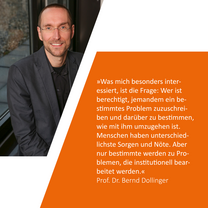
What interests me most is the question: Who has the authority to attribute a specific problem to someone and to determine how it should be addressed? People have a wide variety of concerns and hardships. But only certain ones become problems that are addressed by institutions.
What fascinates you most about your field?
The complexity of the topics and the opportunity to draw on diverse bodies of knowledge and disciplines. I’ve done a lot of interdisciplinary collaboration in recent years. You learn an awful lot here. It can be challenging, but it’s only through engaging with differences that you gain new insights.
Was there a moment in your academic career that had a particularly profound impact on you?
Yes, it was while writing my dissertation. There was a shift from searching for the causes of problems to asking why problems are actually interpreted as such. That fundamentally changed my understanding of myself as a scholar.
What do students learn in your courses?
Hopefully, they learn to take a stand independently in public, political, and academic discourses. Max Weber once described scholarly work as labor with “plowshares to loosen the soil of contemplative thought.” I find that very apt.
Is there a typical phrase you often say in your seminars?
So what do you think of that?
What’s your favorite spot on campus?
A place where you can get coffee and also run into colleagues on the spur of the moment.
What are you currently working on with particular enthusiasm outside of research and teaching?
Well, I’m not working—or at least I’m trying not to…
What do you do when you’re not thinking about the university?
I work out, eat Japanese food, and hope that I can really unwind for a change.