Assistant Professor Jovita Lukasik
Jovita Lukasik conducts research in the field of visual computing and focuses on how to search artificial neural architectures more efficiently and make neural networks more robust. After earning her Ph.D. in Mannheim, she accepted a postdoctoral position at the University of Siegen. Since 2025, she has led the Visual Computing Group as an assistant professor and is supported by the DFG’s renowned Emmy Noether Program. Through her research, she combines complex machine learning methods with current technological challenges and opens up new perspectives for the development of reliable and high-performance AI systems.
What are you currently researching? And why is this topic important?
I’m researching the development of AI models related to images. In this work, I’m investigating how neural networks can be designed to be efficient, robust, and adaptable. I’m also exploring the possibility of automating this development process using neural networks themselves, rather than leaving it exclusively to experts. I believe this topic is particularly important today, when AI models are accessible to everyone, yet their underlying principles remain unclear to many.
What question has long been on your mind in your research?
I’m particularly interested in how AI models work and how we can improve them without consuming unnecessarily high computational resources. Specifically, I’m interested in how we can increase the robustness of these models against disturbances.
What fascinates you most about your field?
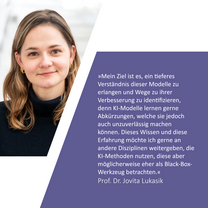
I’m particularly fascinated by the opportunity to delve deeply into complex AI approaches rather than simply applying them. My goal is to gain a deeper understanding of these models and identify ways to improve them, because AI models tend to take shortcuts, which can also make them unreliable. I’d like to share this knowledge and experience with other disciplines that use AI methods but may tend to view them more as black-box tools.
Was there a moment in your academic career that had a particularly profound impact on you?
What influenced me the most was starting my Ph.D. After completing my master’s degree in applied mathematics, I began a Ph.D. in computer science. This step, along with the support of my Ph.D. advisor, sparked my fascination with research and, in particular, with my current field of research.
What do students learn in your courses?
In my courses, students learn the fundamental ideas and concepts behind image generation methods and the research-oriented field of automated machine learning. We cover the mathematical concepts behind AI models such as ChatGPT and DALL-E, as well as how to improve AI models and develop them on their own.
A typical phrase you often hear from you in seminars?
AI models are incredibly helpful, but it’s important to use your own judgment and question the information and answers they provide.
What’s your favorite spot on campus?
The outdoor area of the AR cafeteria is especially nice, particularly in the spring and summer when everything is in bloom and you can let your gaze wander over the greenery. That’s my favorite spot on campus.
What are you currently working on with particular enthusiasm outside of research and teaching?
Supporting early-career researchers is particularly important to me. It makes me happy when students develop a passion for research, especially female students. To support this, we have a group in our department called “Women in Vision.” There, we meet regularly for pizza and invite national and international female researchers in the field of computer vision to talk about their research and personal experiences.
What do you do when you’re not thinking about the university?
I love discovering new places and traveling. I’ve also rediscovered my childhood passion for Taekwondo.