Prof. Dr. Thomas Ludwig
Thomas Ludwig conducts research on human-centered information systems and explores how artificial intelligence and virtual reality can be designed to support us in our daily lives and at work. As a professor in this field, he teaches and conducts research at the University of Siegen, where he began his career. Before returning to Siegen, he was a professor at the FernUniversität in Hagen and played a leading role in driving digitalization forward among regional small and medium-sized businesses. Through his work, he bridges the gap between technological feasibility and human needs, demonstrating how the workplace of tomorrow can be shaped in a responsible and value-adding way.
What are you currently researching? And why is this topic important?
Imagine a world where technology adapts to us, not the other way around. I’m researching how digital tools—from AI to virtual spaces—can support work in companies and organizations rather than dictate it. My focus is on how people creatively adapt technology to their everyday lives, develop their own practices, and thereby actively shape processes. This is important to ensure that digitalization isn’t planned without considering people, but instead delivers real benefits.
What question has long been on your mind in your research?
How can we ensure that AI and algorithms augment human expertise rather than replace it? I’m driven by the question of how employees in a highly automated world can maintain control over their work and use technology as a tool in a self-determined way, rather than being controlled by it.
What fascinates you most about your field?
The more autonomously technology operates, the more crucial the human factor becomes. This paradox fascinates me. After all, it is precisely the unpredictability of human creativity and social practices that transforms standardized software into a vibrant, value-adding, and socially meaningful innovation.
Was there a moment in your academic career that had a particularly profound impact on you?
My appointment back at the University of Siegen. For me, this brings things full circle. I can directly connect cutting-edge international research with the people and businesses in my home region.
What do students learn in your courses?
Ideally, students learn to bridge the gap between technical feasibility and human needs. Using real-world examples from industry, they learn how to manage the introduction of new technologies in companies in a way that benefits employees.
What’s a typical phrase you often say in your seminars?
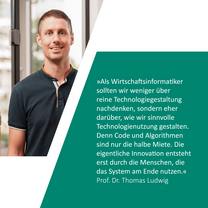
As Business Information Systems specialists, we should focus less on the design of technology itself and more on how to design meaningful ways to use technology. After all, code and algorithms are only half the battle. True innovation comes from the people who ultimately use the system.
What’s your favorite spot on campus?
I like to hang out in the food court at the Unteres Schloss. That’s where students, staff, and professors casually mingle with people from the city. It’s great to see that such a lively, central spot has emerged right in the heart of Siegen. Plus, the food is delicious.
What are you currently working on with particular enthusiasm outside of research and teaching?
When I have time outside of the university, I love nothing more than helping my two children build a strong foundation for their lives. Otherwise, I do a lot of volunteer work. I lead the European network EUSSET, support the DIGITALUM Wittgenstein, and enjoy pitching in with tasks at my local sports club.
What do you do when you’re not thinking about the university?
Then I rarely sit still. I’m either working around our house in Schameder or burning off energy on long runs in the region. For me, that’s the perfect way to unwind.