Rome Seminar 2027
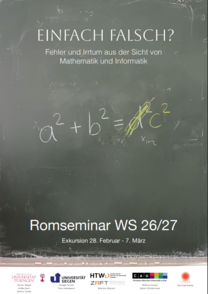
Simply wrong?
Errors and Mistakes from the Perspective of Mathematics and Computer Science
Man errs as long as he strives.
- J. W. von Goethe
Errors accompany us at every turn. The mistakes we make or have made ourselves, but even more so those we might make; and, of course, the mistakes of others (parents, teachers, the administration, the police, politicians, AI...) and the notorious “systemic errors.” There are mistakes caused by carelessness and a lack of diligence (typos, measurement errors), but also genuine errors in reasoning and glaring misjudgments (errors) that can have serious or even catastrophic consequences.
We often view mistakes as something negative. A great deal of effort is made to prevent mistakes from happening in the first place or to ensure that they cause as little harm as possible. On the other hand, however, it’s said that we learn from our mistakes, and recently there has been increasing talk of productive errors, error tolerance, and a positive culture of error. So perhaps the “wrong” isn’t as “simple” as it seems at first glance?
In this year’s Rome Seminar, we want to examine the topic of “errors” from many different perspectives, focusing in particular on those closely related to mathematics and computer science. Possible guiding questions might include:
-
What is an error, and under what conditions is something considered an error at all? What significance(s) does the distinction between “wrong” and “right” hold?
-
(How) can machines or algorithms make errors?
-
What role do mathematics and computer science play in preventing errors or managing the consequences of errors?
-
What role do errors play in or for mathematics/computer science and their teaching?
-
When is a mistake productive, and when and how do we learn from it?
-
What can a positive culture of error mean for academic studies?
-
Which major and minor errors have shaped the history of science, and which have shaped world history?
These and other topics can be addressed at the 2027 Rome Seminar. The agenda is determined by the participants, who are free to pursue their own interests. The Rome Seminar thus offers a unique opportunity to look beyond the boundaries of one’s own field of study and discuss topics of general relevance (against the backdrop of our disciplines). But it’s also about practicing presentation, rhetoric, and discussion in an academic context.
Over the course of the 2026–27 winter semester, we will first explore and develop the topic through shared reading, short introductory presentations, and discussions. By the end of December, each participant should have identified their own project. This project will ultimately be presented and discussed during our group field trip to Rome (February 27 through March 7, 2027). Through a diverse accompanying program, we will also draw inspiration from places in the “Eternal City” that are not normally accessible to the public.
A prerequisite for the seminar is a willingness to engage actively with the subject matter; it is suitable for students starting in their first semester.
We learn from our mistakes.