Research
Main research areas
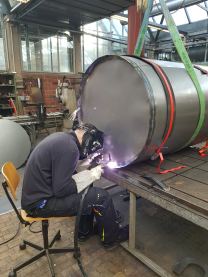
As part of the EU research project RadonNET, high-precision systems for measuring the concentration of the noble gas radon-222 in the air are being constructed, mechanically designed and built as prototypes at the Chair. In cooperation with the mechanical workshop at the Paul Bonatz Campus, a large-volume measuring chamber with a volume of over 1m3 is currently being assembled to calibrate these measuring systems. Once completed, precisely defined time-variant reference values of Rn-222 concentrations can be set. The measured values will then be displayed as a chart on a website.
For technical use as dampers or protectors, materials are required that deform with a delay when a load is applied and gradually dissipate the deformation energy. We are particularly interested in how this time dependency manifests itself under very short, impact-like loads.
Soft elastomers can dissipate the shock waves generated at high strain rates and thus dampen the pressure impulse. We develop material models that capture not only the viscoelasticity but also the local microstructure. For example, we investigate open-cell polymer foams and optimize their damping properties.
Solid metallic mixtures are inhomogeneous and form phases of different compositions, which can change due to diffusion, loads and electric fields. Examples of this are solder alloys in microelectronic components and lithium battery anodes during charging and discharging. Here, numerical simulations help to predict the mechanical properties and avoid premature failure.
We calculate such processes using phase field methods, whereby the Cahn-Hilliard equations of diffusion are coupled with the equations for the mechanical, electrical and/or temperature field problem. Due to their structure and non-linear coefficients, the resulting 4th order differential equations place high demands on the numerical solution method. Promising results are obtained using isogeometric NURBS approaches for the FE basis functions.

The numerical calculation of crack initiation and propagation is currently the subject of much research work. In addition to the cohesive element technique, which can now almost be described as classical, we use the phase field method and peridynamics for this purpose.
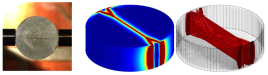
Phase field models regularize the discontinuous problem of crack propagation and thus allow efficient and numerically stable simulations. Our current work deals, for example, with the formulation of polyconvex material models for the crack-inducing
distortion energy function, with more accurate calculation through adapted local refinement and with continuum mechanical formulations in peridynamics.
In addition to two servo-hydraulic tensile machines, we have two self-constructed bar impact devices in the laboratory of the Chair of Solid Mechanics. Here we carry out tests on dynamic material testing, in particular dynamic fracture. We have now optimized the test setup so that material data can also be determined for relatively soft samples. Our numerical algorithms for calculating dynamic fracture are used in the sense of an inverse analysis. For example, we are currently investigating open-cell lattice structures under shock wave loading.

