Spin-Crossover FeII Complexes and Metal-Organic Cages
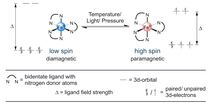
Octahedrally coordinated transition metal ions with 3d4 to 3d7 electronic configurations can occur in two spin states if their ligand field strength (Δ) and spin-pairing energy are of a similar magnitude. A greater ligand field strength compared to spin pairing energy results in the adoption of the diamagnetic low spin state, with the maximum of paired electrons. Vice versa, a greater spin pairing energy compared to ligand field strength leads to the paramagnetic high spin state, with the maximum of unpaired electrons. The transition of the two states is termed spin-crossover. Interestingly, the ligand field strength can be manipulated by external stimuli like temperature, light and pressure, which makes spin-crossover complexes attractive for magnetic switching or sensing applications.
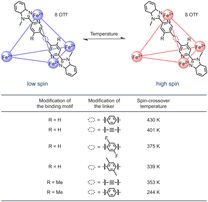
Our group is interested in the design of polynuclear spin-crossover complexes or, to be more precise, spin-crossover cages. We have recently shown that tuning of the spin-crossover temperature (temperature with equal spin state fractions) towards room temperature is possible in tetrahedral FeII4L6 cages with linear 2-(2’-pyridyl)benzimidazole ligands by introduction of relatively subtle ligand modifications (Dalton Trans., 2023, 52, 12789 - 12795).