
healthup - Your student health management

Our goal
Studying, exams, part-time job, social life - studying can be quite challenging. That is why we are committed to ensuring that you can study healthily and successfully at the University of Siegen!
We want you to be physically, mentally and socially well. In order to promote your health holistically, we are working on creating an attractive campus life and healthy study conditions as well as activities and offers for your health and well-being.
You students are not only the target group, but also experts for the SGM project healthup. We want to develop and implement ideas together with you!
In short - we are committed to this:
- to strengthen your well-being,
- reduce stress and strain during your studies,
- integrating health as an important part of your everyday university life,
- to involve you in shaping your study environment.

About us
Who is behind the project?
We are a dedicated network of students and staff from various departments who are committed to your health during your studies. The network brings together important health stakeholders at the university to anchor the topic of health as a cross-sectional task in your everyday student life. The participation of students is particularly important to us, because nobody knows better what is needed for healthy and successful studies.
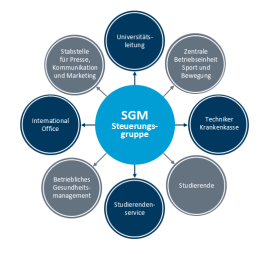

Where is the project based?
Student Health Management (SGM) at the University of Siegen is coordinated by the Central Operations Unit for Sport and Exercise on behalf of the university management. The development of the SGM will be actively supported by our health partner, Techniker Krankenkasse, during a three-year project phase (2024-2027).
Our projects

Running training
Everything to do with running for students and employees!
Meet up with others to run in the Sieg Arena, learn about optimal nutrition while running and get motivated to do something for your health by running in a theory session!

Student self-help groups
Find people who are struggling with similar problems and share your experiences with them!


Guide to healthy studying
Find various offers for students at the University of Siegen to promote your health. Here you will find everything you need to know about mental, physical and social health!

Play & sports equipment rental
Have a great time playing games and sports on the LEO meadow on the AR campus with the University Library and healthup

Kick-off event
Get to know existing health services at the University of Siegen.

Health blog
Tips for a healthy everyday life!
27. May : Running theory
16:00 - 17:00 German/English
17:00 - 18:00 English/German
June 02 : Nutrition workshop
16:00 - 17:00 German
17:15 - 18:15 English
June 03 - July 08 : Running Sieg-Arena
Every Wednesday at
16:30 - 17:30 German/English
17:30 - 18:30 English/German
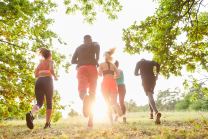
In preparation for the company run on July 15, 2026, students and employees of the University of Siegen can participate in our running meeting, offered by the student health management healthup, the company health management represented in department 1.1 and the Techniker Krankenkasse.
At the beginning, various running units are described in detail in a theory-based unit. This includes an explanation of the different types of running training (e.g. endurance runs, interval training or tempo runs) and the objectives of the respective units. Basic training theory is also covered. This includes principles such as load and recovery, training control and the importance of regularity and progression in training. The fear of running is also to be taken away here.
Following this, on July 2, 2026, there will be a refresher course on healthy eating and nutrition during sport.
You can meet up for a run every Wednesday afternoon at the Sieg Arena. The training is professionally supervised. In addition to tips on your running style, targeted stretching and mobilization exercises are also carried out to improve mobility, prevent injuries and prepare the body for exertion.
You can register for the company run hereuntil April 30.
Register here for the courses, there are only limited places available!
Have fun and good luck! Take good care of yourself and stay healthy!
Best regards
Your healthup team

Our student self-help groups:
Depression, listlessness, loneliness, exam stress, pressure to perform, anxiety, feelings of panic
Day: Fridays, every two weeks (start: 13.02.2026)
Time: 16:00-17:30
Room: AR-S 005 (studio above the large sports hall)
High sensitivity, neurodivergence
Expected to start on August 7, 2026
Day: Fridays, every two weeks (start: 13.02.2026)
Time: 14:00-15:30
Room: AR-S 005 (studio above the large sports hall)
Psychosocial stress, financial worries, long-term studies
Expected to start on August 7, 2026
Day: Fridays, every two weeks (start: 13.02.2026)
Time: 16:00-17:30
Room: AR-S 005 (studio above the large sports hall)
What are student self-help groups?
Student self-help groups are voluntary associations of students who meet regularly to support each other with personal or study-related challenges. In a confidential setting, experiences can be shared, worries discussed and ways of coping can be found together.
How do the meetings work?
The first group meetings are accompanied by a member of staff from the Siegen self-help contact point. She will help you get started, answer questions and support you with the organization. After that, the group continues to organize itself. The groups are self-organized and depend on the commitment of the participants. This means that you organize your meetings together according to your needs.
Is there a charge for participation?
No, participation is free of charge.
Are the meetings confidential?
Yes, confidentiality is a central component of the self-help groups. All participants undertake to treat each other with respect and to keep personal information confidential.
Are the self-help groups a therapeutic service?
No, the self-help groups are not a therapeutic service. They do not replace medical or psychotherapeutic treatment and are not suitable for acute crisis situations. In acute mental crises, please contact professional help services, e.g. the social psychiatric service in the Siegen-Wittgenstein district (Tel. 0271 333-2800) or the telephone counseling service (Tel. 0800 1110111 / 0800 1110222 or 116 123).
How can I take part in a student self-help group?
If you are interested in taking part in a self-help group that starts in mid-February, please complete the questionnaire and register for participation.
Fun & exercise on the LEO meadow - since June 12, 2025, the University Library, in cooperation with University Sports and the Student Health Management healthup , has been offering a rental service for games and sports equipment on the AR campus and, since July 1, on the Paul Bonatz campus. The selection ranges from sports to relaxation.
You can find the entire range in the KatalogPlus of the University Library under the keyword "Leowiese" or "Paul-Bonatz", as well as their loan status. Make sure you have an even better time on the LEO-Wiese or at the PB-Campus. We hope you're looking forward to it!
Use the offer for yourself by going to the library and borrowing the items like a book. You will need a valid library card for this. Items should be returned on the same day within the library's opening hours, otherwise late fees will be charged. You can find more details here.
For more updates, follow us on our Instagram channel and check back here on our website regularly to stay up to date.
Until then, have fun outdoors and get into the game! - Stay healthy and relaxed!
Relaxed studying - everything to do with well-being during your studies - this was the motto of the kick-off event of the student health management program healthup on 28 May 2025 in the sports hall on the AR campus. Students had the opportunity to get to know the University of Siegen's wide range of health, wellbeing and student life offers - and to actively experience them first-hand.
Various hands-on and information stands presented themselves, including
- healthup: students were able to rate the conditions at the university and share their wishes for a healthier student life.
- Techniker Krankenkasse: Smoothies with a difference - mixed by muscle power on a bicycle.
- AStA: Advice, networking and support - everything you need to know about student life.
- Psychological counseling: Helpful tips against stress and exam anxiety.
- Student Living Room: Relax, calm down and get new ideas from the self-care sessions.
- University sports: Information and activities relating to sports at the university - with free courses in cricket and basketball or simply a few shots at the basket.
- USK57: Action on the dance mat and an insight into the creative games initiative.
Refreshing drinks and small snacks invited visitors to linger and chat. Many good conversations, new contacts and exciting insights were made in a relaxed atmosphere.
Couldn't be there? No problem - on our Instagram channel and the website to stay up to date on upcoming events.
See you next time - stay healthy and relaxed!
Health blog
ACTIVE AND HEALTHY through your studies
"The art of resting is part of the art of working." - John Steinbeck. But what constitutes a relaxing break? (04.05.2022)
By Sophia Landgrebe
Why should you take regular breaks?
Regular breaks can reduce stress in the long term and prevent many problems such as lack of sleep, exhaustion, concentration problems or similar, which can occur due to permanent overload.[2] Without breaks, the ability to concentrate decreases significantly. Ultimately, the tasks that need to be completed suffer as a result. Breaks are therefore more helpful in completing tasks faster and more successfully than working through them for hours on end. Breaks prevent tiredness, help you to keep a clear head and work with more fun and energy.[3]
For this reason, regular breaks should be considered, especially when working or studying. Even with long to-do lists and assignments, it doesn't help to work for hours on end, but it can be crucial to integrate relaxing breaks.
How can I integrate regular breaks into my daily routine?
Scheduling breaks is an important step towards a sensible and regular break rhythm. There are several methods in the literature that should make it easier for you to structure your work. These include the Pomodoro technique, for example. It specifies that you should alternate between 25 minutes of concentrated work and a 5-minute break. After 2 hours, take a longer break of around 20-25 minutes. A more detailed explanation can be found in our blog post on the Pomodoro technique https://www.uni-siegen.de/sport/blog/965536.html.
Another option for structuring is to follow three rough rules of thumb. After 45 minutes there should be a 5-minute break, after 90 minutes 10-15 minutes and after four hours there should be at least a 30-minute break.
Fixed breaks have the effect that an end is already determined during the work. The idea that work will only continue for 30 minutes until the next break, for example, can have a positive effect on productivity.[4]
Ultimately, however, breaks must be planned individually, depending on whether several short breaks or longer ones lead to greater success.
A written overview can help when planning breaks. This ensures that not only the breaks are not forgotten, but also that it is possible to check which activities have been completed during the breaks. In the overview, for example, you can specify the break times and the activities that should be carried out during these times. Such a log can ultimately turn planned breaks into routines and certain activities, such as going for a walk or having lunch, are assigned to each break[3].
What makes a relaxing break?
In addition to the correct planning of breaks, their organization is also crucial. The main focus here is on balance. During everyday life with long periods of sitting, it is important that the body and mind are offered a good balance.
Movement is an important aspect of this and breaks can be sensibly filled with a short movement break. Often, just 5-10 minutes is enough to do something good for the body.[4]
Furthermore, fresh air should be breathed in during the break. Everyday life usually takes place in closed buildings, which is why breaks are particularly important to get enough fresh air. A short walk or exercise break outside the building is enough. But sufficient ventilation can also help to supply the brain with enough oxygen. Performance and concentration are automatically increased for the rest of the day.[2]
Another very important aspect for a restful break is distance from any technical devices. Especially for activities that mainly take place on the computer or cell phone, a balance should be found during the break that does not involve technical devices and thus allows the eyes to rest.[3]
Tip for working from home: When working from home, it can also be advantageous to use the breaks for little things that need to be done around the house. For example, shopping can be combined with a short walk or the laundry can be hung up in between. Such tasks not only provide a brief distraction through exercise, but also give a sense of achievement during the break, as tasks can be ticked off that would otherwise have to wait until after work[3].
The planning and organization of breaks are individual. You can try out different methods to find out which break structure and duration promises the most relaxation. It is important that the actual work is faded out so that body and mind can recover[5].
Footnotes and sources
[1] American writer (1902-1986).
[2] Ludwig, Jan (2015). Breaks and recovery times: An investigation of the effects of mental work using the example of the manager. Hamburg: Diplomica Verlag GmbH.
[3] Tran, Minna (2016). 10 simple habits that will help you take a real break from now on and become noticeably fitter. 10 simple habits that will help you take a real break from now on and get noticeably fitter (ergotopia.de).
[4] Stegmüller, Sina Maria (2020). Taking a break properly: Here's how. Taking the right break: How to do it | FOCUS.de.
[5] Wolking, Sebastian (2018). Taking the right break: 5 simple tips. Taking the right break: 5 simple tips - dhz.net (deutsche-handwerks-zeitung.de).
Stress and muscle tension are not only linked, they can also reinforce each other. This is precisely where progressive muscle relaxation comes in and provides a method for coping with stress. (23.03.2022)
By Sophia Landgrebe
The expression "someone has tension written all over their face" is widespread.
This is because stress and inner tension do indeed cause tangible and outwardly visible muscular tension. This is evolutionary and was intended to prepare our ancestors to react to dangerous situations in the shortest possible time. Nowadays, however, we rarely have to fight or flee from stressful situations. On the contrary, conscious relaxation can help us to be more relaxed in stressful situations and thus keep a clear head. In exam situations in particular, excessive tension can lead to inhibited performance. Conscious relaxation requires method and practice.
There are various relaxation methods, which are presented in the following video. It makes sense to try out different methods and find the one that suits you best. One of the methods presented is progressive muscle relaxation. It can lead to a feeling of relaxation from the very first session. It takes around six to eight weeks to learn the method. With regular practice, it is then possible to recognize and reduce tension in your own body. The serenity achieved in this way can be useful for life.
The topic of stress is a current issue, especially among students. A study by Techniker Krankenkasse, which was conducted in cooperation with the German Center for Higher Education Research and Science Studies (DZHW) and Freie Universität Berlin in 2017, clearly shows that one in four students complains of high levels of stress and exhaustion. From this point of view, progressive muscle relaxation can be a helpful relaxation technique that can be particularly beneficial for students[1].
What is progressive muscle relaxation?
The term progressive muscle relaxation consists of two words, which can be translated as progressive (progressiv) and relaxation (Relaxation). The technique goes back to the doctor Edmund Jacobson. He discovered a connection between the feeling of stress and muscular tension. His aim was to reduce this tension and thus also reduce stress. To this end, he developed progressive muscle relaxation. Jacobson's method took many weeks to learn and for this reason the method has been further developed to this day, so that it is possible to learn PMR in six to eight weeks.
A short-term effect can already manifest itself as a feeling of relaxation. In the long term, body awareness can also improve, states of tension can be recognized and thus relaxed in a targeted manner. In addition, more serenity is felt in stressful situations.
How does progressive muscle relaxation work?
PMR involves exercises in which various muscle groups from head to toe are tensed and then relaxed again. The alternation between tensing and relaxing is perceived as pleasant and relaxing after a short time. Initially, 16 muscle groups are introduced, which are later combined into 7 or 4 larger muscle groups.
The exercise is performed either lying on a soft surface or sitting down. However, a chair with a backrest should be used for this. A pillow for the neck or back and a blanket may be required. This depends on the individual's perception of cold and individual comfort. The aim is to be able to relax at the end, regardless of location, while standing or walking.
People with acute illnesses or injuries (e.g. colds, bladder infections, sprains, lumbago, etc.) should not take part. However, as soon as these have subsided, the exercises can be resumed. Furthermore, people with acute migraines, cardiovascular diseases with inadequately controlled blood pressure, acute psychoses and people taking tranquilizers should not take part in the exercises.
How can progressive muscle relaxation be learned?
The University of Siegen's university sports department currently offers a Moodle course that deals with the topic of PMR and provides a structured program for learning progressive muscle relaxation. In addition to detailed explanations, there are also videos in which the various exercises are demonstrated. There are also audio files that guide you through the exercises so that you can close your eyes while doing them. Afterwards, there are tips on how to organize your own exercises until the next course unit. The course can be found here: Courses | GENERAL HIGH SCHOOL SPORTS (uni-siegen.de).
For further information, there is a selection of books in the university library that deal in detail with the subject of PMR. Some of them are listed under Footnotes and Sources.
Footnotes and sources
University Sports Siegen (2021). Lecture "Relaxation - how does it work?" - Digital Diversity Week of the University of Siegen 2021. (1) Lecture "Relaxation - How does it work?"- Digital Diversity Week at the University of Siegen 2021 - YouTube.
[1] The technicians (2020). Grief cum laude? How to study more relaxed! https://www.tk.de/techniker/magazin/life-balance/im-studium/studierende-stress-2048684?tkcm=aaus.
Bernstein, Douglas A. & Borkovec, Thomas D. (1990). Relaxation training: Handbook of "progressive muscle relaxation" according to Jacobson. Munich: Pfeiffer. (Available for order in the university library).
Brenner, Helmut (2002). Progressive relaxation training: the practice of deep muscle relaxation. Lengerich: Pabst. (Available from the university library).
Hofmann, Eberhardt (1999). Progressive muscle relaxation: a training program. Göttingen: Hogrefe. (Available for order from the University Library).
Midsummer has arrived and with it the temperatures have soared. Heat can exhaust the human body and be dangerous for the cardiovascular system. That's why we're giving you 7 tips to combat the heat. (24.08.2022)
By Sophia Landgrebe
When outside temperatures are high, the body tries to lower its own temperature by producing more sweat. However, this leads to the loss of fluids, valuable minerals and trace elements. In addition, the blood vessels in the skin dilate in order to cool the body down. This then causes a drop in blood pressure and a weakening of the circulation. Intense heat can therefore lead to the brain not being supplied with enough oxygen. This then manifests itself in dizziness, headaches or difficulty concentrating[1].
Tips to combat intense heat:
1. drink
The most important tip in extreme heat is to drink. It is essential that the body gets enough fluids, especially if you are sweating a lot. [ 2] Tap water is ideal for this. To compensate for lost minerals and trace elements, it is also important to drink beverages containing minerals. These include teas, juice spritzers and soups, for example. You can find a list of healthy summer drinks to make yourself here.[3]
In addition, the drinks should not be too cold, as ice-cold drinks can cause stomach problems.
1.1 No alcohol or caffeine
Alcohol removes additional fluids and minerals from the body. For this reason, it is advisable to avoid alcohol on particularly hot days. The effect that the temperature has on the body is otherwise intensified by the alcohol.[3]
Caffeine also has a dehydrating effect and can therefore put additional strain on the circulation and lead to more extreme reactions in an already weakened body.[3]
2. diet
Generally speaking, anything that puts a strain on the body in extreme heat is counterproductive. For this reason, attention should also be paid to your diet. It is helpful to eat small, light meals spread throughout the day. Large and very heavy portions can further increase the feeling of fatigue, as the body has to put a lot of energy into digestion. Fruit and vegetables are particularly good as a snack between meals, as their high water content provides the body with more fluids. Good examples are cucumbers, watermelon or lettuce[2].
3. daily routine
If possible, it is helpful to adapt your daily routine to the temperature. In the early morning and evening, temperatures are lower and the body is not exposed to direct sunlight. This time is particularly suitable for strenuous work and sport.[3] At midday, exercise should only be done at medium or low intensity, preferably in the shade. Exercise should be interrupted in the event of severe exhaustion, dizziness or impaired vision[5].
4] Protection from the sun
If it is not possible to stay in a cool building during periods of extreme heat, it is essential to protect yourself from the effects of the sun's rays. This primarily includes the use of sun cream.[3] More detailed information on the topic of sun rays and sun protection can be found in the blog posts "Summer, sun, sunshine..."
and "How do I find the right sun cream?"
can be found.
The choice of clothing is also crucial. In hot weather, loose and breathable clothing should be worn to protect your skin and still allow you to cool down sufficiently.
5. keep your home cool
The best tip for keeping your home cool is to darken it throughout the day. This means using curtains or shutters to keep the rooms dark throughout the day. Windows should also be kept closed at all times to prevent warm air from entering the home. Only in the late evening or early morning hours can the windows be opened to ventilate the home and allow fresh air into the rooms.[2]
All unnecessary electrical appliances should be switched off, as everything that consumes electricity also heats up the room at the same time. However, it is important that the appliances are really switched off and not just on standby[3].
6. quick tips for cooling down
A brief refreshment can be achieved by running cool water over your wrists. It is also helpful to place a cool, damp compress on the back of the neck or forehead. Water sprays can also provide a brief cooling effect. It is not necessary to buy one from the drugstore, but any refillable spray bottle will do the job[3].
7. in an emergency
If a long stay in extreme heat leads to physical complaints, you must react quickly. If there are signs of dizziness, circulatory problems, headaches or severe thirst, you should move to a cool place as quickly as possible. You should also drink something to compensate for fluid loss. If the symptoms persist, it is important to see a doctor[4].
An ambulance must be called immediately for anyone with an elevated body temperature, shaking convulsions, dizziness or even unconsciousness. While waiting, the person should be moved to a cool place and, ideally, lie flat. The person can be cooled externally by applying cool compresses to the neck, armpits or groin. Unconscious people should be placed in the recovery position[4].
Conclusion: Hot summer days put a noticeable strain on the body, but can be endured well with a little preparation: long, breathable clothing, sufficient drinks and a place in the shade. So that you can look forward to a cool apartment in the evening, only open the windows at night or in the early hours of the morning and darken the windows during the day.
Footnotes and sources
[1] Tagesschau.de (2022). What to do in the heat? https://www.tagesschau.de/inland/gesellschaft/hitze-tipps-103.html
[2] NDR.de (2022). Ten tips against the heat. https://www.ndr.de/ratgeber/gesundheit/Zehn-Tipps-gegen-Hitze,sommerhitze132.html
[3] Gürster, Anna (2022). What to do in the heat? The best tips for surviving the heatwave. Tips against heat: The best tips to endure the heatwave (utopia.de)
[4] ZDF.de (2022). Hot temperatures at the weekend: Tips against the heat. https://www.zdf.de/nachrichten/panorama/hitze-tipps-wetter-100.html
[5] Deutschlandfunk (2018). Sport in the heat "In extreme cases, it can be life-threatening". https://www.deutschlandfunk.de/sport-bei-hitze-im-extremfall-kann-das-lebensgefaehrlich-100.htm
In the last blog post, we talked a lot about the sun's rays and possible dangers. Sun cream in particular is a decisive factor in protecting yourself. But what makes a good sun cream and what should you look out for? (29.06.2022)
by Sophia Landgrebe
All the important information about the sun's rays and the dangers of the sun can be found at
in the blog post 'Summer, sun, sunshine...'.
to find.
Sun cream is one of the best ways to protect yourself against the sun's various UV rays. Sunscreen can absorb these rays and process them further as lower-energy radiation. It is also possible that the filters in the sun creams reflect the radiation and thus deflect it away from the skin. [ 1]
Sun creams are available on the market in a wide variety of forms. For this reason, we have created a checklist to help you buy the right sunscreen.
Sunscreen - checklist
- sun protection factor
Sunscreens should have a sufficiently high sun protection factor. For adults, the minimum SPF is 20, but a higher SPF should be chosen, especially when spending time in water, snow or sunny regions. SPF 50/50+ can be used here[1].
- UV-A
The products should be labeled with protection against UV-A rays[2].
- Ingredients
Particular attention should be paid to the ingredients of sun creams, especially in the case of intolerances or hypersensitivity. In particular, sun creams with additives such as fragrances should not be used on sensitive skin[2].
- Application
Sun cream should ideally be applied 20-30 minutes before exposure to the sun to ensure full protection[3].
- Quantity
Sunscreen should also be applied in sufficient quantities. For an adult, a quantity of approx. four heaped tablespoons can be expected for the entire body[3].
-Regularity
Sun cream should be reapplied every two hours. The cream should be reapplied especially after contact with water[3].
What is the sun protection factor?
The sun protection factor (SPF) ultimately indicates how long the sun cream can protect the skin from the penetration of UV rays. The SPF often only describes the protection against UV-B rays. For this reason, it is important to ensure that protection against UV-A rays is also guaranteed[4].
The different sun protection factor categories:
- SPF 6-10 basic
- SPF 15-20 medium protection
- SPF 30-50 high protection
- SPF 50+ very high protection
A simple calculation can be used to determine how long the skin is protected from the sun. To do this, the skin's own protection time must be multiplied by the SPF. This then gives the sun protection in minutes.[4] You can find out the exact value of the self-protection time on the NIVEA website The right sun cream for your skin type - NIVEA.
An example of this calculation could look like this: A person has a self-protection time of 10 minutes. This means that the person can spend 10 minutes in the sun before developing sunburn. Now he uses a sunscreen with an SPF of 20, so he has to calculate 10*20. This gives 200, so they can stay in the sun for just over 3 hours without getting sunburnt. [ 4]
Footnotes and sources:
[1] Nivea (2022). Calculate sun protection factor for optimal sun protection. Calculating the sun protection factor: How it works - NIVEA.
[2] Federal Office for Radiation Protection (2022). Protection from UV radiation. BfS - Protection from UV radiation.
[3] Kirschner, Uwe (2022). Sun protection: applying sunscreen correctly. Sonnenschutz: Sonnencreme richtig auftragen - Hautarztpraxis Dr. Kirschner (hautarztpraxis-mainz.de).
[4] Nivea (2022). Sun protection according to skin type: Here's what to consider! https://www.nivea.de/beratung/sonnenschutz/sun-hauttypen.
Lemon iced tea, lemonade or an iced coffee all sound tempting, especially on hot days. Unfortunately, most sweet drinks contain a lot of sugar or other unhealthy ingredients. That's why we have four recipes for you with delicious and light summer drinks to make yourself. (10.08.2022)
by Sophia Landgrebe
Iced tea with black tea
4 tea bags of black tea
2-3 lemons & mint
Sweetener to taste
ice cubes
- Pour the black tea into a jug and add approx. 1 liter of boiling water. Leave to infuse for 3-5 minutes, depending on the desired intensity.
- Remove the tea bags from the water and allow to cool directly with plenty of ice cubes. The tea should cool quickly, as it releases bitter substances during a slow process, which change the taste of the iced tea.
- A sweetener can now be added to taste. For example, a teaspoon of honey or agave syrup can be used. Alternatively, a sugar substitute such as xylitol is also suitable.
- The lemon can now be squeezed. If you like it more acidic, use more lemon juice. Also cut a lemon into thin slices. Add the lemon juice and slices to the tea and serve iced.
Homemade iced tea will keep in the fridge for 2-3 days. You can fill larger quantities into sealable bottles and freeze them. However, make sure that you only fill the bottles about two-thirds full, as the liquid expands when it freezes.
Lime iced tea
4 tea bags of 'Italian lime' or a similar lime tea
Approx. 700ml cold water
1 lime & mint
Ice cubes
- Brew the tea in a glass and leave to infuse for approx. 5-8 minutes, then remove the tea bags and pour the tea into a 1 liter container. Leave the tea to cool briefly.
- Fill the container with ice-cold water.
- Pour the juice of one lime into the iced tea and add the mint.
- Serve the lime iced tea with ice cubes.
Homemade iced tea will keep in the fridge for 2-3 days. You can fill larger quantities into sealable bottles and freeze them. However, make sure that you only fill the bottles about two-thirds full, as the liquid expands when it freezes.
Iced coffee
200g coarsely ground coffee
1 liter of water
ice cubes
Milk as required
- Place the coffee and water in a container and leave to infuse overnight.
- Carefully pass the liquid through a coffee filter or filter with cheesecloth.
- Pour the coffee into a glass with ice cubes and top up with milk as required.
Cold brewing not only saves heating and cooling the coffee, but is also easier on the stomach. The coffee can be kept in the fridge for up to four days.
Strawberry and melon smoothie
50 grams of netted melon
80 grams of strawberries
basil
100 ml green tea
2 tablespoons yogurt
Sweetener as required
- Remove the rind and seeds from the melon and process in a blender together with the remaining ingredients. Blend the ingredients until the smoothie has a creamy consistency.
- If a sweetener is desired, honey, agave syrup or a sugar alternative, such as xylitol, can be used.
- Pour into a glass and top with a
Temperatures continue to rise and the need to cool off is great. In this article, we introduce you to the best places to swim. (13.07.2022)
By Sophia Landgrebe
Below we present the best places in Siegen and the surrounding area to cool off:
Warm water outdoor pool in Siegen Kaan-Marienborn
The outdoor pool in Kaan-Marienborn offers three 50-meter swimming lanes, five 25-meter swimming lanes and a non-swimmers' area. There are also mini goals for playing soccer, a table tennis table and a bowling alley for all sports enthusiasts.
The outdoor pool is also barrier-free. This means that there are disabled parking spaces and an access slide into the pool. There are also disabled and wheelchair-accessible changing rooms with appropriate sanitary facilities.
The opening times of the outdoor pool in Kaan-Marienborn:
Monday/Tuesday/Thursday 9 a.m. to 8 p.m., Wednesday/Friday 7 a.m. to 8 p.m., Saturday 9 a.m. to 7 p.m., Sundays and public holidays 9 a.m. to 7 p.m.
The bathing time ends 15 minutes before the end of the opening time and the cash desk closes 30 minutes before the end of the bathing time.
How to get there:
From Siegen ZOB you can take the R12 or R13 bus to the Kaan-Marienborn Ortsmitte stop. From there it is about a 7-minute walk to the outdoor pool.
The address for the navigation system is: Breitenbacher Straße 59, 57074 Siegen.
Warm water outdoor pool Siegen-Geisweid
The outdoor pool in Geisweid offers four 50-meter swimming lanes and four shorter swimming lanes.
In addition to mini goals for playing soccer, there is also a beach volleyball court and two outdoor playing fields: a chess field and a mill field.
The opening times of the outdoor pool in Geisweid:
Monday/Wednesday/Friday 9:00 am to 8:00 pm, Tuesday/Thursday 7:00 am to 8:00 pm, Saturday 9:00 am to 7:00 pm, Sundays and public holidays 9:00 am to 7:00 pm.
The bathing time ends 15 minutes before the end of the opening time and the cash desk closes 30 minutes before the end of the bathing time.
How to get there:
From Siegen ZOB you can take the R12 or R13 bus to the Kaan-Marienborn Ortsmitte stop. From there it is about a 7-minute walk to the outdoor pool.
The address for the navigation system is: Auf der Schläfe 4, 57078 Siegen.
Natural outdoor pool in Deuz
The natural outdoor pool in Deuz has a large main pool as well as a smaller non-swimming pool. The special thing about this outdoor pool is that the water is not chlorinated, but naturally purified in a pond. There are 25-metre swimming lanes for sports enthusiasts and there are also plenty of opportunities to play sports outside the pool (beach volleyball court) or relax on the large lawn.
The opening hours of the natural outdoor pool in Deuz:
Mon-Sat 2.30 pm to 6.00 pm, Sunday 10.00 am to 6.00 pm.
How to get there:
From Siegen ZOB you can take the R16 or SB5 bus to the Deuz Ortsmitte stop. From there it is a 5-minute walk to the outdoor pool.
The address for the navigation system is: Am Freibad 1, 57250 Netphen.
Natural outdoor pool in Eiserfeld (Eiserfelder Weiher)
The outdoor pool in Eiserfeld is a natural outdoor pool, just like the previously mentioned outdoor pool in Deuz. For this reason, it is also known as the Eiserfeld pond. This swimming pool has a large swimming area with a water trampoline and the opportunity to hire surfboards.
It is also possible to do sports here. There is a soccer pitch and a beach volleyball court.
The opening hours of the natural outdoor pool in Eiserfeld:
Mon-Sun 2 p.m. to 7 p.m.
Times may vary if temperatures are very high.
How to get there:
From Siegen ZOB you can take the R22 bus to the Eiserfeld (Siegen), Gilbergstraße stop. There you can change to the A614 and get off at Eiserfeld (Siegen), Am Freibad.
The address for the navigation system is: Am Freibad 3, 57080 Siegen.
Seelbacher Weiher
The Seelbacher Weiher is also a natural outdoor pool. There is a large swimming area equipped with a diving board (1m), a water slide and a platform floating in the water.
There is also a large sunbathing lawn, soccer goals and a beach volleyball court.
The opening hours of the Seelbacher Weiher:
Mon-Fri 13:00 to 19:00, Sat/Sun/Public holidays 10:00-19:00.
During school vacations daily 10:00-19:00.
How to get there:
From Siegen ZOB you can take the bus line R38 and R39 to the bus stop Seelbach (Siegen), P+R Seelbacher Weiher. From there it is about a 6-minute walk to the outdoor pool.
The address for the navigation system is: Bubergstr. 78, 57072 Siegen.
Please note: The teaching pool at the University of Siegen is currently closed due to a defect. The repair will unfortunately take some time. We do not know exactly when the damage can be expected to be repaired. We hope that we will be able to put the teaching pool back into operation at the start of the winter semester in October.
For tips and information on freely accessible public sports facilities in and around Siegen, please take a look at our overview of leisure and sports facilities
here.
Picnics in the countryside, a long day at the lake or sport in the fresh air - all of these are great fun when the sun is shining brightly. However, people often underestimate the dangers of the sun and especially the sun's rays on our skin. (22.06.2022)
By Sophia Landgrebe
In addition to the tanned skin that many people hope to achieve in summer, the sun's rays also harbor a number of dangers that can cause damage to health. These include sunburn and sunstroke, for example. Ultimately, the heavy exposure of the skin also leads to an increased risk of skin cancer.
What are UV rays?
The sun emits so-called UV rays. Starting with the sun, the radiation penetrates to the earth's surface to varying degrees depending on the wavelength. Of these rays, only the so-called UV-A and UV-B rays ultimately reach the earth's surface. The sun's rays do not have the same intensity at all times. For example, it is well known that the radiation is stronger in the summer months than in winter, but the time of day can also influence the intensity of the radiation. Furthermore, cloud cover, altitude and the ecological environment can also make a difference. This change can already be noticeable when you are in water or surrounded by snow. Such factors can naturally amplify UV rays[1].
For this reason, the intensity of UV rays is constantly monitored worldwide and published as a UV index.[1] There is a difference between UV-A and UV-B rays in terms of potential dangers. UV-A rays do not cause sunburn, but they penetrate much deeper into the skin and can cause considerable damage to health. In contrast, UV-B rays only reach the surface, but are therefore also responsible for tanning and sunburn[2].
What protects against UV radiation?
There are simple steps you can take to protect yourself from the effects of the rays. On the one hand, you can look for a place in the shade to reduce your exposure to the rays, and on the other hand, clothing is a functional aid to protect your skin from the rays. You should pay particular attention to loose clothing that covers as much skin as possible and is breathable. There are special UV shirts for water sports that can protect the skin from the rays. These two methods are already effective protection against the effects of the sun's rays. However, the skin should be protected in summer by an additional and very important step, namely sun cream[3].
Sun creams are now available in a wide variety of forms, from light creams and sprays to thick sun milk. There is a wide range to choose from and the sun protection factor information can also vary from product to product. Sun cream contains both soluble and insoluble UV filters. The UV radiation can be absorbed and processed further as lower-energy radiation. It is also possible that the filters in the sun creams reflect the radiation and thus deflect it away from the skin.
Sun cream can therefore help to reduce the intensity of UV rays and reduce the risk of damage to the skin. As well as delaying the onset of sunburn, it also helps to prevent some forms of skin cancer.
For sunscreen to support the skin in this way, it is essential that the sun protection products protect against UV-A radiation[2].
Footnotes and sources:
[1] Federal Office for Radiation Protection (2022). Protection from UV radiation. BfS - Protection from UV radiation.
[2] Nivea (2022). Calculate sun protection factor for optimal sun protection. Calculating the sun protection factor: How it works - NIVEA.
[3] Nivea (2022). Sun protection according to skin type: Here's what to consider! https://www.nivea.de/beratung/sonnenschutz/sun-hauttypen.
Christmas is the time for cookies and cookies. And to make snacking on cookies even more fun, we have three recipes that are healthy and delicious! (21.12.22)
by Sophia Landgrebe
Healthy vanilla crescents
100 g ground almonds
50g ground hazelnuts
130g spelt flour type 812
100g soft butter
100g soft dates
pinch of salt
1/2 tsp ground vanilla
approx. 5 tbsp ground almonds (without skin)
1 msp. ground vanilla
- Chop the soft dates in a blender. Briefly roast the ground nuts in a pan until fragrant. Then knead all the ingredients into a shortcrust pastry. Shape the dough into a ball and chill for 30 minutes.
- Knead the dough well again (without adding flour) and tear off small pieces. Shape these into a roll and cut into pieces about 5 cm long. For the typical croissant shape, these pieces should then be formed into crescents and the ends pressed together a little.
- Place the vanilla crescents on two baking trays lined with baking paper and bake one after the other for approx. 8-10 minutes at 180° top/bottom heat.
- Remove and leave to cool. Mix the ground almonds with a pinch of ground vanilla and roll the lukewarm crescents in it.
Oatmeal cookies with cranberries
100 grams butter (cold)
50 grams dried cranberries
50 grams oat flakes
1 tbsp cocoa powder
6 tbsp milk
150 grams wholemeal flour
50 grams sweetener, e.g. honey, maple syrup, agave syrup or sugar substitute (erythritol) or sugar substitute, such as erythritol
1 egg yolk
1 pinch of salt
- Finely chop the cranberries. Knead the butter, rolled oats, cranberries, cocoa powder, milk, flour, sweetener, egg yolk and salt thoroughly into a smooth dough, first using the dough hook of a hand mixer and then with your hands. Shape the dough into a roll with your hands, cover and chill for at least 30 minutes.
- Cut the roll into about 20 slices and place the biscuits on a baking tray lined with baking paper. Bake the cookies at 180° convection oven for about 8-10 minutes. Remove the cookies from the baking tray and leave to cool.
Chocolate hazelnut cookies
120g apple sauce
40g oat flakes
15g baking cocoa
20g ground hazelnuts
10g chocolate drops
- Mix all the ingredients together thoroughly and form approx. 10 cookies with your hands.
- Place them on a baking tray lined with baking paper and bake at 180° top/bottom heat for approx. 10-15 minutes.
- Remove and leave to cool. If you like, you can drizzle some melted chocolate over the cookies.
The Central Operating Unit for Sport and Exercise is not only responsible for planning university sports. It also offers the Sport - Education and Training certificate course. (08.06.2022)
by Sophia Landgrebe
What exactly is the certificate?
The certificate program offers the opportunity to acquire an additional qualification in addition to the main course of study. The course is designed to teach the skills required to plan, implement and evaluate sports programs (level 6 of the German Qualifications Framework). It focuses on the design of sports activities from various fields of movement in the context of education and training.
How does the certificate work?
The certificate program should be available to as many students as possible. For this reason, it is easily accessible and offers many options. This should allow for optimal compatibility with the main course of study.
Overall, the certificate program has a total scope of at least 16 SWS and is divided into a sports science preparatory course (2 SWS), a compulsory area (6 SWS) and an elective area (at least 8 SWS).
The compulsory section includes three courses with theory-practice links that take place in the sports hall. The first course deals with the movement field of playing in the context of education, the second course focuses on the design of training processes in (fitness) sport, and the third course is the final examination (teaching test).
At least four elective courses must be taken in order to obtain the certificate. The courses offered in the elective area are based on demand and the current continuing education needs of the students.
The University cooperates with the Kreissportbund Siegen-Wittgenstein. This cooperation enables students to have the training content of the certificate recognized by the state sports association and thus obtain the trainer C license (popular sports). The prerequisite for this is that the propaedeutic examination was completed no more than four semesters ago when applying for the certificate.
How can I start with the certificate?
The first step to start the certificate is to register for the sports science propaedeutic course. This consists entirely of digital lessons and can be started at any time. Self-enrolment via Moodle is sufficient for registration. The propaedeutic course concludes with a digital exam, passing which is a prerequisite for access to all further courses in the certificate program. This exam can be repeated as often as required until it is passed. Participation in the preparatory course and the examination is free of charge. After the propaedeutic course in sports science, three compulsory courses and at least four elective courses must be completed as well as two external courses (first aid course and work shadowing). Compulsory and elective courses can be completed in parallel. The courses are each subject to a fee of 15 euros.
From an insider tip to one of the fastest booked-out courses in university sports. Once again this year, you had to be quick to get a place on the small games course. But why are these courses so popular and what is actually played there? (27.07.222)
By Niklas Wilde

Categorization and some examples
Most of us will have played small games in our lives. Whether unorganized as a child in the playground, kindergarten or schoolyard, as a warm-up in the sports club or as a reward at the end of a successful lesson. The small games are divided into different categories, which is not always easy, as many games can be assigned to several categories. The categorization into coordination games, running games, catching games, ball games and dance and music games seems to be widespread. However, the games can also be categorized according to their venue (water, terrain, snow, hall, sports field, schoolyard)1
Various catching games such as chain catch, island catch, ribbon catch, "fisherman, fisherman how deep is the water?", etc. and ball games such as burn ball, zombie ball, dodgeball, hare and hunter or similar should be familiar from school lessons.
Difference to the big games
"The 'small games' include all forms of movement games with or without equipment and are distinguished from the so-called 'big games' by the fact that they are not subject to any defined competition rules. They therefore leave plenty of room for improvisation and variation in terms of the number of players, the size of the playing field, the equipment, the auxiliary materials and the rules, which are usually very simple "2
According to Döbler, we describe small games as "a sequence of fun-filled and enjoyable activities based on a specific game idea or task, which develop and practice physical and mental skills in a stimulating and entertaining way "3
However, this does not mean that small games are not competitive in nature. Ambition, passion and team spirit often fuel the game just as much as in the big games. However, there are also small games without winners.
In sports lessons or in clubs, small games are usually played as a warm-up, for coordination training or to round off a session. The games are often seen as an introduction to one of the big games such as handball, basketball, soccer or volleyball and are incorporated into a series of lessons.
Why do students play children's games?
They only play for one reason: because it's fun! At the moment, there are many things to worry about or to be depressed about. But as soon as you enter the sports hall, these fears and worries no longer exist for the next 90 minutes. All that matters is not getting caught, dropping your opponent or being the last one standing. The game is a world of its own, completely without the outside world. And such a sporting, fun and mental break is good for everyone.
Footnotes and sources
[1] Moosmann, K. (2009). The big Limpert book of little games. Bewegungsspaß für Jung und Alt, Wiebelsheim: Limpert Verlag GmbH (available in the library).
[2] Unfallkasse NRW (2017). Prävention in NRW 29 - Kleine Spiele für alle Schulformen. https://www.unfallkasse-nrw.de/suche.html?q=Kleine+Spiele+für+alle+Schulformen
[3] Döbler, E. & Döbler, H. (1983). Little games. Ein Handbuch für Kindergarten, Schule und Sportgemeinschaft, Berlin: Volk und Wissen, Volkseigener Verlag, p. 31 (available in the library).
