Book Projects

Modern bank management is based on three control loops: internal control, external accounting, and regulatory limits. These three control loops open up a wide range of possibilities for methodological design. The book highlights the areas of tension and offers perspectives for integration that aligns with the business model. The various (business model-driven) calculations of interest rate book management, along with their differences and interdependencies, are systematically analyzed; and, building on the VaR resampling method, a concept is presented for systematically integrating stress events into risk measurement.
The starting point is an introduction to the various business models of banks and their integration into an overarching risk governance philosophy, including the risk appetite framework and risk culture. The analysis of the integrability of the three control cycles is conducted using the example of interest rate risk. First, economic interest rate portfolio management is presented, along with its components: return/performance, Value at Risk/scenario analyses, RORAC, and stress testing. The internal control metrics are compared with regulatory requirements and linked to them (in particular the IRRBB). Finally, the economic substance is reflected externally in HGB and IFRS accounting. The standards IDW RS BFA 7 and IDW RS BFA 3 are also addressed. The discussion is rounded off with an outlook on current trends in integrated reporting.
Implementing Business Models and Strategies in the Context of Management Circles
Integration Capability of Management Circles Using the Example of Interest Rate Risk
With numerous examples, illustrative calculations, and digital tools
Have we piqued your interest? Order here.
You can find a reviewhere!
You can find the detailed table of contents here:
Excel files for Integrated Bank Management:
Disclaimer
The Excel files provided are intended solely to enhance and deepen the understanding of the topics presentedin the book "Integrated Bank Management—Internal Controlling, External Accounting, and Regulatory Limits on Interest Rate Risk. " The content is presented in simplified form and is intended to facilitate an understanding of various calculations.
The content is expressly not intended for practical application in banks and should under no circumstances be used for that purpose. The authors assume no responsibility for errors or omissions in the files and are not liable for any damages resulting from their use.
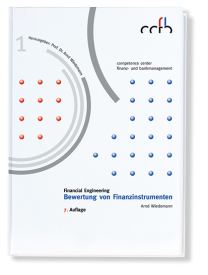
Today, it is more important than ever for market participants to know and understand financial engineering. Starting with an introduction to financial mathematics, the course first explains basic symmetric products (fixed- and floating-rate bonds, forward rate agreements, and swaps). Subsequently, using stock options as an example, the various types of options, their valuation components, and option pricing models are presented. These form the foundation for the analysis of structured products with stock options (equity-linked bonds, discount certificates, index-linked bonds).
Furthermore, interest rate options (bond options, caps, floors, collars, and swaptions) are discussed, and building on this, structured products (bonds with single and multiple call options, reverse floaters, leveraged floaters, capped constant maturity swaps). The product range is rounded out with the analysis of convertible bonds and certificates (including guarantee, bonus, and leverage certificates).
Valuation methods based on analytical formulas as well as binomial trees are employed. Furthermore, Monte Carlo simulation is becoming increasingly prevalent, particularly for products with complex payout profiles. The reader is gradually introduced to the various valuation techniques. A new chapter on ethics in financial engineering has also been added.
This book is now available in its seventh, revised, and expanded edition.
Table of Contents:
- Financial Engineering
- Fundamentals of Financial Mathematics
- Symmetric Financial Products
- Stock Options and Option Pricing Models
- Structured Financial Products with Stock Options
- Interest Rate Options
- Structured financial products with interest rate options
- Convertible bonds
- Monte Carlo simulation
- Certificates
- Ethics in Financial Engineering
Case Studies for Volume 7 - Financial Engineering:
Here you can download the solutions to all case studies in the book in PDF format.
Chapter 2 - Fundamentals of Financial Mathematics
Case Study 01: Calculation of Cash Flow Transformers
Case Study 02: Determining Present Value
Chapter 3 - Symmetric Financial Products
Case Study 03: Valuation of Credit-Risk-Free Bonds
Case Study 04: Duration Analysis
Case Study 05: Valuation of Credit-Risk-Exposed Bonds
Case Study 06: Valuation of a Floater
Case Study 07: Valuation of Forward Rate Agreements
Case Study 08: Valuation of Plain Vanilla Swaps
Case Study 09: Valuation of Forward Swaps
Case Study 10: Valuation of an In Arrear Swap
Case Study 11: Valuation of a Constant Maturity Swap
Chapter 4 - Stock Options and Option Pricing Models
Case Study 12: Valuation Using the Binomial Model
Case Study 13: Valuation Using the Black-Scholes Model
Chapter 5 - Structured Financial Products with Stock Options
Case Study 14: Valuation of a Convertible Bond
Case Study 15: Valuation of a Discount Certificate
Case Study 16: Valuation of an Index-Based Bond
Chapter 6 - Interest Rate Options
Case Study 17: Valuation of Bond Options
Case Study 18: Valuation of Caps
Case Study 19: Valuation of Floors
Case Study 20: Valuation of Collars
Case Study 21: Valuation of Swap Options
Chapter 7 - Structured Financial Products with Interest Rate Options
Case Study 22: Valuation of a Single-Putable Bond
Case Study 23: Valuation of a Multi-Callable Bond
Case Study 24: Valuation of a Reverse Floater
Case Study 25: Valuation of a Leveraged Floater
Case Study 26: Valuation of a Capped Constant Maturity Swap
Chapter 8 - Convertible Bonds
Case Study 27: Valuation of a Non-Callable Convertible Bond
Case Study 28: Valuation of a Callable Convertible Bond
Chapter 9 - Monte Carlo Simulation
Excel File 1: Valuation of a European Call Option
Excel file 2: Generating price paths
Excel file 3: Valuation of a barrier option
Excel File 4: Generating Correlated Random Numbers
Excel file 5: Valuation of an exchange option
Chapter 10 - Certificates
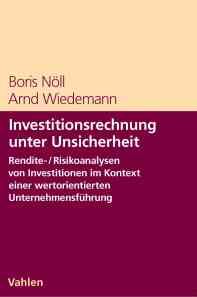
Investing Under Uncertainty: Return-Risk Analyses of Investments in the Context of Value-Based Corporate Management
Successful investments increase corporate value—failures diminish it! Investments are characterized by high capital commitment and long durations. Once implemented, they can generally only be reversed at high cost. Consequently, an integrated analysis of investment decisions from the perspectives of return and risk is of paramount importance.
This book offers a comprehensive and practical insight into modern investment analysis methods and their connections to value-oriented corporate management. The valuation framework is based on the net present value formula, whose central components—the expected cash flows and the risk-adjusted discount rate—are brought to life step by step. First, the discount rate is determined using capital market-oriented models. Subsequently, the external corporate perspective islinkedwith the internal corporate perspective on investment risk (revenue, operational, and financial
risk). Using the WACC and APV approaches as examples, the simple net present value model is expanded into a comprehensive valuation approach. At the same time, the combined valuation of individual investments and entire companies is achieved.
You can find the detailed table of contents for the book here:
Downloads:
Chapter 2
Bernoulli Principle [Fig. 2-10 ff.]
Decision Matrix [Fig. 2-16]
Chapter 3
State Preference Model [Chapters 3.2.2 and 3.2.4]
Risk-return relationship of risky financial investments [Chapter 3.4.3]
Chapter 4
Iso-expected-value lines [Fig. 4-23]
Iso-variance ellipses [Fig. 4-24]
Combination of iso-expected-value lines and iso-variance ellipses [Fig. 4-25]
Optimal Portfolio I [Fig. 4-31]
Optimal Portfolio II [Fig. 4-32]
Portfolio with 2 stocks and a risk-free investment [Fig. 4-35]
Optimal portfolio with risk-free investment [Fig. 4-36]
Chapter 5
CAPM according to Black [Fig. 5-16]
Company valuation using the CAPM [Fig. 5-21 ff.]
Chapter 6
Leverage [Chapter 6.1]
WACC Approach [Chapter 6.2]
WACC approach with tax adjustment in the numerator or denominator[Fig. 6-36 ff.]
WACC Approach with Autonomous Financing [Fig. 6-46 ff.]
Municipal Debt Management - Volume 1: From the New MunicipalFinancial Management (
) to the Risk Measurement of Investment and Cash Loans
Municipal Debt Management - Volume 2: From Interest Rate Derivatives to a Proposal for a MaRiskKomm


The current budgetary situation poses major challenges for many municipalities. Professional debt management can help ensure that the diverse municipal tasks continue to be fulfilled in the future.
The topic is particularly demanding and complex with regard to the measurement and management of interest rate risk. The aim of this two-volume compendium is to provide a systematic introduction to the techniques of professional municipal debt management and to offer solution strategies for debt portfolios of varying sizes and complexity.
The first volume outlines fundamental methods for measuring and managing interest rate risk. The second volume presents both selected derivatives for interest rate hedging and optimization as well as advanced interest rate modeling techniques for valuation and risk measurement. The second volume is rounded out by proposals for a MaRiskKomm, a qualitative risk management system for municipalities.
Municipal Debt Management
Volume 1: From the NKF to the Risk Measurement of Investment and Cash Loans
Table of Contents:
- The Challenge of Debt Management
- Municipal Debt Management
- Integrated Credit and Interest Rate Management
- The Yield Curve and Its Modeling
- Basic Approaches to Generating Interest Rate Scenarios
- Risk Measurement of Investment and Operating Loans
- Interim Conclusion and Outlook for Volume 2
Municipal Debt Management
, Volume 2: From Interest Rate Derivatives to a Proposal for a MaRiskKomm
Table of Contents:
- Selected derivatives for interest rate hedging and optimization
- Models for Valuing Interest Rate Derivatives
- Models for Generating Interest Rate Scenarios in Risk Management
- Integration of municipal debt management into qualitative risk management