Current projects
Projects combine computer science didactic research with practical innovations - from digital learning and exercise environments to AR/VR-based teaching/learning scenarios and AI-supported feedback. In various courses, students have the opportunity to plan and actively participate in projects.
VRUPI - AI-supported VR teaching internships (2025 - 2027)
The project "AI-supported VR teaching internships (VRUPI)" in the computer science teacher training program uses virtual reality (VR) to offer future teachers an immersive teaching-learning experience. In the VR environment, student teachers of computer science slip into the role of teachers and encounter a variety of teaching situations, from routine tasks to complex pedagogical challenges and testing of computer science didactic teaching strategies. The AI-generated feedback from virtual students is designed to be realistic in order to create an authentic learning environment. Another aspect of the project is debriefing, which enables subsequent reflection and analysis of the simulated teaching experiences under the supervision of an experienced person and supported by AI in order to promote pedagogical and didactic skills.

Funding: Freiraum 2025
Period: 2025 - 2027
Evaluation, development and implementation of this project also take place in university courses.
take place.
Completed projects
This overview provides insights into key issues, project progress and results achieved in recent years - including concepts, materials, publications and prototypes developed. Many results remain relevant beyond the project duration and are made available here as a reference and starting point for new research projects and collaborations.
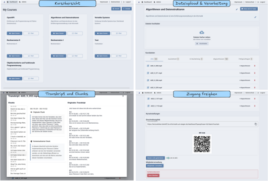
A platform (LectureLinker) has been developed on which teachers can create their own chatbots for students. Teachers upload their lecture recordings as videos and receive an individual link that they can forward to their students. Students use this link to activate the chatbot for the lecture. In addition to familiar chatbot functions, the chatbot uses the lecture recordings as a source of information and links to relevant passages. Students can use these links to verify relevant information or find out more. The chatbot uses generative artificial intelligence that runs entirely on a server at the University of Siegen in compliance with data protection regulations.

The AI-supported learning in computer science (KULI) project aims to improve the practice and study conditions in introductory computer science courses with the help of a new type of web-based practice platform.
The use of large language models such as GPT-4, which are able to understand and react to semantic contexts, is intended to enable individual feedback that goes far beyond the mere confirmation of conformity with a sample solution. The availability of immediate feedback is particularly necessary for the asynchronous processing of exercises in courses in the introductory phase of studies in order to avoid frustration.
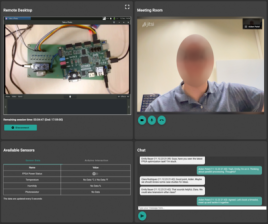
The past few years have shown that university teaching can be both purely digital and hybrid with a presence component. However, it has also been shown that teamwork and the understanding of interaction with technical processes are lost in the exercises and laboratories of STEM subjects. The aim of the project is therefore to develop a mixed physical/virtual (hybrid) laboratory for cyber-physical systems. By developing a new teaching concept analogous to interactive computer games, in which the players are in a virtual room with avatars and solve tasks, real sensors and actuators are to be controlled in the laboratory room. The learning environment should be usable remotely, but also physically on site at any time, so that hybrid teaching units are also supported. The TECY project (telepresence and collaboration of students in a mixed physical/virtual laboratory for cyber-physical systems) is being implemented in collaboration with Prof. Dr. Roman Obermaisser and Veit Wiese.
Details of the implementation and evaluation have been published[1][2][3][4]
As part of the LAARAproject
(Learning, Informing and Acting Competently with Augmented Reality in the Work Process) project, an interdisciplinary research network is being established between engineering and vocational education and didactic research.
The increasing use of augmented reality technologies will influence forms of qualification and further training as well as the acquisition of professional competence. This opens up new perspectives for lifelong learning in the work process. The aim of the research project is to determine parameters that have an influence on learning, informing and acting in the workplace in the context of a semi-virtual space.
In the PACER project, the development of a teaching format with a playful character is planned. To this end, a point-and-click adventure game is being developed based on the game principle of escape rooms, in which puzzles to be solved require a playful examination of topics relating to basic computer science content. The initial target group is student teachers whose digital literacy is to be promoted. The aim of the project is to promote the skills required in the course of digitalization in the field of basic computer science education in a low-threshold, location- and time-independent and playful way. The target group is initially teacher training students, who are increasingly expected to promote IT skills themselves and must therefore also possess them.
The possibilities of AR and VR technologies are tested as part of an interdisciplinary collaboration between different subject didactics, so that the different didactics become familiar with the potential applications for their subjects. These will then be further developed and implemented together using computer science tools.
Specifically, starting in the summer semester of 2022, the didactics of computer science will offer workshops on the use of AR and VR in school contexts. The material created during the workshops will also be made available in a Moodle course and published as an open educational resource if it meets quality criteria that have yet to be determined.
The ko.ve.diproject
(competent, networked and digital) project aims to implement the "connectivity" megatrend in inter-company apprentice training. The implementation is exemplified in the training occupations of plant mechanic for HVAC technology, information electronics technician, automotive mechatronics technician and carpenter. The trainees are given a comprehensive understanding of the networking of digital processes. The didactics of computer science at the University of Siegen is providing scientific support for the project as a partner for technology and IT didactics.
In the Communities of Practice NRW for Innovative Teacher Education (COMeIN) project, representatives from all phases of teacher education work together to address issues relating to innovative teacher education across disciplines and locations. The didactics of computer science is a partner in the "CoP Informatische Grundbildung."
All twelve teacher training universities in the state of North Rhine-Westphalia have joined forces to develop products in line with school needs and a prototype for cooperation between science and practice, working closely with the two ministries for schools and further education and for culture and science, the five district governments and the Quality and Support Agency - State Institute for Schools (QUA-LIS).
More about COMeINat: https://www.uni-due.de/comein/
As part of SQLesson, a web-based learning support system is being developed that provides teachers with administration and evaluation tools on the subject of SQL in computer science lessons.
The core functions are that different database instances can be assigned to students and courses. The current learning status (course/student) is automatically analyzed and recommendations for interventions are generated. Tasks can be loaded from a pool and assigned to courses and students. Students' results can be saved automatically and manually.
The ERASMUS+: KA107 sub-project "Republic of Moldova" is a research and teaching cooperation in the subjects of computer science and electrical engineering. Didactic training program for university lecturers(Erasmus+)