Can a robot talk to children about prayer?
Social robotics and generative AI are already the subject of intensive research in nursing and therapy—but in religious education, where the focus is not merely on knowledge but on questions of meaning and faith, they represent uncharted territory. A team from the Department of Religious Education (Dr. Steffi Fabricius) and the Department of Business Information Systems (Dr. Rainer Wieching) at the University of Siegen, in collaboration with TU Dresden (Prof. Dr. Birte Platow) and ScaDS.AI Dresden/Leipzig, has investigated for the first time how children experience a social robot as a conversation partner on the topic of prayer and how the roles of teacher, learner, and machine shift in the process.
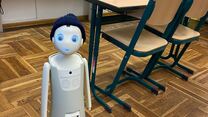
Foto: Hermann Diebel-Fischer
A Robot as Explanator, Storyteller, and King David
The 72-cm-tall robot Navel, whose responses are generated by a language model configured for religious education, accompanied a six-hour lesson series titled “How Can I Talk to God?” at the Evangelical Gymnasium Siegen-Weidenau and the Evangelical Kreuzgymnasium Dresden—serving as an explainer, a writing aid for formulating their own prayers, a storyteller, and King David. Fifty children participated; the study analyzed approximately 13 hours of classroom video, interviews with teachers, eleven focus groups, and pre- and post-questionnaires.
Trust in Knowledge, Not in Relationship
The children consistently accepted Navel as a learning aid; about 80 percent would use him again. However, their trust is clearly based on competence: The robot is “like an encyclopedia” that retrieves knowledge and explains it in an understandable way. Listening, a sense of security, and comfort, on the other hand, remain the preserve of God and the teacher. Navel can recite a prayer, but cannot “mean” it—“he doesn’t have real feelings,” as one child put it. The children make this distinction on their own, without naive anthropomorphism, but with palpable ambivalence: “weird” is the most common word in the data, usually alongside “cool.”
Relief for the teacher—with a clear boundary
Teachers delegate knowledge-transfer and organizational tasks to the robot, freeing up time for relationship-building; as a non-judgmental presence (“he’s not going to give me a grade”), Navel lowers the barrier for some children to express themselves. What remains non-delegable is the very essence of religious education—bearing witness, speaking about one’s own faith practices: “That’s what’s human. We don’t need a robot for that.” At the same time, the children perceive Navel as neutral, even though a design authority beyond their reach determines what he is allowed to say about God—even when they know he is “programmed.” This effect of neutrality points to questions of power that are fundamental to religious education involving AI.
The value lies less in what the robot can do than in what it cannot do: it is precisely here that the children articulate what distinguishes humans—and God—from a seemingly omniscient machine. An overview was published in the Katechetische Blätter (151 [2026] 1, pp. 58–61); additional journal articles are currently under review or in preparation. Presentations on the project took place in Lund (October 2025) and at the European Academy of Religion in Rome (July 2026).
