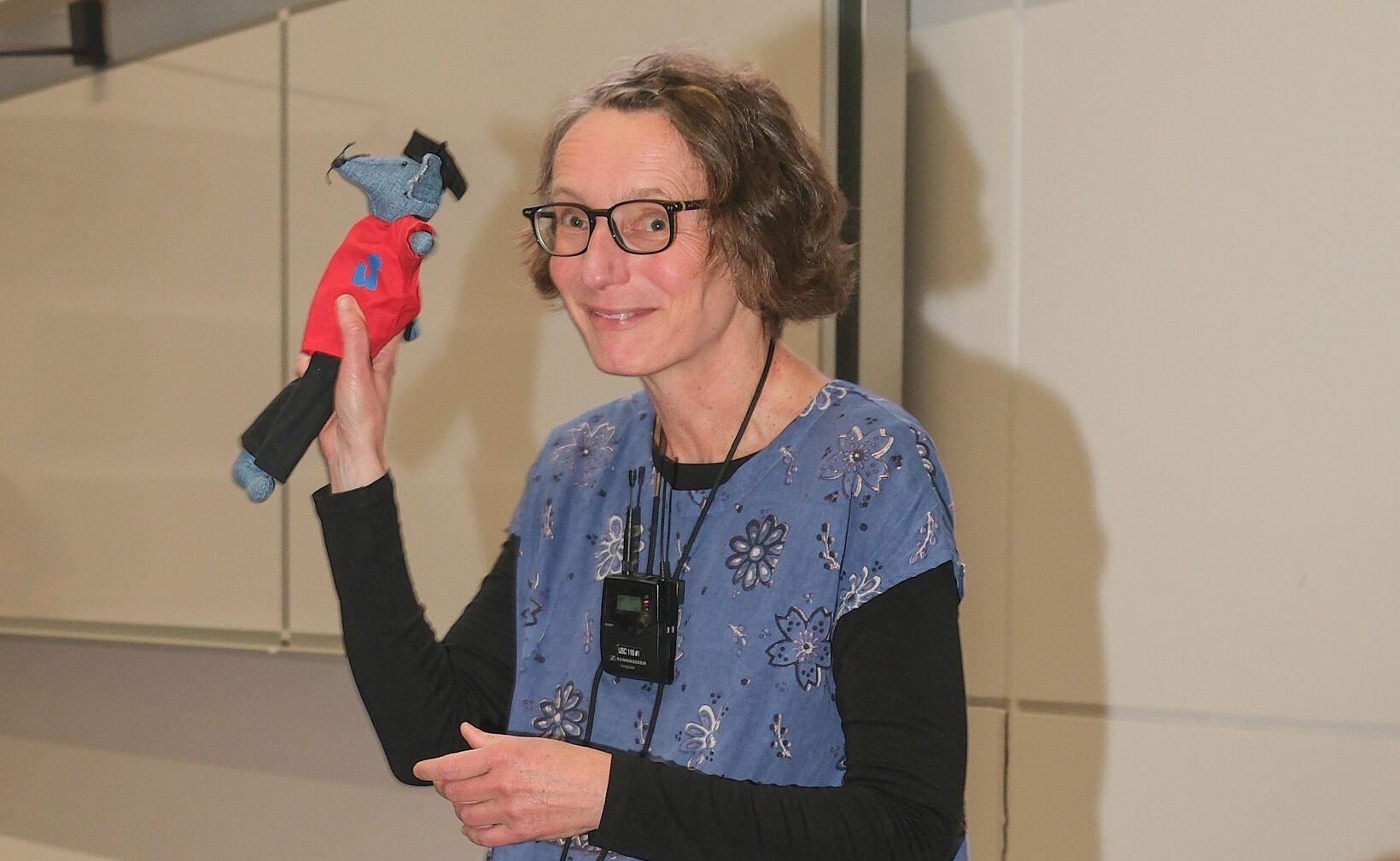
Folk tales have a long tradition of being passed down orally

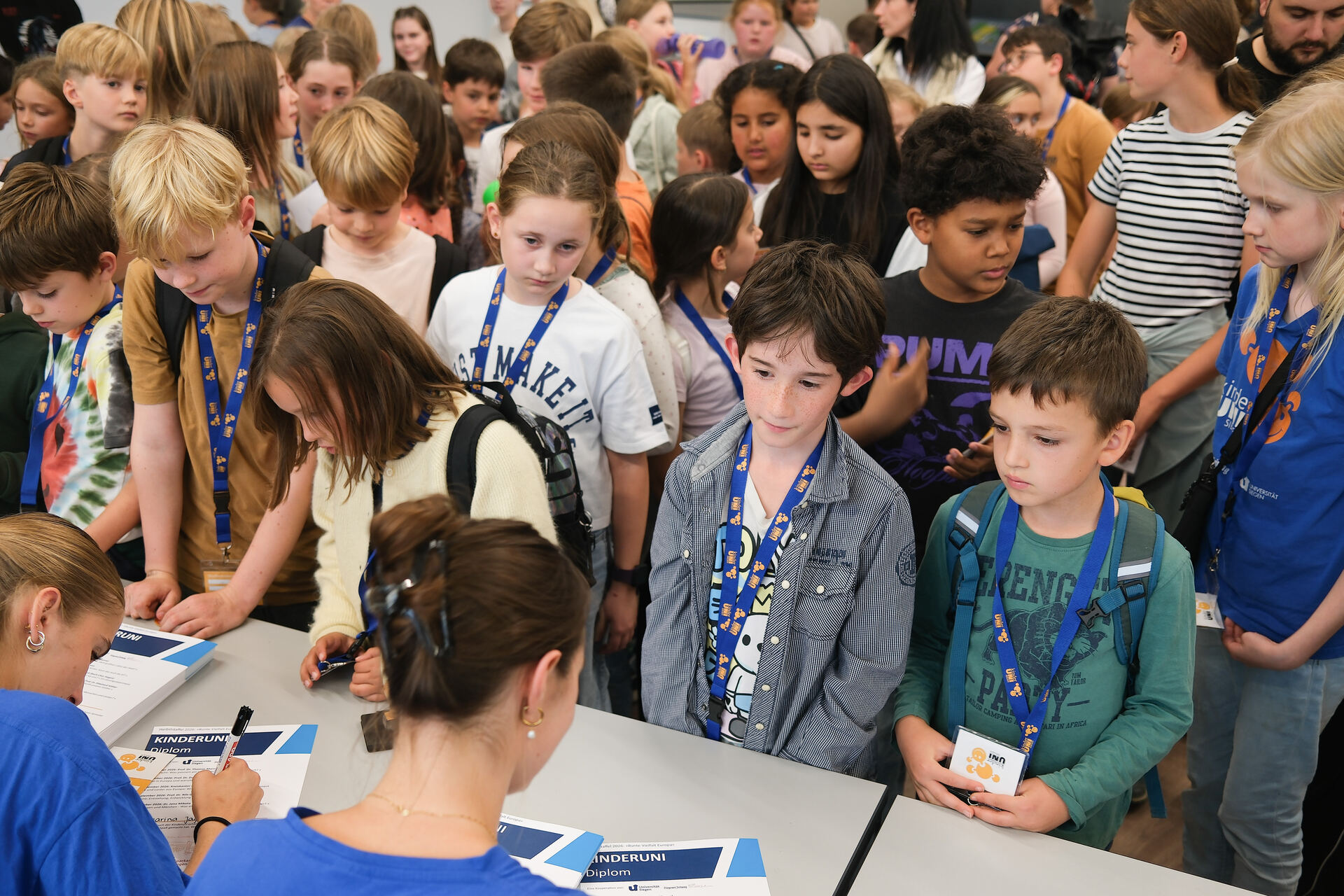
To wrap up the "Colorful Diversity of Europe" Children's University series, participants received coloring pages on the theme of fairy tales as well as the coveted Children's University diplomas.
Once upon a time… Who isn’t familiar with this opening line of a fairy tale? Literary scholars like Dr. Jana Mikota know at a glance: this is a folk tale. The author is often unknown, and the stories have been passed down over many years. The story takes place in an unspecified location—a castle, a village… The characters often include kings, their youngest daughters, or witches. There are talking animals and wizards. The protagonists must pass trials and complete tasks. For young listeners in our part of the world, one thing is very important: fairy tales usually have a happy ending. The framework for so-called literary fairy tales is different. As a rule, the author is known. The setting and time period are specific, the scenes and plots are original, the language is artistic, and the worldview is complex. There is usually no happy ending.
Fairy tales were the focus of the fifth and final Children’s University event on the topic “Colorful Diversity in Europe.” Jana Mikota, a literary scholar and expert in children’s and young adult literature, guided the 8- to 12-year-olds through the world of European fairy tales. The journey began in Norway with the fairy tale “The Kitten on Dovre.” The children learned that, according to ancient tales, trolls visit homes in Norway during the pre-Christmas season and expect to be fed. Halvor and his bear—whom the trolls mistake for a big kitten—manage to drive the trolls away for good. The children got a taste of what Norwegian sounds like in a short film clip from the fairy tale.
The journey continued to the Czech Republic, the lecturer’s childhood home. The fairy tale of Silly Honza shows that in the Czech Republic, even in fairy tales, it’s impossible for the king to give his daughter in marriage to a peasant. Honza, who wins a verbal contest against the king, receives a lot of money but not the princess.
Jana Mikota: “With Frau Holle, you could travel all over Europe.” Nearly every country has a character and a fairy tale about the origin of snow.”
The word “fairy tale” comes from the Old High German “Mär,” which means news, report, story, or rumor. “Märchen” is the diminutive form and originally meant “short story.” Later, fairy tales came to be associated with invented and untrue stories. Folk tales were collected and written down. Charles Perrault was the first to record folk tales in France in 1697. The Brothers Grimm did the same in Germany in 1812. Fairy tales such as Little Red Riding Hood, Sleeping Beauty, and Cinderella exist in both countries, though sometimes with different endings. Jana Mikota: “Perhaps the Brothers Grimm adapted these fairy tales from Perrault.” In France, Little Red Riding Hood is eaten by the wolf and dies. The fairy tale conveys the moral that girls should not let strangers speak to them. In the Brothers Grimm’s version, the grandmother and Little Red Riding Hood are rescued by the hunter. Jana Mikota: “Fairy tales can change.” In a third version of Little Red Riding Hood—a so-called fairy tale parody—Little Red Riding Hood and the wolf switch roles. The wolf bakes cakes and takes care of Grandma, while Little Red Riding Hood becomes a bandit in the forest.
The most popular fairy tale in our part of the world is “Aschenputtel” or “Cinderella.” It was written down by Jacob and Wilhelm Grimm. Both were linguists. Folk tales have a long tradition of oral transmission. The tales were collected primarily through conversations with women who passed down the stories from generation to generation.
The content of fairy tales varies across the regions of Europe. Fairy tales in Germany and France are similar. In Greece, they mostly deal with gods and heroes; in Ireland, with fairies and goblins.
A very well-known author of literary fairy tales is the Dane Hans Christian Andersen, who lived in the 19th century. He wrote the fairy tale “The Little Mermaid,” which was adapted into a film by Disney Studios under the title “The Little Mermaid.”
And because fairy tales exist everywhere and writing them requires imagination, Jana Mikota encouraged the Children’s University students to write their own fairy tales and send them to the House of Science: “Maybe we’ll end up with a collection of fairy tales by the girls and boys of the Siegen Children’s University.”
As the season came to a close, Children’s University diplomas were awarded as usual.