Made in North Rhine-Westphalia and Siegen: Green Light for a New Quantum Computer
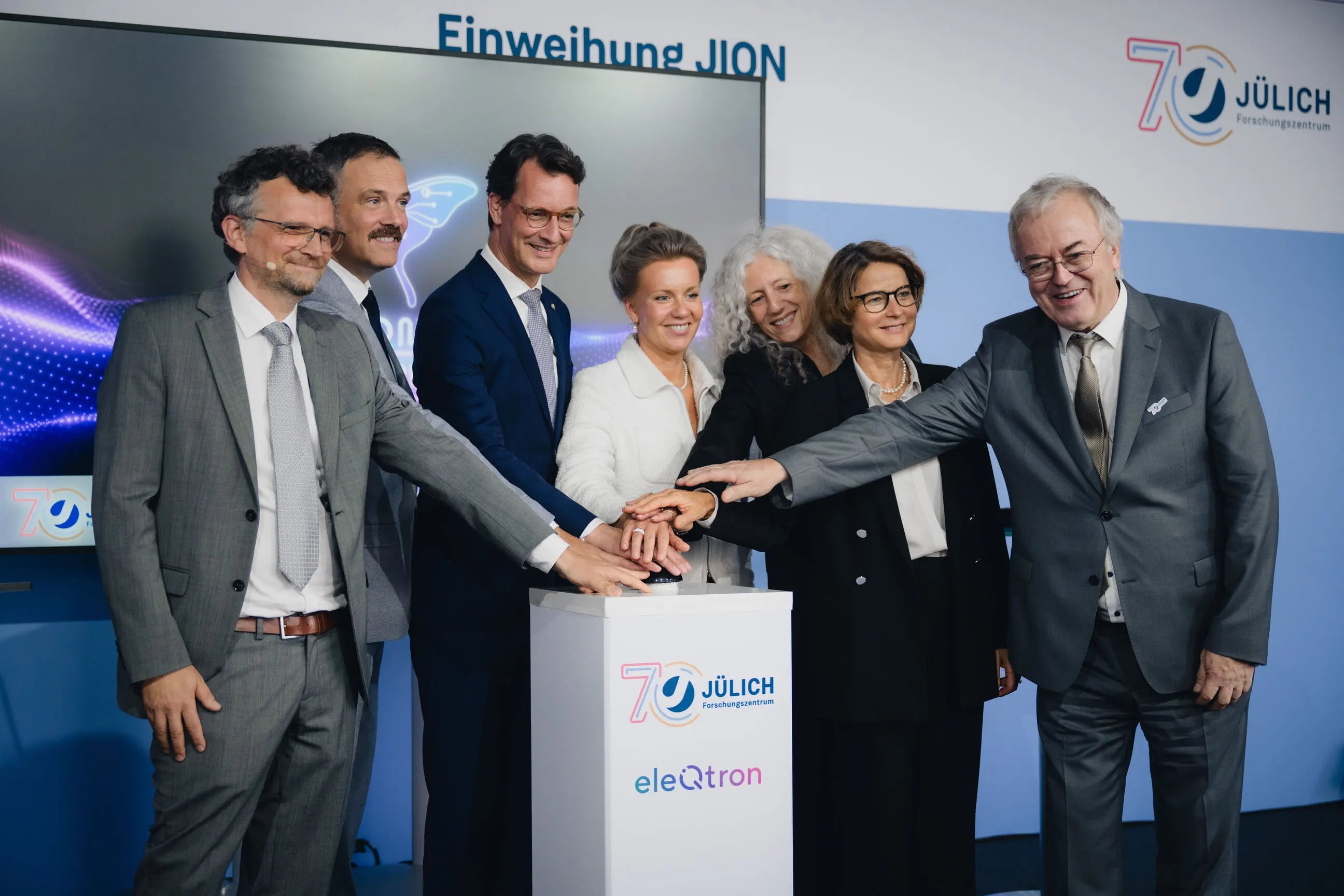
A symbolic kickoff for the new quantum computer: Dr. Michael Johanning and Dr. Jan Leisse (eleQtron), Minister President Hendrik Wüst, Minister Ina Brandes, Prof. Dr. Kristel Michielsen (Director of JSC), Prof. Dr. Astrid Lambrecht (Chair of the Executive Board of Forschungszentrum Jülich) and Prof. Dr. Dr. Thomas Lippert (Director of JSC).
A New Generation of Quantum Computers
It is a new generation of quantum computers that was developed in North Rhine-Westphalia and will deliver immense computing power here. JION stands for “Jülich trapped-ION quantum computer” and is an ion-trap quantum computer. It uses electrically charged atoms (ions) as computational units (qubits) and keeps them in a suspended state using electromagnetic fields. This makes them particularly stable and results in low error rates compared to many other quantum computer systems. Quantum computers are expected to enable, for example, more precise calculations—both for the development of new drugs or materials (such as in battery research) and for more secure encryption methods for communication—than is possible with classical computer systems.
Minister President Hendrik Wüst and Minister of Science Ina Brandes attended the grand opening at the Jülich Supercomputing Center (JSC) of Forschungszentrum Jülich on Thursday, September 3, 2026. As a symbolic part of the ceremony, a computational operation on JION was demonstrated publicly for the first time.
With its official commissioning, JION will be integrated into the “Jülich User Infrastructure for Quantum Computing” (JUNIQ) and thus become part of Forschungszentrum Jülich’s modular supercomputer architecture. Users from research and industry can access hybrid computations using Jülich’s supercomputers and specifically offload certain computational operations to quantum systems. This combination of quantum and high-performance computing (HPC) infrastructure is unique in Germany in terms of its scope and diversity. JION emerged from the “Development Partnership for Ion Trap Quantum Computers in North Rhine-Westphalia” (EPIQ) between Forschungszentrum Jülich and the Siegen-based startup eleQtron. eleQtron was founded in 2020 as a spin-off from the University of Siegen. One of the founders of Germany’s first quantum computing startup is Prof. Dr. Christof Wunderlich, who conducts research in quantum optics at the University of Siegen and remained on board as a shareholder after stepping down from eleQtron’s management. The Ministry of Culture and Science is providing approximately 21 million euros in funding for the project, which is scheduled to run for four and a half years until the end of 2027. EPIQ emerged from the North Rhine-Westphalian network “EIN Quantum NRW.”
Reactions to the Inauguration
Minister President Hendrik Wüst: “Quantum technologies offer enormous opportunities. North Rhine-Westphalia has long been leading the way. Our goal is clear: Germany is to become the world’s leading quantum hub, with North Rhine-Westphalia as a powerful driving force. We are the pioneer state in quantum technology; the first breakthroughs in quantum hardware in Germany were achieved here. The new JION quantum computer exemplifies what can be achieved when we connect our strong quantum computing startup ecosystem with our cutting-edge research. The race for technological leadership in quantum computing is still wide open on the international stage. Our state has everything it needs to be at the very forefront. To that end, we are systematically and strategically connecting science and industry in the field of quantum technologies. We want to make North Rhine-Westphalia’s quantum ecosystem irreplaceable.”

University Rector Prof. Dr. Stefanie Reese was also present at the official launch: “The fact that a quantum computer developed in Siegen is enhancing the supercomputing infrastructure in Jülich underscores our region’s tremendous innovative strength. It demonstrates how closely outstanding science and successful technology transfer are intertwined. As the University of Siegen, we are proud that a spin-off from our institution is making a significant contribution to this forward-looking field.”
Minister of Science Ina Brandes: “Fast, resource-efficient computers will be the key to innovations that make people’s lives better and safer in the future: in medicine, materials research, and cybersecurity. By connecting JION to the Forschungszentrum Jülich computing network, we are creating opportunities—unique in Germany—for science and industry to drive innovation forward more quickly. I would like to express my sincere thanks to everyone involved who made this milestone possible: the Jülich Research Center, eleQtron—the startup founded at the University of Siegen—and the ‘EIN Quantum NRW’ platform, which played a key role in the success of this project by connecting all stakeholders.”
Minister of Economic Affairs Mona Neubaur: “A strong Europe needs technological strength—and that’s exactly what we’re building here in the Rhineland mining region. Quantum technologies are among the most exciting and promising technologies of our time, as they offer enormous opportunities for fast and secure digital processes and intelligent solutions to the major challenges of our era. Here, cutting-edge technology is being advanced that benefits many companies in the chemical, pharmaceutical, and logistics sectors—and, through their products, benefits everyone.”
Chairwoman of the Board of Forschungszentrum Jülich GmbH, Prof. Dr. Astrid Lambrecht: “With JION, we are bringing together a quantum computer developed in North Rhine-Westphalia with our high-performance supercomputing infrastructure here in Jülich. This creates the conditions for the interplay between quantum and high-performance computing and enables the use of quantum computing to address specific problems in research and industry.”
Jan Henrik Leisse, co-founder and CEO of eleQtron: “With JION, we are bringing our ion trap and MAGIC technology to one of Europe’s leading user infrastructures for quantum computing. Together with the Jülich Supercomputing Center, we are creating the conditions to further develop the system, integrate it into hybrid computing architectures, and eventually make it accessible to industry and science.”
The JION ion trap quantum computer executes complex algorithms—that is, computational instructions involving large amounts of data—often more efficiently than other architectures. Superconducting systems (such as JIQCER in Jülich) behave more like sprinters. They compute extremely quickly but lose their quantum properties rapidly. In contrast, ion-trap systems are more like endurance athletes. They compute more slowly but are highly precise and perform deeply interconnected operations. To achieve this, they use natural, identical ions and, unlike superconducting systems, can be operated at room temperature. This reduces cooling costs.
JION is expected to enable new applications in science and industry, such as optimization tasks in logistics, transportation, and process engineering, as well as in physics, chemistry, biology, medicine, materials research, and machine learning. As part of EPIQ, JION will also offer services, support, and training for the scientific and industrial communities.
Funding Approval for eleQtron
At the inauguration ceremony, Minister President Hendrik Wüst presented the funding approval from the Ministry of Economic Affairs for SQALING (“Scalable Quantum Computing from NRW”). The independent development project by eleQtron GmbH is being funded by the state of North Rhine-Westphalia with up to approximately 25 million euros from EU funds under the EFRE/JTF Program NRW 2021–2027. The goal is to further develop the ion trap technology developed in Siegen into scalable, chip-based quantum computing platforms that could eventually be used in industrial applications. While JION demonstrates what has already been built, SQALING represents the next step in development. Together, both projects are intended to help strengthen technological expertise and economic value creation in Germany.
In addition, the funding approval for the new Q-STAR.NRW project was presented. The goal of Q-STAR.NRW is to procure and integrate a scalable semiconductor quantum computer into JUNIQ—to strengthen research, industrial collaborations, and structural transformation in the Rhineland mining region. The project, funded with up to approximately 35 million euros from the state of North Rhine-Westphalia and the Rhineland Mining Region’s structural development program under the Coal Regions Investment Act (InvKG), plans to integrate a system with up to 200 qubits. Like EPIQ and SQALING, Q-STAR.NRW strengthens North Rhine-Westphalia’s technological sovereignty, increases the international visibility of the Rhineland Mining Region as a high-tech hub, and contributes to a high-performing innovation ecosystem for quantum computing, which will enable long-term value creation, new industries, and sustainable employment in the region.
Background
North Rhine-Westphalia boasts a sustainable ecosystem in quantum technologies. The “EIN Quantum NRW” network has become firmly established in recent years and brings together stakeholders from academia and industry in the field of quantum technologies. Collaboration on the quantum roadmap toward making North Rhine-Westphalia a hub for quantum technology has shaped a shared vision. Thanks to its diverse expertise and broad range of stakeholders, the quantum community in North Rhine-Westphalia is successful even beyond the state’s borders. The Jülich Research Center and the startup eleQtron, together with the state network “EIN Quantum NRW,” are also committed to ensuring North Rhine-Westphalia plays a leading role within the framework of Germany’s High-Tech Agenda.