Rome Seminar 2018
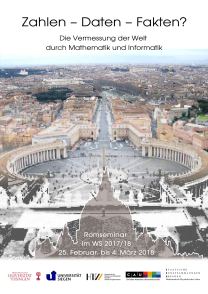
Numbers, Data, Facts?
Measuring the World Through Mathematics and Computer Science
In fact, everything that can be perceived has a number. For without it, nothing can be grasped or perceived.
- Philolaos, Diehls 32 B 4
While some professional mathematicians like to identify mathematics with set theory and praise it for its inherent “aesthetics,” “viewed from the outside,” a very different picture emerges. From that perspective, it is primarily perceived as a science of the quantitative. To put it bluntly: Mathematics is about numbers, while computer science—which, after all, once began as “scientific data processing”—is about data. While this description may be an inappropriate oversimplification, its true essence should not be denied, especially since it is precisely those aspects—the collection of data (quantification) and the manipulation of that data—that shape our lives to an ever-increasing extent. This dynamic is further fueled by the desire to counter “post-factual” arbitrariness with reliable knowledge, rock-solid insights, and objective truths. And what is more objective, truer, or more certain than a measurement manifested in a number?
Building on this observation (while also questioning it), we want to focus on mathematics and computer science—as the sciences of numbers and data—and their role in society during our field trip week in Rome. For example, we might explore the following questions:
- What exactly is a number; how has the concept of a number developed historically?
- What is a measurement in the natural sciences, but also, for example, in the field of public opinion polling? How do “data” actually come about?
- What is the relationship between quantitative and qualitative determinations?
- What influence do data and numbers have on social conditions and political decisions? To what extent is the term “Weapons of Math Destruction” (Cathy O’Neil) justified?
- What role do mathematics and computer science play in the public debate over facts?
- (How) can we distinguish between fact and fiction?
Over the course of the winter semester, we will first explore and delve into the topic through shared readings, short introductory presentations, and discussions. By mid-January, each participant should have identified their own project. This project will ultimately be presented and discussed during the field trip phase in Rome to the entire group, consisting of students from Dresden, Kiel, Siegen, and Tübingen. Through a diverse accompanying program, we’ll also draw inspiration from places in this “Eternal City” that are otherwise inaccessible.
Contact the Working Group
Postal address
University of Siegen
Department of Mathematics (Faculty IV)
Walter-Flex-Straße 3
57068 Siegen
Visitor address
University of Siegen
Department of Mathematics (Faculty IV)
Emmy Noether Campus
EN-B 222
Walter-Flex-Straße 3
57072 Siegen