History and Philosophy of Mathematics

Mathematicians need to be philosophers just as much as philosophers need to be mathematicians.
Gottfried Wilhelm Leibniz (1646–1716)
Even though the approaches of mathematics and philosophy should be strictly distinguished from one another for good reasons, there are nevertheless equally good reasons to repeatedly relate mathematics and philosophy to one another—in the spirit of Leibniz’s call. Against this backdrop, the working group focuses on new approaches and perspectives for a cultural philosophy of mathematics, in which historical and systematic approaches mutually illuminate one another.
The working group’steaching program is dedicated to integrating these disciplines of reflection into all mathematics degree programs. Notable teaching formats include the annual“Rome Seminars” and the “DerBüchergarten” series, organized in collaboration with the Philosophy Seminar.
Our Research Profile
Historical Perspective
Mathematics is a cultural endeavor of humanity whose significance can hardly be overestimated. It spans at least three millennia of (Western) intellectual and cultural history and has repeatedly marked and accompanied decisive developments. In particular, the philosophy of Plato or Aristotle, or that of Leibniz (cited above), as well as the scientific revolution associated with the names of Galileo and Newton—and thus a fundamental shift in humanity’s view of nature—cannot be adequately understood without engaging with the corresponding mathematics.
In addition to a perspective on such developments from the history of ideas and culture, the working group focuses in particular on the following authors:
- Ernst Cassirer (1874–1945)
- Immanuel Kant (1724–1804)
- Nikolaus von Kues (1401–1464)

Daniel Koenig, Gregor Nickel (eds.) Ernst Cassirer’s Theoretical Philosophy: Perspectives from the Philosophy of Mathematics and Culture.Cassirer Studies 25 2025
|

Gregor Nickel, Dieter Schönecker, Wilko Ufert (eds.) Kant on the Philosophy of Mathematics: A Selection from His Writings.2018
|
Systematic Perspective
One task of the aesthetics of mathematics is the systematic description and exploration of the beauty and artistic character repeatedly attributed to mathematics. Going beyond the static, product-oriented view that prevails in the public sphere, the perspective of the aesthetics of mathematics can highlight rarely noticed facets of mathematics and mathematical creation. The assumption of a resemblance to art provides a language for description. In this way, the perspective of mathematical aesthetics contributes to a comprehensive picture of mathematics.

Susanne Spies Aesthetic Experience of Mathematics: On the Phenomenon of Beautiful Proofs and the Mathematician as ArtistSieB - Siegen Contributions to the Philosophy and History of Mathematics (Eds. Ralf Krömer, Gregor Nickel) Vol. 2 (2013)
|
In today’s landscape of mathematics education, the topic of mathematics and education may seem somewhat outdated. After all, the attention of most people interested in the teaching and learning of mathematics is still heavily shaped by the influence of large-scale quantitative-empirical tests and rankings, as well as by discussions of (more or less convincing) applications of mathematics. Precisely for this reason, it is time to offer a counterpoint—to ask the simple question: “What exactly is mathematics, and what does it contribute to (general) education?”—and to discuss possible answers. Anyone who wishes to teach a discipline responsibly must not, in any case, shut out such questions, which are indispensable not only for a rich and appropriate presentation of the subject but also for addressing the question of the justification for teaching such a discipline at all—and in the specific topics selected.
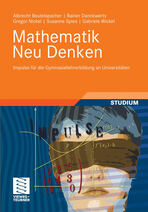
Albrecht Beutelspacher, Rainer Danckwerts, Gregor Nickel, Susanne Spies, Gabriele Wickel (eds.) Rethinking Mathematics: Impulses for High School Teacher Education at Universities2012
|
While an established and nuanced field of ethics in the sciences now drives discourse about and with the natural and engineering sciences, this discourse extends, at most, only as far as computer science in the realm of the formal sciences. Yet the attempt to establish a mutual relationship between ethics and mathematics is already evident in that both morality—and thus also its reflection in ethics—and mathematics are, to a high degree, universal means of observation. This universality gives rise to two perspectives: On the one hand, mathematics and mathematical research can be evaluated from an ethical perspective; this raises the typical questions arising from the intertwining of science and application; in this context, the discipline of mathematics, with its central role in scientific and technical culture, bears a corresponding degree of responsibility. Conversely, the guiding role of mathematics in the development of ethical theory can be analyzed; the debate over the extent to which ethical discourse should be guided by the methods of mathematics (and mathematicians) has accompanied and shaped the entire history of Western thought.
|
|
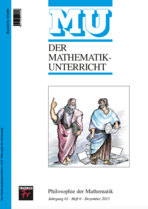
Gregor Nickel (ed.) MU | Mathematics Instruction: Contributions to Its Content and Pedagogical Design. Special Focus: Philosophy of Mathematics Volume 61, Issue 6 (2015) |