Rome Seminar 2025
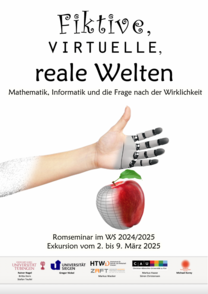
Fictional, Virtual, and Real Worlds:
Mathematics, Computer Science, and the Question of Reality.
Insofar as mathematical propositions refer to reality, they are not certain; and insofar as they are certain, they do not refer to reality.
- Albert Einstein (1879–1955)
Mathematics models reality; computer science simulates it. However, both disciplines also create their own worlds, and the more realistic these worlds aim to be, the more artificial (but also: artistic) they become. But are these worlds really just a neutral representation of reality—useful fictions (mathematics), well-programmed virtual reality (computer science)?
In this year’s “Rome Seminar,” we want to explore the complex interplay between reality and mathematics or computer science. The following questions can guide us in this endeavor:
- Where do mathematical objects and structures come from? Are they one—or even “true reality”—that is waiting to be discovered (Plato), are they the only language through which the physical, “real” world can be understood (Galileo, Descartes), or are they (e.g., socially) constructed fictions?
- Which reality or realities are captured by models and simulations, and which are excluded? For example, are emotions real, and what place do they hold in the worlds of mathematics and computer science?
- How far does the concept of the archetype (reality) and the image (mathematical theory, computer simulation) hold up? Is there even a (single) reality that we explore in mathematical theories or represent in virtual realities?
- Is the “modeling cycle”—widely discussed in the field of didactics—perhaps conceived a little too naively after all?
- To what extent—or up to what point—are computer simulations and the development of mathematical theories meaningful or helpful? What limits do they have, or should they have? What role do they play in social reality, and how do they influence it?
- What dangers does “virtual reality” pose? Where do we lose touch with reality, and do we sink into mindless media consumption (“digital dementia”)? How do virtual realities alter our understanding of reality?
- What reality does AI “know”? How does AI change our (lived) reality? Will the “virtual” reality ultimately become the only “real” reality?
These and other topics will be addressed in the Rome Seminar 2025, depending on the participants’ preferences. It thus offers a unique opportunity to look beyond the boundaries of one’s own field of study and discuss topics of general relevance (against the backdrop of our disciplines). In addition, however, the seminar is also about practicing presentation, rhetoric, and discussion in an academic context.
Over the course of the 2024–25 winter semester, we will first explore and develop the topic through shared reading, short introductory presentations, and discussions. By the end of December, each participant should have identified their own project. This project will ultimately be presented and discussed during our group field trip to Rome (March 2–9, 2025). Through a diverse accompanying program, we will also draw inspiration from places in the “Eternal City” that are not normally accessible to the public.
A prerequisite for the seminar is a willingness to engage deeply with the subject matter; it is suitable for students starting in their first semester.
Contact the Working Group
Postal address
University of Siegen
Department of Mathematics (Faculty IV)
Walter-Flex-Straße 3
57068 Siegen
Visitor address
University of Siegen
Department of Mathematics (Faculty IV)
Emmy Noether Campus
EN-B 222
Walter-Flex-Straße 3
57072 Siegen