Skip to main content

Didactics of the social sciences

Seminar for Social Sciences

We are located in the social sciences and cover the subjects of sociology and political science with intersections to the educational sciences. Our central subject is political education in and out of school. In our work, we deal with fundamental questions, such as the tasks, forms and functions of political education in different social spaces. We regularly present our research approaches and results to the public in order to make them open to discussion. We see ourselves as an actor who actively shapes civic education and the understanding of it; as an active part of the academic, practice-oriented and political-social discourse on civic education.

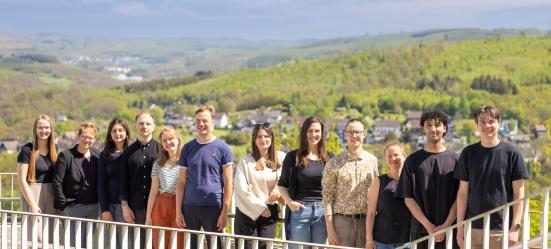
Team Didaktik der Sozialwissenschaften

News from the professorship

No news updates at the moment.

Dates of the professorship

Kolloquium Symbolbild

Colloquium of the Department of Didactics of Social Sciences

The colloquium Didactics of Social Sciences is an exchange format in which student papers, doctoral projects, research projects and texts from the field of civic education are discussed. We see the colloquium as a place for collegial consultation and discussion of work and projects relating to civic education in schools and extracurricular activities in the broadest sense. All interested parties are invited to participate at any time and present their own work and projects.

Research profile

Thematically, in terms of content and professional theory, the department is located at the interface between civic education in and out of school (in particular with intersections to political youth education and youth work).

This is reflected in our research projects, publications and courses. In our research, we analyze concepts of civic education as well as the history of the profession. We do not see either as static, but as contested and historical. The concepts are also closely linked to related educational approaches, such as democracy education/pedagogy, education for sustainable development, global learning, etc. Determining these relationships is a central part of our work.

The aim of our work is to critically reconstruct and work on these (educationally determined) concepts. Our research aims to further develop concepts in the sense of critical political education. These are transferred into practice through the development of didactic materials, among other things.

In terms of content, the research area is located in sociological and critical political education. The integrative understanding of social sciences that this expresses is a specific feature of teacher training in Siegen. Our research and courses reflect this understanding as well as the focus on issues critical of power and discrimination or similar issues.
Main areas of research

  • Concepts and conceptions of the didactics of social sciences
  • Cooperation between civic education in schools and youth work
  • Democracy education and civic education
  • Education for sustainable development and civic education
  • History of political education from a genealogical perspective
  • Theories of democracy, social theories, educational theories, diagnoses of the times and their relationship to civic education
  • Popular phenomena as subject matter
  • Reconstruction of ideas of students and teachers in the context of civic education
  • Textbook research
  • Qualitative methods and political education


Book
2026

Demokratiebildung und politische Bildung

Book
2025

Der Mythos 'Neutralität' in Schule, politischer Bildung und Lehrer*innenhandeln

Book
2024

Politische Bildung in Handlungsfeldern der Jugendarbeit

Current projects

HofBelke
-

Multi-perspective sustainability in science lessons

The project "On the teaching and appropriation of systemic sustainability contexts between social and natural science perspectives in childhood" is an interdisciplinary collaboration between Prof. Dr. Alexander Wohnig (didactics of social sciences), Prof. Dr. Jochen Lange (educational science with a focus on didactics of subject teaching), Manuela Siewert (teacher for special tasks in the primary school pedagogy working group) and myself (didactics of social sciences, political sustainability education).

The aim of the project is to take a multi-perspective view of sustainability issues, which is closely linked to both general knowledge teaching and the educational approach of Education for Sustainable Development (ESD). To date, however, educational practice has mainly focused on biological and physical topics, which is why ESD practice - both in elementary school and beyond - has often been criticized as apolitical in recent years. In contrast, political, social and sociological dimensions as well as corresponding contexts tend to remain marginally integrated. The role of human practices, socio-cultural processes, lifestyles, norms and values in shaping a (non-)sustainable present and future is also often insufficiently considered.

This is where the project comes in, with the aim of identifying starting points for social science learning processes based on current practice. To this end, we are working with practice-based case vignettes as well as starting points, challenges and potential for reflection using the example of dilemma stories. On this basis, we develop OER educational materials, which are then tested and reflected on in practice.

In the project, I am responsible for project coordination, for the regular, ethnographically accompanied exchange with educational practice and for the development of OER materials, which are designed from practice for practice.

-

Between professional autonomy and state appropriation: A genealogy of the relationship between democracy, governance and political education in the history of the Federal Republic of Germany

Team Didactics of Social Sciences

Teamfoto Didaktik der Sozialwissenschaften

From left to right: Maria Thielmann, Sylvia Seibert, Lina Hachi, Steffen Pelzel, Hanna Butterer, Prof. Dr. Alexander Wohnig, Dana Grebner, Julia Steuber, Max Barnewitz, Georgia Vassiliadou, Yamma Bahser, Jan-Niklas Kellermann. Max Meyer is missing.

Contact us

[Optional section: Further sections as required]