SieB - Siegen Contributions to the History and Philosophy of Mathematics
The Siegen Papers provide a forum for discourse in the fields of the philosophy and history of mathematics. The focus is on the following topics:
- The philosophy and history of mathematics should stimulate each other in a mutually fruitful way.
- The role of mathematics in the history of science, as well as its social role and historical context, should be examined.
- A specific aspect concerns the (school-based) teaching and learning of mathematics and how these have changed over time.

The Current SieB
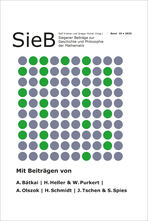
Ralf Krömer, Gregor Nickel (eds.) SieB - Siegen Contributions to the History and Philosophy of MathematicsVol. 19 (2025)
The essays collected in this nineteenth volume of SieB document the diversity of topics, perspectives, and methods related to the overarching theme of the history and philosophy of mathematics —a focus that has already been a hallmark of the series in previous volumes.
|
Publish in SieB
Formal Information:
- The journal is published once a year (in the fall);
- articles are not peer-reviewed, so publication can take place relatively quickly;
- Languages of publication are German (preferred), English, French, and Italian;
- The Siegener Beiträge is designed as a preprint series; all publication rights remain with the respective author.
Publisher’s Website
It is also possible to publish shorter monographs as special issues of the series.
Templates
Authors who wish to submit texts should use one of the following templates, depending on the format:
This makes it easier for us to convert the text into the journal’s LaTeX format. Please direct any questions regarding the template to Hannes Wagener, hannes.wagener(at)uni-wuppertal.de.
- nickel(at)mathematik.uni-siegen.de
- rkroemer (at) uni-wuppertal.de
Articles
- András Bátkai: On Nothing.
- Henning Heller & Walter Purkert:“ ” On the 200th Birthday of the Mathematics Teacher Julius Toeplitz.
- Alfred Olszok: “The Untraveled Journey from Alpha Graphs to Linear Notation.”
- Hannes Schmidt: Dürer Is Right After All. On Geometric Constructions in the “Four Books on Human Proportion.”
- Julia Tschen & Susanne Spies: Students’ Aesthetic Judgments of Mathematics—Results of a Qualitative Study.
Articles
- Roman Büchi: On Proof, Truth, and Certainty in Mathematics.
- Oliver Ebbers: The Mathematical Life’s Work of Ghiyath ad-Din Jamshid bin Mas’ud bin Muhammad al-Kashi.
- Susanne Spies: Intuition as a Guiding Principle in Arithmetic Instruction According to Pestalozzi and Diesterweg.
- Karin Richter and Toni Reimers: A Contribution on the Unpublished Cantor Correspondence in Halle.
- Julia Franke-Reddig: Bernard Bolzano in the Context of Heinrich Scholz’s History of Logic.
- Niko Strobach: Heinrich Scholz on the Death of Felix Hausdorff.
Articles
- Michael Herrmann: The Shift from Statistics to Machine Learning—A Kuhnian Paradigm Conflict?
- Henning Heske: “Structure versus Applications”—Controversial Concepts in Mathematics Education During the Nazi Era and the Case of Otto Zoll.
- Andrea Reichenberger: Elli Heesch, Heinrich Heesch, and the Tiling Problem: Collaborative Research at the Intersection of Philosophy, Mathematics, and Application.
- Toni Reimers: 18th-Century Mathematization in the First Academic Mine-Surveying Textbook.
- Renate Tobies: An Alliance Between Science, the State, and Industry—Friedrich Althoff and Felix Klein.
- Matthias Wille: The Core Thesis of the Logical Empiricists—Highly Influential Yet Unfounded.
Articles
- Stephan Berendonk: A Dialectical Path to the Sum of Cubic Numbers.
- Harald Boehme: From Theodoros to Speusippus. On the Discovery of the Incommensurable, as well as Lateral and Diagonal Numbers.
- Christian Hugo Hoffmann: The Fundamental Theorem in the *Ars conjectandi*: Interpretations of Bernoulli’s Contributions to the Beginnings of Mathematical Probability Theory.
- Daniel Koenig: Space as a Concept of Series—Ernst Cassirer’s Interpretation of the Development of Geometry in the 19th Century.
- Jens Lemanski: Schopenhauer’s Logical Diagrams in Adolph Diesterweg’s Mathematics Textbooks.
- Jasmin Özel: Diagrammatic Thinking in Euclid.
- Felicitas Pielsticker & Ingo Witzke: Devilish Prime Factorization—Fundamental Theorem of Arithmetic.
- Štefan Porubský: Stefan Schwarz and the Origins of Semigroup Theory.
- Dolf Rami: Frege on the Characteristics of Concepts.
- Renate Tobies: On the 100th Anniversary of the Ernst Abbe Memorial Prize.
Alessa Waldvogel: Duality in Functional Analysis.
Contributions
- Claus-Peter Wirth: Gisbert Hasenjaeger and a Most Interesting Unpublished Draft for Hilbert and Bernays’ “Grundlagen der Mathematik.”
- Oliver Passon and Tassilo von der Twer: Methodological Problems in Quantitative-Empirical Educational Research.
- Toni Reimers: The Roots of Mine Surveying as Reflected in Scholarly Writings: A Historical-Mathematical and Bibliographical Analysis.
- Andreas Kirchartz: “Infiniti ad finitum proportionem non esse”—The Astrological, Astronomical, and Computational Studies of Nicholas of Cusa.
- Susanne Spies: Standing on the Shoulders of Giants—“History of Mathematics” for Teacher Education Students.
- Hannes Junker: Perspectives on Geometry—Three-Dimensional Models in the Research of Julius Plücker and Felix Klein.
- Henning Heske: Chaos and Fractals—The Rise and Fall of an Innovative Topic Area for Mathematics Education.
Contributions
- Thomas Bedürftig: Infinitesimals, Limits, and Back Again.
- Stephan Berendonk: Two Stories of Discovery—Between Theory and Empiricism.
- Rosmarie Junker/Susanne Spies: “Dear Mr. Bernoulli…” A Digital Project on Source Analysis in Calculus Classes.
- Edward Kanterian: Kant’s Conception of Mathematics as the Ideal of Philosophy and the Problem of Meaning.
- Martin Mattheis: How the Concept of a Function Made Its Way into Schools.
- Gregor Nickel: Numbers During the Pandemic—An Attempt.
- Andrea Reichenberger: Two Discoveries Regarding Henri Poincaré.
- Toni Reimers: The Contribution of the Wittenberg Mathematician Johann Friedrich Weidler to the Conceptual Development of Applied Mathematics.
- Moritz Vogel: Plato’s Test—The Synopsis of Mathematical Sciences as a Medium for Platonic Philosophy of Ideas.
- Matthias Wille: Before Fraenkel: Set Theory in Marburg, 1904–1911.
- Matthias Wille: “Wanted: Russell and Whitehead.” An ad by Rudolf Carnap.
S. Confalonieri, P.-M. Schmidt, K. Volkert (eds.): The Correspondence of Wilhelm Fiedler with Alfred Clebsch, Felix Klein, and Italian Mathematicians.
Articles
- Gottfried Gabriel & Sven Schlotter: Frege’s Philosophy of Mathematics in the Context of Neo-Kantianism.
- Kay Herrmann: Leonard Nelson: Mathematical Knowledge as a Synthetic A Priori.
- Daniel Koenig: Ernst Cassirer and Mathematical Space—From the Problem of Knowledge to the Problem of Symbols.
- Thomas Mormann: The Philosophy of Mathematical Science in Marburg Neo-Kantianism.
- Matthias Neuber: Cassirer, the Foundational Controversy, and the “Ideal Elements” of Mathematics.
- Shafie Shokrani: The Philosophy of Mathematics and Leonard Nelson’s Socratic Method—An Overview.
- Merlin Carl & Eva-Maria Engelen: Some Remarks by Kurt Gödel on Set Theory.
- Gregor Nickel: Nec finitum – nec infinitum. Reflections on the Role of Mathematics in the Cosmology of Nicholas of Cusa.
- Christian Thiel: Heinrich Behmann’s Contribution to the Foundational Debate.
This volume is the result of the conference “Mathematics in the Tradition of Neo-Kantianism.”
Contributions
- Edward Kanterian: What Is in a Definition? Understanding Frege’s Account.
- Karl Kuhlemann: On the Technique of Infinite Enlargement and Its Mathematical Justification.
- Karl Kuhlemann: On the Axiomatization of the Real Numbers.
- Andrea Reichenberger: Walther Brand and Marie Deutschbein’s “Introduction to the Philosophical Foundations of Mathematics” (1929): A Book for Teaching Practice?
- Tilman Sauer and Gabriel Klaedtke: A Leibnizian Identity.
- Shafie Shokrani and Susanne Spies: “Feeling the Essence of Mathematics”—Socratic Discussions at the House of Mathematics in Isfahan.
- Klaus Volkert: Mathematical Models and the Polytechnic Tradition.
- Matthias Wille: “So They Must Also Be Able to Happen”: On the Philosophical Conditions of Meaning in Deontological Modeling.
Tanja Hamann: “Set Theory” in Elementary Education. A Historical Account of a Failed Educational Reform in the Federal Republic of Germany.
Contributions
- Thomas Gruber: Caught Between Military Applications and Scientific Responsibility? On the Intertwining of Mathematical Research in Germany with Modern Warfare.
- Anna-Sophie Heinemann: “Logic is, in fact, nothing but mere formalism…” On an episode in the history of the term “formal logic.”
- Edward Kanterian: The Idea of a Mathematical Philosophy: From Descartes to Functional Semantics.
- Daniel Koenig: The Problem of Space and the Problem of Knowledge—Ernst Cassirer’s Reception of the Discovery of Non-Euclidean Geometries.
- Martin Rathgeb: Lewis Carroll, the Tortoise, and Achilles—Part II. An Infinite Logical Discourse on Three Pages.
- Andreas Vohns: Do Math Teachers Need Education? A Question Not Entirely Unserious.
- Matthias Wille: “A Labor of Love”—From the History of the Editions of the Conceptual Notation (1952–2017).
Contributions
- Karl Kuhlemann: Non-standard elements in elementary analysis—toad or frog king?
- Nikolay Milkov: The 1900 Turn in Bertrand Russell’s Logic, the Emergence of His Paradox, and the Way Out
- Gregor Nickel: Don’t Just Reach for the Ripe Fruit…—The History of Mathematics in School Education.
- Martin Rathgeb: Lewis Carroll, the Tortoise, and Achilles. An Infinite Logical Discourse on Three Pages.
- Laura Schulte: A Cross-Sectional Analysis of the Role of the History of Mathematics in Current School Textbooks.
- Harald Schwaetzer: Mathematics and Anthropology at the End of Days.
- Christian Thiel: Oskar Becker and the Pyramids.
- Matthias Wille: The Man Who Did More Than Just Publish the “Begriffsschrift.”
Martin Rathgeb: George Spencer Brown’s “Laws of Form” Between Mathematics and Philosophy. Content—Genesis—Validity.
Contributions
- Thomas Bedürftig: What Is a Point?—A Journey Through History.
- Alessa Binder: Lorentz’s Operativism and the Real Numbers.
- Martin Janßen: David Hilbert and the Genetics of Drosophila.
- Elisabeth Pernkopf: Diabolical Number Talk and the Language of Mathematics.
- Matthias Wille: “Largely Unknown”—How Gottlob Frege Achieved Posthumous World Fame.
Contributions
- Peter Ullrich: Some Remarks on the Development of Calculus Instruction Up to the Mid-20th Century.
- Nicola Oswald: David Hilbert, a Student of Adolf Hurwitz?
- Tanja Hamann: “New Mathematics” as Exemplified by the Alef Program in Comparison to Kühnel’s “New Structure of Arithmetic Instruction”—A Didactic Revolution?
- Sebastian Schorcht: Training Teachers to Use Sources on the History of Mathematics in the Classroom.
- Elena Ficara: Hegel on the Mathematical Infinite.
- Tim Räz and Tilman Sauer: A Cycle Model of the Application of Mathematics.
- Gregor Nickel: Financial Mathematics—Principles and Foundations? An Obituary for an Interjection.
Henrike Allmendinger: Felix Klein’s *Elementary Mathematics from a Higher Point of View*. An Analysis from a Historical and Mathematics Education Perspective.
Susanne Spies: Aesthetic Experience in Mathematics. On the Phenomenon of Beautiful Proofs and the Mathematician as Artist.
Contributions
- Gregor Nickel: Contradictions and Infinity—Observations on Nicholas of Cusa and Georg Cantor.
- Ingo Witzke: The Series Representation of the Exponential Function—On Euler’s Approach to Infinite Quantities.
- Anna-Sophie Heinemann: The Calculus of Logic and the Logical Machine: George Boole and William Stanley Jevons.
- Matthias Wille: Between Algebra and the Erlangen School: Lorentz’s Contributions to Proof Theory.
- Philip-Emanuel Karschuck: The Implementation of Computer Technology at the Jülich Nuclear Research Facility and the “Supercomputing” Project.
- Ralf Krömer & David Corfield: The Duality of Space and Function, and Category-Theoretic Dualities.