Course Content
Examination Regulations 2021
The field of computer science encompasses the research, development, operation, and maintenance of complex information-processing systems. Demand for computer science graduates in the labor market remains consistently high. The master’s program provides specialized expertise in key areas of computer science, including theoretical foundations, practical skills, and knowledge of application areas. As part of elective study tracks in embedded systems and visual computing, students gain in-depth knowledge and can choose from a wide range of modules. In addition, students acquire non-technical skills ranging from presentation techniques and teamwork to management and leadership skills.
Graduates of the computer science program at the University of Siegen are well-positioned for careers in industry and academia. The University of Siegen benefits from close collaboration with local industry as well as leading German and international companies (e.g., automotive, avionics, semiconductors, factory automation, and sensor technology). The University of Siegen participates in numerous international and national research projects, collaborating with other universities and research organizations. The master’s program in computer science at the University of Siegen includes various types of modules.
Core modules cover a broad spectrum of topics relevant to computer science, including theoretical, practical, and technical aspects. Practical modules teach basic practical skills, such as software and hardware development, as well as hands-on activities closely aligned with future professional fields. These practical modules build key competencies required for teamwork on typical projects in the information technology industry.
Specialized modules provide in-depth scientific knowledge in the areas of embedded systems or visual computing. Students can select specialized modules from a comprehensive catalog of options. These modules build upon the core modules and focus on expertise in a specific area that typically serves as the foundation for student projects and the master’s thesis.
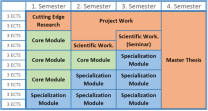
Grades and credit points are based on the European Credit Transfer System (ECTS)
Please find the 2021 Examination Regulations with the Module Manual here
Main Structure of the Master’s Program in Computer Science
- The Master’s program in Computer Science is a 2-year (four-semester) program worth 120 ECTS credit points (CP).
- The overall structure of the Master’s program comprises the following components:
- Core Courses (total: 24 ECTS): Students must select 4 courses out of 10 (6 ECTS each).
- Specialization Courses (total: 36 ECTS): These courses are related to one of the focal areas, namely Embedded Systems or Visual Computing.
- Cutting-Edge Research (6 ECTS): Insight into research projects conducted by the Computer Science department at the University of Siegen
- Scientific Work (Seminar) (3+6 ECTS): Includes the following interrelated activities:
- learning how to conduct scientific work;
- giving a presentation on a specified topic;
- preparing a written report on the content of the presentation;
- participating in all seminar presentations and in discussions about the presentations.
- Project Group (15 ECTS): A project group is designed to teach typical working methods for managing larger-scale projects. It prepares students for future professional practice and covers aspects such as division of labor, subject-specific knowledge, and teamwork.
- Master’s Thesis (30 ECTS): The thesis is intended to demonstrate that the candidate is capable of independently working on a scientific problem in accordance with scientific methods within a specified time frame.
Core Courses
The following courses are offered, from which 4 must be selected (6 ECTS each, for a total of 24 ECTS).
- Bilingual courses:
- Algorithms I
- Computer Architecture II
- Modeling and Animation
- Embedded Systems
- Parallel Computing
- Advanced Logic
- Knowledge-Based Systems and Cognitive Science
- In addition, the following (optional) German courses are offered:
- Computer Networks II
- Database Systems II
- Software Engineering II
Specialization Courses: Embedded Systems (ES)
From the module list, students must select courses totaling 24 ECTS. Additionally, two further modules totaling 12 LP must be selected from the module lists “Embedded Systems,” “Visual Computing,” “Complex and Intelligent Systems,” or “Medical Informatics.” Each course is worth 6 ECTS. The following list is an example of available courses for the "Embedded Systems" focus area. The complete list can be found here (Computer Science study regulations) (unofficial English version).
- Structure and Interconnection Technology (German)
- Communication and Information Security II
- Communication Engineering I
- Development of Embedded Systems with FPGA
- Digital IC Design
- Estimation Theory / Compressed Sensing
- Industrial Communication
- Microsystems Fabrication & Testing
- Operations Research
- Process Automation (German)
- Reliability of Technical Systems
- Statistical Learning Theory
- Stochastic Models
- Storage Technologies
- Telematics - Multimedia
- Telematics - Technologies and Applications
- Practical Training in Ubiquitous Systems
Specialization Courses: Focus Area Visual Computing (VC)
From the module list, students must select courses totaling 24 ECTS. Additionally, two further modules totaling 12 LP must be selected from the module lists “Embedded Systems,” “Visual Computing,” “Complex and Intelligent Systems,” or “Medical Informatics.” Each course is worth 6 ECTS. The following list provides examples of available courses for the “Visual Computing” focus area. The complete list can be found here (Computer Science Study Regulations) (unofficial English version).
- Required courses:
- Modeling and Animation (core module)
- Optional courses
- Rendering
- Convex Optimization for Computer Vision
- Deep Learning
- Distributed Systems
- Machine Vision
- Numerical Methods for Visual Computing
- Practical Training in Computer Graphics
- Recent Advances in Machine Learning
- Scientific Visualization
- Statistical Learning Theory
- Ubiquitous Computing
- Ubiquitous Systems
- Virtual Reality
- Higher-Level Computer Vision
- Unsupervised Learning
Specialization Courses: Complex and Intelligent Software Systems (CISS)
TBA
Specialization Courses: Focus Areas "Complex and Intelligent Software Systems" and "Medical Informatics"
Computer science students specializing in visual computing and embedded systems may select up to two modules (12 ECTS) from the "Complex and Intelligent Software Systems" or "Medical Informatics" focus areas. Examples of courses taught in English from the focus area “Complex and Intelligent Software Systems” are listed below (the complete list can be found here (Computer Science Study Regulations) (unofficial English version)).
- Complexity Theory II
- Ubiquitous Computing
- Advanced Programming in C++
- Recent Advances in Operating Systems and Distributed Systems