Master of Arts (M.A.) in Pluralist and Transformative Economics
The Master of Arts in Pluralist and Transformative Economics focuses on a central question: How can economic activity be shaped in a way that is both socially and environmentally sustainable? To answer it, we engage with the full breadth of economic thought, exploring a wide range of theories, perspectives, and schools, to understand economies in all their complexity. Students build the ability to analyze the intricate relationships between the economy, society, and the environment, and to actively contribute to the socio-ecological transformation of economic life.

Understanding and Shaping the Economy of Tomorrow
Shaping a sustainable response to climate change, advancing equality and justice at home and abroad, and turning businesses and organizations into drivers of transformation: these challenges call for new ways of thinking and acting economically.
In the Master of Arts in Pluralist and Transformative Economics, you will develop exactly these perspectives. You will learn to analyze complex economic relationships with depth and nuance, and gain the tools to actively contribute to solutions for the future. We call this Transformative Economics.
The program is grounded in Pluralist Economics. This means understanding the economy in all its diversity: from profit-oriented companies to common-good initiatives, from paid work to care work. Pluralist Economics also opens up a range of theoretical perspectives on economic relationships. Through the philosophy of science and the history of economic thought, you will reflect on how economic knowledge is produced. This is complemented by broad methodological training, from qualitative and quantitative methods to hands-on collaboration with partners in the field.
Pluralist and Transformative Economics also means understanding the present as a product of history, in two respects. In economic history, you will analyze how past transformations continue to shape the economy today. In the history of ideas, you will trace how economic thought has evolved, giving you a richer context for engaging with different theoretical traditions. Together, these perspectives help you build a solid understanding of how economic systems have developed over time, and how you can play a role in shaping them going forward.
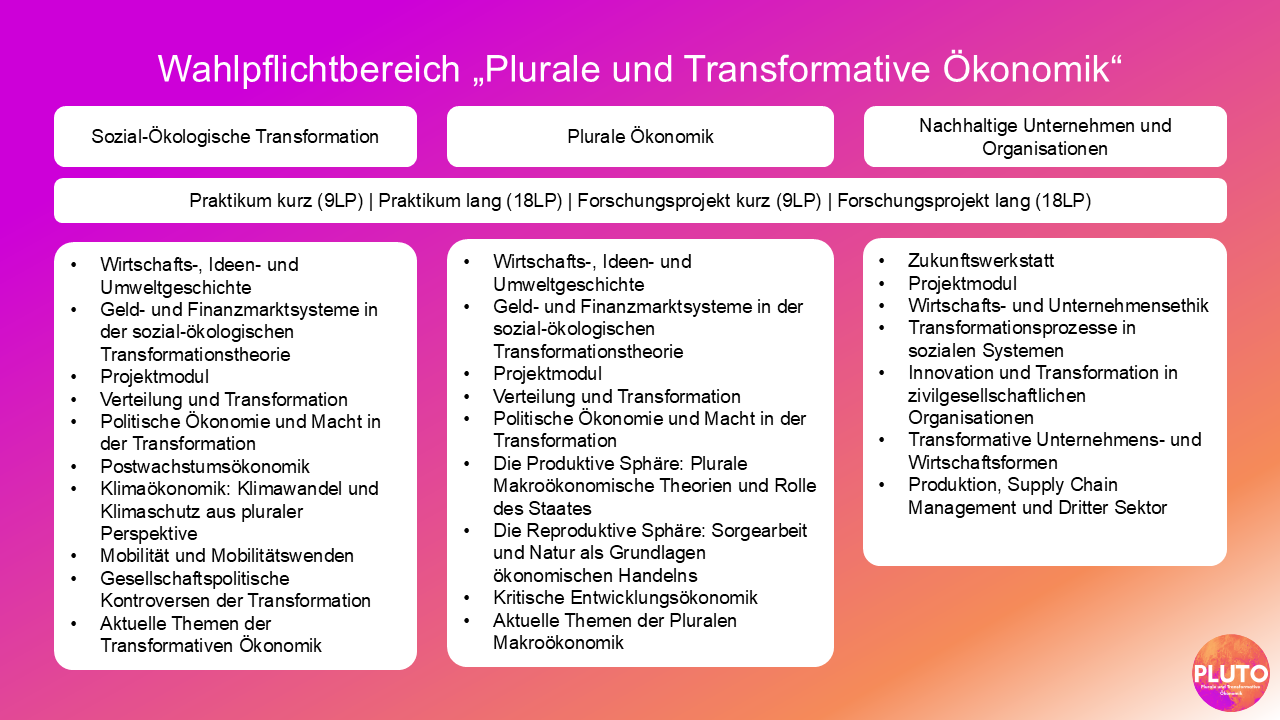
You have the opportunity to choose between three specializations, tailoring your studies to your specific interests:
(1) ‘Pluralist Economics,’ in which you develop an in-depth understanding of diverse economic perspectives;
(2) ‘Social-Ecological Transformation,’ focusing on key societal challenges and concrete solutions;
(3) ‘Sustainable Businesses and Organizations,’ where you’ll learn to actively shape change processes within organizations.
A Module Overview can be found here.
We want your studies to fit your life. Classes are held Monday through Wednesday, giving you the flexibility to balance coursework with professional and personal commitments. Beyond the classroom, you can deepen your individual focus through internships, research projects, or a semester abroad.
Quick Facts
-

Start of studies:
Summer and winter semesters -

Standard duration of study:
4 semesters -

Separate application required
Yes -

Language of instruction
German and English
Career prospects
A Master of Arts in Pluralist and Transformative Economics opens doors across a wide range of sectors. This flexible program lets you build your own academic focus through elective courses drawn from multiple disciplines and professional fields. Our graduates go on to work in nonprofits and NGOs, government ministries and agencies, social enterprises, labor unions, civil society organizations, foundations, think tanks, academic institutions, economic research institutes, management consultancies, and economic journalism.
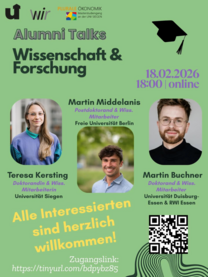
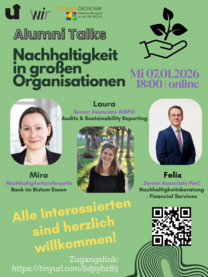
Here are some insights into the variety of career paths they pursue:
https://www.instagram.com/reel/DNNa8LNMgj4/
https://www.instagram.com/reels/DMpUg4us6sT/
https://www.instagram.com/reels/DMzxLw4sfD-/
|
|

The “Pluralist and Transformative Economics” program begins in the summer and winter semesters. Admission requires a bachelor’s degree from a university or a comparable qualification. In addition, at least 30 credit points from the bachelor’s program must have been earned in courses covering economic topics (all economics and business administration subjects, as well as relevant subjects from other disciplines, e.g., political economy, economic sociology, economic geography). Additionally, proof of English language proficiency at a minimum B2 level is required (e.g., through a high school diploma). Detailed information on application and enrollment is available here (https://www.uni-siegen.de/bewerbung).
The current examination regulations always apply.
- The examination regulations with detailed information (not yet available)
- Apply
- The program on YouTube
- The program on Instagram
-
Faculty:
- https://www.wiwi.uni-siegen.de/jpoe/
- https://www.uni-siegen.de/wir/poe/franke
- https://www.uni-siegen.de/wir/poe/lange
- https://www.wiwi.uni-siegen.de/dekanat/kontakt/paech/index.html?lang=de
Program Structure
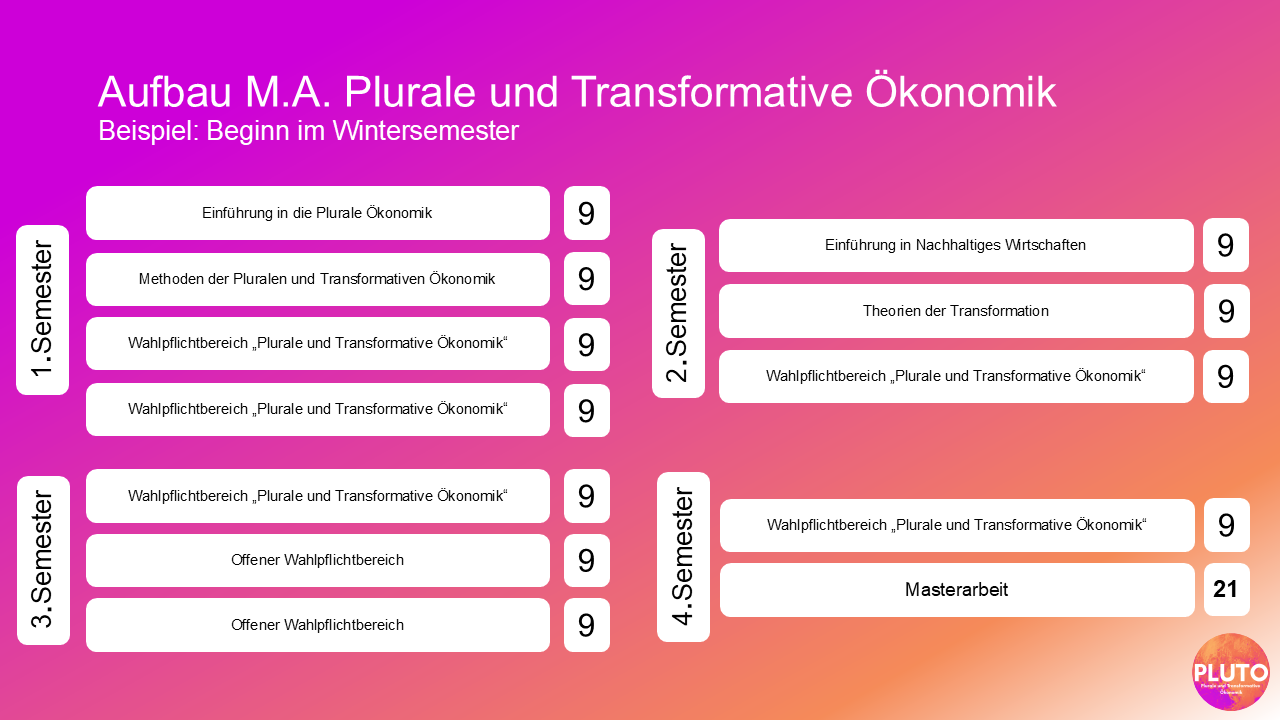
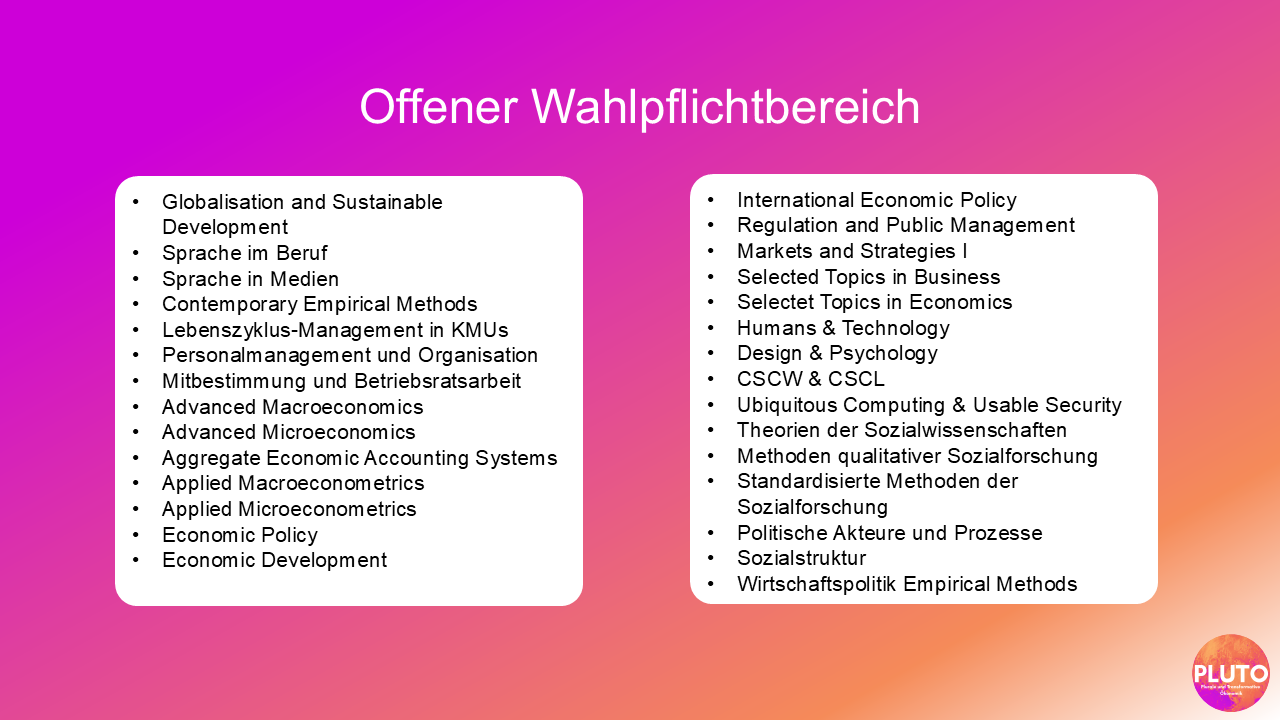
There are four required modules (two each in the first and second semesters) that all students must take. After that, students have a wide range of options, with a total of seven modules to choose from. Of these, at least five must be selected from the “Pluralist and Transformative Economics” core elective track. This area also offers the opportunity to complete an internship or research project. The remaining two modules can be chosen either from the “Open Elective” area or the “Pluralist and Transformative Economics” area.
Why choose Pluralistic and Transformative Economics at the University of Siegen?
- We take the major social and environmental challenges of our time seriously and equip you with the knowledge and skills to actively help develop sustainable solutions.
- We help you build the analytical and practical skills to understand the economy as a complex, interconnected system and to shape it in real-world contexts.
- We offer a distinctive economics program that approaches the discipline from a pluralist perspective and focuses on transformation and sustainability within an economics department.
- We introduce economic schools of thought beyond the mainstream (for example ecological economics, post-Keynesianism, ordoliberalism, behavioral economics, and economic history) and encourage you to examine them critically.
- You learn in small, supportive groups that foster close interaction and mentoring between students and faculty.
- Our graduates pursue impactful careers in non-governmental organizations, government ministries, social enterprises, labor unions, civil-society organizations, as well as academic institutions and economic research institutes.


