Computer Graphics and Multimedia Systems
The Chair of Computer Graphics and Multimedia Systems focuses on all aspects of image synthesis, ranging from the creation of 3D models of complex objects and scenes (modeling), the generation of geometric objects from abstract data fields (visualization), through the simulation of visual natural phenomena and physically based lighting calculations, to efficient image generation methods(rendering).

Current Research Topics


Polymorphic Scene Representation
We investigate real-time RGB-D mapping using multiple complementary scene representations with adaptive mapping of geometry and/or appearance. Different representations offer specific advantages, for example, in terms of stable geometry, tracking, base color, high-frequency surface details, or view-dependent appearance. The goal is to progressively combine multiple representations, each with its own local advantages, to improve the quality of photorealistic novel views and the compactness of the map without compromising the speed and robustness of classical methods.


Physics-Based Simulation
Our research focuses on the Material Point Method (MPM) as a powerful framework for continuous physical simulation. Our goal is to improve the computational efficiency of this method for large-scale simulations, extend it to a broader range of physical models and phenomena relevant to visual production, and develop novel applications in the fields of graphics and visual computing.


Dynamic 3D Scene Reconstruction and Understanding
Our research focuses on real-time 3D reconstruction and the understanding of dynamic environments from a first-person perspective. We investigate methods that combine RGB-D cameras with inertial and eye-tracking data to achieve robust camera tracking, reconstruct static and moving objects, and capture human activities and interactions. The goal is to progressively integrate this multimodal information into a consistent spatiotemporal representation to understand scenes and activities in real time.


Uncertainty-Aware Visual Analytics
We are investigating how visualization can help us understand complex and often uncertain data—not only to recognize what the data reveals, but also to determine the extent to which these findings can be trusted. Therefore, we focus on interactive applications involving uncertainty modeling, propagation, and visualization, dimensionality reduction, and parameter space analysis, in order to combine computational methods with human strengths.

Sensor Optimization via Differentiable Simulation
Our Research Profile
The Chair of Computer Graphics and Multimedia Systems at the University of Siegen conducts research on all aspects of image synthesis: from 3D modeling of complex objects and scenes, to the visualization of abstract data sets, to physically based lighting calculations and efficient rendering.
Key research areas include 3D reconstruction using time-of-flight and depth-sensing cameras, GPU-based particle and fluid simulations, scientific and medical visualization, and the analysis of multi- and hyperspectral sensor data. In addition, the group works on classic computer graphics topics such as light-field rendering, terrain rendering for GIS applications, voxelization, and virtual reality.
A detailed list of publications can be found here.
Research Focus Areas
- Sensor Optimization via Differentiable Simulation
- Polymorphic Scene Representation
- Physics-Based Simulation
- Dynamic 3D Scene Reconstruction and Understanding
-
Uncertainty-Aware Visual Analytics
Courses
|
Ba
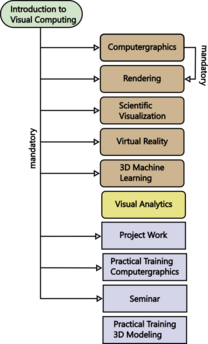
Introduction to Visual Computing 2+2 SWS, 6 LP, Winter Semester
|
- Fundamentals of computer graphics - Creating Your Own Interactive 3D Applications |
|
Ba
2+ 2 SWS, 6 LP, Summer Semester
|
- Fundamentals of Computer Graphics - Creating Your Own Interactive 3D Applications |
|
Ma (Ba)
Visual Analytics 2 + 2 SWS, 6 LP, Summer Semester
|
- Basic concepts of interactive visual data analysis - Algorithms and visualizations for tabular data and graphs |
|
Ma
2 + 1 SWS, 6 LP, Summer Semester
|
- Advanced Computer Graphics Algorithms - Photorealism and Visual Effects |
|
MA (BA)
2 + 1 SWS, 6 LP, Winter Semester
|
- Visualization of data from medicine, the natural sciences, and engineering - Interactive techniques and 3D visualizations |
|
Ma
2 + 1 SWS, 6 LP, Summer Semester
|
- Basic knowledge of human perception and virtual reality systems - Development of immersive applications in the VR lab |
|
Ma
3D Machine Learning 2 + 2 SWS, 6 LP, Winter Semester
|
- Learning on 3D representations, e.g., volumes, points, and meshes - Neural rendering and scene reconstruction, e.g., NeRF and Gaussian Splatting |
Publications
Variable layout CMOS pixels for end-to-end learning in task specific Image Sensors
Variable layout CMOS pixels for end-to-end learning in task specific Image Sensors
Lipschitz-agnostic, efficient and accurate rendering of implicit surfaces
Lipschitz-agnostic, efficient and accurate rendering of implicit surfaces
Visual sentiment analysis with semantic correlation enhancement
Visual sentiment analysis with semantic correlation enhancement
2022 IEEE Scientific Visualization Contest Winner: Multifield Analysis of Vorticity-Driven Lateral Spread in Wildfire Ensembles
2022 IEEE Scientific Visualization Contest Winner: Multifield Analysis of Vorticity-Driven Lateral Spread in Wildfire Ensembles
Hashed, binned A-buffer for real-time outlier removal and rendering of noisy point clouds
Hashed, binned A-buffer for real-time outlier removal and rendering of noisy point clouds
多尺度点云补全网络
多尺度点云补全网络
Pacemod: parametric contour-based modifications for glyph generation
Pacemod: parametric contour-based modifications for glyph generation
An active colloidal system showing parallels to a time crystal
An active colloidal system showing parallels to a time crystal
Differentiable Sensor Layouts for End-to-End Learning of Task-Specific Camera Parameters
Differentiable Sensor Layouts for End-to-End Learning of Task-Specific Camera Parameters
Progressive refinement imaging with depth-assisted disparity correction
Progressive refinement imaging with depth-assisted disparity correction
Boosting Image Emotion Analysis via Coupling Dependent Attentive Model
Boosting Image Emotion Analysis via Coupling Dependent Attentive Model
Evaluation of particle-based smoothed particle hydrodynamics boundary handling approaches in computer animation
Evaluation of particle-based smoothed particle hydrodynamics boundary handling approaches in computer animation


Contact the Working Group
Postal address
University of Siegen
School of Science and Technology
Chair of Computer Graphics and Multimedia Systems
Hölderlinstr. 3
57068 Siegen
Visitor address
University of Siegen
School of Science and Technology
Chair of Computer Graphics and Multimedia Systems
Hölderlinstr. 3
57068 Siegen
Secretariat
Please contact XY.