Nanoscience and Nanotechnology
Master of Science (M. Sc.)
The Master in Nanoscience and Nanotechnology of the University of Siegen is a two-year 120 ECTS English language degree program offered to national and international students. It focuses on modern aspects of the science and technology of nanoscopic systems, ranging from basic knowledge to applications and devices. It consists of a set of lectures, seminars and lab courses followed by a project in a research group, accomplished by a thesis.
The master is a joint initiative of the Departments of Physics, Chemistry and Electrical Engineering of the School of Sciences and Technology.
On this page you will find all the important information about your current studies.

What awaits me in the Master's program?
The master program leads to the acquisition of analytical and methodological competences in the fields of nanoscience and nanotechnology, with in-depth education and training in physics, chemistry and engineering, yet from an interdisciplinary perspective. Graduates are thus prepared for conducting research in academia and industry, but also to a career in service and consulting companies. Moreover, the master degree qualifies students for a PhD program. In particular, the interdisciplinary character of the course enables them to investigate topics at the interface of physics, chemistry and engineering.
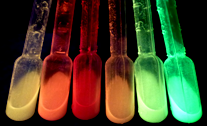
The master program is designed to bridge the Departments of Physics, Chemistry and Engineering, which together cover the entire spectrum of nanoscience and nanotechnology in Siegen. The course not only strengthens education and training in these subjects, but it also provides new opportunities for competitive research.
The aim of the course is (a) to impart current knowledge in the field of nanoscience and nanotechnology and (b) to impart the ability to successfully apply this knowledge to new problems. To this end, in-depth scientific skills are acquired, including communication skills that allow students to work independently in scientific fields beyond the traditional subject boundaries, to develop, evaluate and use new methods. The course prepares students for future tasks in the scientific and technical environment. The technical and methodological knowledge should enable them to act responsibly in their profession towards society and the environment. The training therefore combines theory-based, reflective teaching content and practice-oriented aspects. This enables them to work in an interdisciplinary, methodical manner and meets the requirement for a creative scientific qualification. The consecutive Master's degree program in Nanoscience and Nanotechnology is designed to provide a professional qualification for the career of a scientist in the field of nanoscience and nanotechnology, and basically to prepare for independent work as part of a doctorate in one of the sub-disciplines of physics, chemistry, engineering and in the fields of nanoscience and nanotechnology. The aim of this degree program is to train managers for industry, business and public authorities as well as young academics.
Possible specializations
Nanoscience and nanotechnology involve different areas of physics, chemistry and engineering. For instance, nanoscience includes chemical preparation of nano-scale compounds and their characterization by physical methods, while nanotechnology is related to devices, i.e. nano-electronics and photonic devices based on nano-scale structures. This requires a highly interdisciplinary approach, which is reflected in the research activity of the following groups at the University of Siegen.
Chemistry
The Chemistry research groups cover a broad range of activities in nanoscience and nanotechnologies, focusing on the synthesis, investigation, and application of nanomaterials.
Chemistry and Structure of Novel Materials
Electrical Engineering
The Electrical Engineering research groups are more focused on the technological aspects of nanoscience, especially on device manufacturing, physics, characterization and integration.
High-Frequency Technology and Quantum-Electronics
Analogue Circuits and Image Sensors
Physics
The research groups in Physics deal with topics ranging from solid-state physics to nanoscale optics.
Interdisciplinary Research Centres and Facilities
Centre for Sensor Systems (ZESS)
Centre for Micro- and Nanochemistry and Engineering (Cµ)
Important information regarding the examination regulations
- General examination regulations for the Master’s Degree (RPO-M) at the University of Siegen (in English)
- General examination regulations for the Master’s Degree (RPO-M) at the University of Siegen (in German)
- Specific examination regulations for the Master's Degree (FPO-M) Nanoscience and Nanotechnology (in English)
- Specific examination regulations for the Master's Degree (FPO-M) Nanoscience and Nanotechnology (in German)
- Amendments of the FPO-M of May 2024
- Amendments of the RPO-M of June 2022
- Master of Science certificate
The first examination period of the summer term 2026 begins on July, 27th and ends on August, 7th 2026.
The corresponding registration period in unisono is from July, 6th until July, 20th 2026 (11:59 p.m.).
The second examination period begins on September, 14th and ends on September, 25th 2026.
The respective registration period in unisono is from August, 24th until September, 7th 2026 (11.59 p.m.).
Registration of lab courses and courseworks (exercises, protocolls, presentations etc.) should be done through unisono before the participation / conduction.
Regular withdrawal from examinations (i.e. without a medical certificate) is possible in unisono up to 7 days before the exam. Please note that the unisono system calculates this deadline based on the actual time of the examination.
Withdrawal due to an illness should be done through per e-mail to the examination office immediately / on the day of the examination. Medical certificates must be submitted to the examination office within 3 working days after the examination.
Quicklinks
Our campus management system unisono maps your entire student life cycle from application to examination and event planning to your degree certificate:
In our learning management system Moodle you will find the documents of your lecturers.


Advice and contact
Nanoscience and Nanotechnology Master Program
Prof. Dr. Mario Agio, Spokesperson and Chair of the Examination Board
School of Science and Technology, Laboratory of Nano-Optics
Contact
Room: EN-C 112
Tel. +49 (0)271 740 3532
E-Mail: mario.agio@uni-siegen.de
Credit points, thesis registrations, etc.
Mrs. Annika Ippach, Examination Office
Contact
Room: AR-H 111
Tel: +49 (0)271 740 4114
E-Mail: pa-nanoscience@nt.uni-siegen.de
The tasks of the examination office:
-
Advice for students on examination matters
-
Exam planning
-
Applications: Recognition, compensation for disadvantages, hardship cases
-
Registration for free attempts, grade improvements, final attempts and final theses
-
Processing of withdrawals / sick notes
-
Preparation of certificates
-
Preparation of graduation documents
-
Administration of student accounts: Advice, organization and support
Сontact time
Admission, tuition, fees, living etc.
Mrs. Faria Afzal, International Student Advisor
Contact
Room: H-A 4103/1
Tel: +49 (0)271 740 4415
E-Mail: igs.advisor@nt.uni-siegen.de
