Physics
Master of Science (M. Sc.)
We offer a research-oriented master's degree program (120 ECTS) for national and international students. The duration is two years and the program language is English. The program comprises elective lectures, lab courses, and seminars in the 1st year and a research project in the 2nd year that leads to the Master's thesis. Admission is possible each year in spring and autumn.
With an outstanding student-to-staff ratio of about 300 students and 20 professors working together, the physics department in Siegen provides an inspiring and inclusive environment for in-depth learning and cutting-edge research. You can specialize in our three focus areas:
- Particle physics
- Solid state physics
- Quantum optics & quantum information
Interested? Scroll down for more information!

Physics in Siegen
Get the chance to do state-of-the-art research in our three focus areas. We have a strong track record and are part of numerous international collaborations.
Tackle the most fundamental theoretical questions about the structure of matter at the smallest distances, advance experimental methods to probe it, and expand the limits of our understanding of cosmology, especially the early stages after the Big Bang.
Highlights
- Develop detectors for the world’s largest particle accelerator at CERN, the world’s largest cosmic rays experiment in Argentina, and for medical imaging.
- Explore the fundamental nature of matter and new phenomena in strong and weak interactions, as part of the cluster of excellence "color meets flavor".
- Challenge the Standard Model of particle physics through precision calculations for experiments at the energy and intensity frontier, as part of the CRC "particle physics phenomenology after the Higgs discovery".
Research groups & collaborations
Information brochure
Explore the fascinating physical effects that dominate the nano-cosmos. Solid-state physics gives you an understanding of the world around us, from the structure of matter to the physical principles of electronic devices.
Highlights
- Prepare and characterize novel, ultrathin 2D-Materials as the ultimate limit of device miniaturization.
- Facilitate the development of new materials with cutting-edge x-ray methods at large scale x-ray facilities in Germany, Europe and the world.
Research groups & collaborations
Information brochure
Investigate the connection between quantum physics and information theory, which enables modern quantum technologies such as quantum cryptography, quantum computing, and quantum sensing. Explore the physics behind these technologies in quantum optical experiments that enable the control and manipulation of individual ions or photons.
Highlights
- Develop novel concepts and methods for quantum information processing with trapped ions, in cooperation with the local quantum industry pioneers at eleQtron GmbH and research partners worldwide.
- Develop quantum sensors and single-photon sources based color centers and optical nanostructures.
- Probe the limits of quantum theory with matter waves and macroscopic quantum effects, together with leading experimental groups in Europe.
- Understand the nature of entanglement, its role in quantum networks, and practical applications, as part of European quantum information science initiatives.
Research groups & industry partner
Information brochure
Other opportunities
Consider the Interdisciplinary study programs we offer besides the MSc in physics.
→ For research internships, please contact one of our PIs.
Curriculum
Structure & content of the MSc program
In the first year, you will choose among several elective lectures, seminars, and lab courses. This ensures a solid background in general physics and prepares you for actual research in your chosen specialization.
We mainly offer lectures focused around the topics of our research groups:
- Experimental solid state physics
- Quantum information theory and foundations of quantum mechanics
- Theoretical quantum optics and quantum thermodynamics
- Experimental quantum optics and nano-optics
- Theoretical particle physics
- Experimental particle and astroparticle physics
- Machine learning and computational methods in physics
In addition to lectures, you will take a mandatory lab course and a seminar in which you prepare a talk on a chosen research concept. Between the first and second year, you have to take an oral exam (30-45 min), covering topics from several lectures of your chosen specialization area.
In the second year, you will carry out research and write your MSc thesis as a member of one of the research groups at the physics department. The aim of the thesis is to deliver a contribution to current research in theoretical or experimental physics.
In general, a MSc degree is a precondition to enter a doctoral (PhD) program in Germany. The PhD research is performed in one of the research groups and prospective PhD students have to find a professor who is willing to supervise their work. Typically, PhD theses last 3-4 years and PhD students get financial support.
We offer several specializations that you can tailor your study plan and curriculum to. This will optimally prepare you for your MSc thesis in the respective focus area.
Particle physics
You can specialize in
- Experimental particle physics, with electives on detectors & accelerators, astroparticle physics, machine learning methods, etc.
- Theoretical particle physics, with electives on effective field theories, cosmology, flavour physics, etc.
For more details and example curricula:
Quantum optics & quantum information
You can specialize in
- Experimental quantum optics, with electives on laser spectroscopy, quantum optics, nano-optics methods, and tailored lab courses
- Nano quantum optics, with electives on nano optics, quantum optics, as well as tailored lab courses and selected modules from electrical engineering
- Quantum information theory, with electives on the quantum theory of light, quantum thermodynamics, foundations of quantum mechanics, and selected math and computer science modules
- Mathematical physics, with electives on the foundations of quantum mechanics, functional analysis, advanced algebra, quantum theory of light, etc.
For more details and example curricula:
Solid state physics
Specialize in experimental solid state physics, with electives on modern methods in x-ray science, physics of nanostructures, biological & soft matter physics, synchrotron radiation instrumentation & data analysis, as well as tailored lab courses to develop your experimental skills.
For more details and example curricula:
Admission and Application
- Bachelor of Science degree in Physics.
- Proficiency in English: TOEFL (IBT) 88, IELTS (academic) 6.0, PTE Academic 61, or level B2 of the CEFR.
You are encouraged to apply early, even if you are still in the process of completing your degree. In this case, please explain in an additional statement which courses and examinations are missing and when you expect to finish. We will then make a preliminary decision on your admission. Note that the enrollment requires a completed B.Sc. degree.
If you hold a degree in a subject closely related to physics, you are also welcome to apply. Be aware that we require knowledge in physics at a level equivalent to a BSc in physics including, for example, quantum theory. You can also demonstrate your knowledge in physics via a GRE physics test result.
If you do not yet have a certificate of English proficiency, you may still apply with a letter from your university certifying that the language of instruction was English.
As an international student applying to our MSc program in Physics, you need the following documents as PDF files. In case of admission, original documents have to be presented for the enrollment. For deciding about your application, we may invite you for an online interview.
- Short cover letter (500 words), specifying your intended field of specialization.
- Curriculum Vitae
- Certificates of all your university education
- Transcript of all your university education, providing a list of all grades
- Proof of proficiency in English (or German)
- optional: Graduate Record Examination (GRE) physics certificate
You are also asked to provide two names of professors whom we may contact for a letter of recommendation. Alternatively, you can upload letters of recommendation or ask the professors to submit their letter directly to
-

international.master@physik.uni-siegen.de
Applicants from PR China, Vietnam, and India must apply for a certificate of the Academic Evaluation Center (APS). This is not necessary for application but must be provided at the time of enrollment or already for the German student visa. Please note that it will take a few weeks before the certificate is issued.
We accept applications through our online portal unisono. New applicants must do the “Self-Registration”, before submitting their application and uploading the required documents.
Student visa applications for Germany may be subject to long waiting times in your country. If you do not require a visa and hold a degree from within the EHEA, may also use the deadline for EU citizens.
In case of questions, please contact the International Student Advisory Service below.
Deadlines
Winter term (lectures starting in October)
-
1 Jan – 30 Apr for non-EU citizens
-
1 Jan – 30 Sep for EU citizens
Summer term (lectures starting in April)
-
1 Jul – 31 Oct for non-EU citizens
-
1 Jul – 31 Mar for EU citizens
Living and Expenses
on campus and in the city of Siegen
The University of Siegen is a research university with currently about 14,000 full-time students, founded in 1972. We have a thriving community of about 2,000 international students and over 110 countries are represented in the student body.
A comprehensive program of extracurricular activities is offered by the Department of International Student Affairs. The program includes cultural nights, social meetings and trips to cities around Germany which offer great opportunities to meet other international students and experience German history and culture. German language courses are also offered.
The university provides a number of entertainment activities. Sports classes are offered at the university gym, and students are welcome to join student organizations, get involved with student-run campus and social media broadcast, or other activities such as choirs and orchestras.
|
|
|
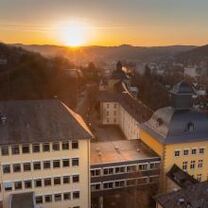
The Department of Physics is situated in the Emmy-Noether campus (ENC). Most of your lectures and study activities will take place there.
There is no tuition fee at the University of Siegen. However, there is a semester fee of approximately 373 EUR due before every semester start as part of (re-)registration. This fee includes a ticket for free regional public transport.
The estimated average costs of living are around 800-1000 EUR per month, depending on lifestyle and spending habits. They include rent, health insurance, food, clothing, learning materials, phone and internet, travel expenses, entertainment, and sports. Additional one-time expenses for residence permit and deposit amount to approximately 900 EUR.
There are several possibilities to obtain funding for studies in Germany:
- The German Academic Exchange Service (DAAD) offers various grants for very good foreign students from certain countries who want to move to Germany. Detailed information can be found in the database of the DAAD, which also contains stipends from other foundations.
- Very good master students frequently work as tutors for younger students, especially when they are doing their MSc thesis in a research group.
- Some students have side jobs to earn money. Note however that there are restrictions of maximum work days for non-EU international students. See the website of our International Office below.
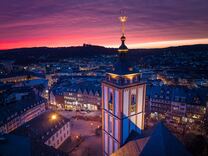
Siegen is a city of about 100,000 residents, surrounded by an idyllic, rural landscape. The local area is home to several internationally recognized industrial companies, many of which cooperate with the university in a variety of innovative projects. The nearby hills and lakes provide opportunities for all kinds of outdoor activities.
The location offers many opportunities to travel throughout Germany and Europe. Frankfurt and Cologne are reached within 1.5 hours by train. The student ticket entitles you to use local public transport and regional trains across North Rhine-Westphalia and Germany free-of-charge.
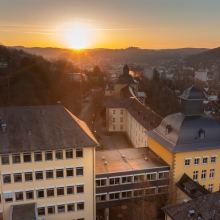
The Department of Physics is situated in the Emmy-Noether campus (ENC). Most of your lectures and study activities will take place here.
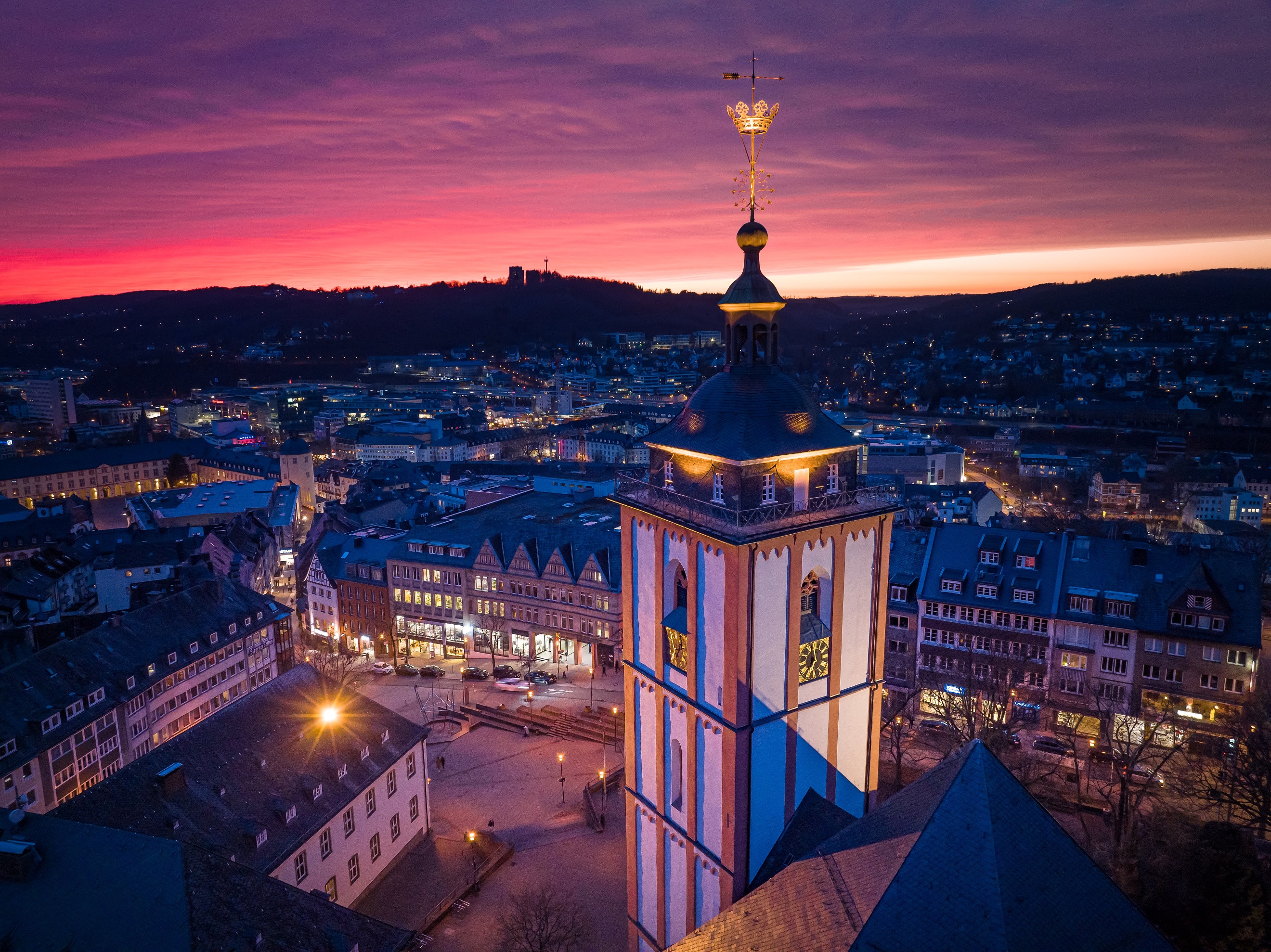
The city center of Siegen is just a 20 min. walk away.
Further information for students
Examination Office
Supports you with your study plan, rules, and examination matters. You will find important information on deadlines, forms, and procedures, as well as the official examination regulations and module handbook of the program.
Online management platforms
The unisono platform maps your entire student life cycle from application, course enrollment, examination, and your degree certificate. All lectures and courses offered within a semester, including time slots, lecture rooms, and lecturers are also listed here.On our learning platform moodle, you can access lecture and exercise materials.
Advice and contact
Our student advisory service, examination office, the department, and the student council are always available to answer questions.
International Student Advisory Service
Contact
for general administrative issues (e.g., visa and housing)
-

Faria Afzal
Advisor for international students -

Contact
for specific questions concerning admission & curriculum
-
Prof. Dr. Stefan Nimmrichter
Program coordinator for international students -
Examination Office Physics
The Examinations Office is your first point of contact for all questions relating to examinations: from registration and submission to the overview of grades. Here you will also find information on examination regulations, deadlines and final documents.


Physics student advisory service
Here you can ask your individual questions to which you cannot find answers on our department's website.
Department of Physics
In our working groups, 22 professors work together with students and scientists to research current issues from experiment and theory.
Physics student council
The Fachschaftsrat (FSR for short) is an association of students elected by the Fachschaft, which campaigns for and represents the interests of the students. The FSR Physics represents all students of the Department of Physics at the University of Siegen, including you.
