


Open Access publications are freely available to all and can be reused under clear conditions. This accelerates the communication of research results and increases the effectiveness of research and innovation. The Rectorate of the University of Siegen recommends that publishers publish in Open Access (Open Access Policy), and the University Library provides support with its services:

Open Access Publication Fund
Authors can apply for funding of up to €700 per article for publication fees for journal articles that appear directly in Open Access (Golden Road). For monographs and edited volumes resulting from a DFG project, up to €5,000 can be applied for.
The application for funding must be submitted BEFORE the invoice is received. The funding amount is then paid directly by the University Library; any costs exceeding this amount are paid by the authors from institutional funds.
Until 2019, the Open Access Publication Fund for journal articles was funded by the German Research Foundation (DFG) as part of the "Open Access Publishing" funding program. In the years 2020 - 2022, the publication fund was only financed from UB funds. For 2023 - 2025 and 2026 - 2028, the University Library was able to obtain funding from the DFG from the "Open Access Publication Costs"funding program to finance the funds.
In 2020, the University of Siegen established an open access publication fund for monographs to support open access monographs and edited volumes by authors and editors at the University of Siegen. Since 2023, this publication fund has also been financed by the DFG.
- Check funding criteria
Check whether the funding criteria for articles or monographs are fulfilled - Procurement
The commissioning and payment of OA publications is an award of a contract and the guidelines for the procurement process must be observed. Information can be found in the Procurement service portal (Department 1.3). - Indicate affiliation
Indicate the University of Siegen as affiliation in your publication, as specified in the Publication Guidelines. We recommend the use of ORCID - Submit application
Please fill out the online form BEFORE receiving the invoice: https://www.uni-siegen.de/en/ub/oa-publikationsfonds - Invoice delivery
The publisher's invoice must be sent to the university's central invoice receipt:- Email with PDF attachment: pdfRechnung@uni-siegen.de
- E-mail with xInvoice: xRechnung@uni-siegen.de.
Funded publications are secondary published on the Open Access repository OPUS Siegen:
Discounts on publication fees
The University Library has concluded agreements with various publishers, consortia and programs that offer discounts on publication fees. These range from reduced Article Processing Charges (APCs) to the central assumption of costs by the University Library. The following overview is not exhaustive. For detailed information, please contact the Open Access team: oa@ub.uni-siegen.de
Term until 2029
Central cost coverage of APCs for articles in the ACM Digital Library.
Term until 2028
Centralized reimbursement of APCs in certain hybrid journals.
Term until 2028
Centralized reimbursement of APCs in the 9 hybrid journals of the American Physical Society (APS).
Term until 2027
Central assumption of costs for APCs in hybrid and gold open access journals
Term until 2026
Central assumption of costs for APCs in 147 hybrid journals of the "Humanities and Social Sciences", elimination of embargo periods for open access publications via the green route (secondary publication) for 48 journals. 20 % discount on the APCs of Gold Open Access journals.
Term until 2028
Central assumption of costs for APCs for hybrid journals, 20 % discount on APCs for Gold Open Access journals, 15 % discount on Gold APCs for Cell Press and The Lancet journals.
Invoice processing via the University Library
The University Library handles the invoice processing for APCs in these Gold Open Access journals and grants €700 funding per article via the Open Access Publication Fund. For the remaining amount, the University Library requires your cost center and the PSP element. In this case, please be sure to contact the Open Access team: oa@ub.uni-siegen.de
Please note DEAS’s guidance on cookies on the ScienceDirect platform.
Term until 2026
10 % discount on all APCs
Invoice processing via UB
The UB handles the invoice processing for APCs in these Gold Open Access journals and grants €700 funding per article via the Open Access Publication Fund. For the remaining amount, the University Library requires your cost center and the PSP element. In this case, please be sure to contact the Open Access team: oa@ub.uni-siegen.de
Term until 2026
Central assumption of costs for APCs of psyjournals, 25% discount on APCs of Gold OA journals.
Term until 2028
Central assumption of costs for APCs in 54 hybrid and 22 gold OA journals.
Term until 2027
Central assumption of costs for APCs in the Journals "English wordlwide" and "Language, Interaction and Acquisition".
Term until 2026
15% discount on all APCs.
Term until 2028
Central assumption of costs for APCs in the hybrid journals of the "Nature" portfolio, with the exception of Nature Review Journals and Nature Protocols.
Term until 2027
Central assumption of costs for APCs in the following journals:
Gold-OA-Journals:
- Biomedical Optics Express
- Optica
- Optical Materials Express
- Optica Quantum
- Optics Continuum
- Optics Express
Hybrid Journals:
-
Applied Optics
- Journal of Optical Communications & Networking
- Journal of the Optical Society A
- Journal of the Optical Society B
- Optics Letters
Term until 2027
Central assumption of costs for APCs in all hybrid and Gold Open Access journals.
Term until 2028
Central assumption of costs for APCs in hybrid journals, 20% discount on APCs of Gold Open Access journals, embargo periods of 1 year for Open Access publications via the Green Road (second publication).
Term until 2026
15% discount on the APCs of the journal Science Advances, immediate secondary publication (Green OA) of the author accepted manuscript of research articles (peer-reviewed) in the subscription journals possible.
Term until 2027
Central assumption of costs of APCs for articles on high-energy physics in selected hybrid journals with various publishers:
- Acta Physica Polonica B (APPB) - Jagiellonian University
- Advances in High Energy Physics (AHEP) - Hindawi
- The European Physical Journal C (EPJC) - Springer
- The Journal of High Energy Physics (JHEP) - Springer
- Nuclear Physics B (NPB) - Elsevier
- Physics Letters B (PLB) - Elsevier
- Physical Review C (PRC) - APS Physics
- Physical Review D (PRD) - APS Physics
- Physical Review Letters (PRL) - APS Physics
- Progress of Theoretical and Experimental Physics (PTEP) - Oxford Academic
Duration until 2028
Central assumption of costs for APCs for hybrid journals, 20% discount on APCs for Gold Open Access journals from SpringerOpen and BioMed Central.
Invoice processing via the University Library
The University Library takes over the invoice processing for APCs in these Gold Open Access journals and grants €700 funding per article via the Open Access Publication Fund. For the remaining amount, the University Library requires your cost center and the PSP element. In this case, please be sure to contact the Open Access team: oa@ub.uni-siegen.de
Term until 2026
Central assumption of costs for APCs in hybrid journals, 15% discount on APCs for Gold Open Access journals.
Invoice processing via UB
The UB handles the invoice processing for APCs in these Gold Open Access journals and grants €700 funding per article via the Open Access Publication Fund. For the remaining amount, the University Library requires your cost center and the PSP element. In this case, please be sure to contact the Open Access team: oa@ub.uni-siegen.de
Term until 2028
Central assumption of costs for APCs in hybrid journals, 20% discount on APCs for Gold Open Access journals.
Invoice processing via UB
The UB handles the invoice processing for APCs in these Gold Open Access journals and grants €700 funding per article via the Open Access Publication Fund. For the remaining amount, the University Library requires your cost center and the PSP element. In this case, please be sure to contact the Open Access team: oa@ub.uni-siegen.de
Things to know about Open Access publications
Open Access publications are freely available to all and can be reused under clear conditions. This accelerates the communication of research results and increases the effectiveness of research and innovation. There are different publication variants for Open Access: the Golden Way, the Green Way or hybrid publishing. Reuse can be structured differently through free licenses.
This overview offers you an initial introduction:
Open Access was defined in the declaration of the Budapest Open Access Initiative in 2002:
"Open Access means that this literature should be freely and publicly available on the Internet so that interested parties can read, download, copy, distribute, print, search, reference and otherwise use the full texts in any lawful way, without financial, legal or technical barriers beyond those associated with Internet access itself. In all matters of reprinting and distribution, and in all matters of copyright in general, the only restriction should be to allow authors to retain control over their work and to secure their right to have their work properly acknowledged and cited."
(Declaration Budapest Open Access Initiative:https://www.budapestopenaccessinitiative.org/read/german-translation/)
Open access to research results increases the degree of visibility and discoverability, publications are cited more frequently and international and interdisciplinary cooperation is strengthened.
There are various routes to open access publications:
- Golden path
First publication of an article in an Open Access journal or a monograph in an Open Access publisher for a fee [Article Processing Charges (APCs) / Book Processing Charges (BPCs)] - Diamond route
First publication in Open Access free of charge - Green route
Second publication of an originally restricted-access publication on an Open Access repository or on personal/institutional websites - Hybrid publishing
Fee-based open access option in fee-based journals - Bronze road
Free publication without legally clear reuse options
Detailed information on all aspects of open access can be found at open-access.network
With a Creative Commons license you can clearly define the legal conditions under which your publication can be reused. Many scientific institutions and research funders (DFG, WR) recommend the CC-BY license as the standard. Only this license complies with the basic ideas of free use in Open Access and the requirements of the "Berlin Declaration". With CC-BY, you are named as the author and others are permitted to reproduce, distribute, remix, modify and build on the publication.
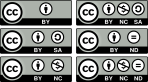
The Creative Commons licenses also include other components, such as SA (Share Alike) or ND (Non Derivatives). Avoid the restriction of commercial use through the "Non Commercial (NC)" license:
- You usually have to grant the publisher these rights anyway, and often the publisher then demands exclusive rights and thus restricts your rights.
- Commercial exploitation by publishers, such as resale or licensing to AI companies, can then take place without your involvement and you will not receive a share of the revenue.
- "Non-commercial" is not clearly defined in German law. Often, desired uses such as cooperation between public and private organizations such as educational institutions are prevented.
Further information can be found on the pages"Open Access means CC-BY" of the DEAL consortium.
A key indicator of the University of Siegen's range of services is the publications of its researchers. In particular, publications in specialist publications (journals, books and monographs, conference and congress reports) are used nationally and internationally to assess the performance of both the authors and the associated institution. It is therefore in the best interest of the authors and the University of Siegen that each publication is clearly assigned, as this is the only way it can be found in literature searches for rankings and other evaluations.
The University of Siegen has therefore defined a binding, standardized affiliation designation in German and English in its publication guidelines. This is intended to ensure that publications and other written documents are recorded correctly and completely for the benefit of the authors and their institution(s). The publication guidelines are binding for the entire University of Siegen. It serves to clearly assign members of the University of Siegen in academic and non-academic publications. All employees of the University of Siegen should use this official designation throughout the publication process and wherever they name their research institution (e.g. congresses, symposia, lectures, research proposals, etc.).
The guideline applies to all academic and non-academic employees, doctoral candidates and students at the University of Siegen. It also applies to all academics who research and publish as part of a guest stay at the University of Siegen. Insofar as publications and other written documents are directly related to activities at the University of Siegen, the guideline also applies to honorary professors, lecturers and scholarship holders.
Publication guidelines of the University of Siegen
Amendment regulations to the publication guidelines
Indication of third-party funding providers
For publications based on third-party funding, the third-party funding provider must be named in the acknowledgement (not in the affiliation information). Many publishers also provide standardized fields such as "funding acknowledgements" or similar for this purpose. Any requirements of the third-party funders must be observed.
ORCID
Only a few authors can be identified by a unique name, as names can change and are subject to cultural developments. In order to be able to identify all of the authors' publications, the names are often researched at great expense. This can be remedied by using a unique personal identifier, such as the Open Researcher and Contributor iD (ORCID) can help. ORCID is an identifier for the unique identification of scientific authors. In addition to different types of publications, scientists can store their different name variants as well as information on their professional career, websites, funding and awards in their ORCID profile.
Advantages
ORCID is already used by several scientific publishers, institutions and professional societies for scientific publications and offers scientists the following advantages:
- The unique assignment to all publications (including research data) of an author,
- the automatic generation of a publication overview through synchronization with various international databases (e.g. Web of Science, Scopus),
- the linking of publications with the same ORCID by publishers - this leads to increased visibility of the publications,
- the simple and complete mapping of research achievements for interim and final reports to research funders by means of automated export options,
- the possibility of conveniently displaying personal CVs and research projects,
- enabling international visibility and thus the possibility of new collaborations.
Registration with ORCID is free of charge: orcid.org/register. Scientists can easily register via the web portal orcid.org and carry out the further administration of their data there - their own data sovereignty is always guaranteed, as the visibility can be set individually for all entries. The search for scientists is also freely available.
ROR and other identifiers for the University of Siegen
Institutions are similar to people: Names change, affiliations to superordinate institutions can change and translations into other languages are not always unambiguous. For this reason, there are also persistent identifiers for institutions that enable a clear assignment.
If possible, use the following University of Siegen identifiers wherever you indicate your affiliation with the University of Siegen:
- Research Organization Registry (ROR): 02azyry73
- ISNI: 0000 0001 2242 8751
- Crossfef-Funder ID: 100018222
- DFG_Inst_ID: 10291
- Ringgold: 14312
- Wikidata: Q504723
Not all publications in the scientific field are trustworthy, and there are incentives on the part of both publishers and publishers to save on quality: more articles with lower costs lead to higher profits for publishers, more publications in a shorter time improve publication figures for researchers. Supposed specialist journals promise scientific quality, which is used for the targeted dissemination of fake science. In this context, there is often talk of "predatory publishing" or "predatory publishers": publications are published for sometimes high fees without adhering to common quality standards.
Careful selection of a journal or publisher is therefore important. Once published, publications cannot simply be taken back and publications with dubious publishers can do more harm to your own person than an additional publication can help your CV.
To help you choose a reputable publication venue , we recommend the checklists from the Think.Check.Submit! initiative.
If you are not sure, you are welcome to contact the Open Access team: oa@ub.uni-siegen.de
How can you recognize dubious offers?
- Offensive acquisition of articles or publications by e-mail
- Advertising with peers, members of the editorial board or editors who either do not exist or have never agreed to act as such for the journal
- Advertising with short processing times, high acceptance rates and rapid publication
- No information on quality assurance measures such as peer review
- Name and online layout are often confusingly similar to those of renowned journals or publishers
- Misleading or incorrect information on indexing in databases and metrics such as the impact factor
- No allocation of free licenses and persistent identifiers, no long-term archiving
- No indication of contact options or the publisher's address
What problems can arise with dubious providers?
- Missing or inadequate peer review leads to the publication of non-peer-reviewed results
- Lack of legally secure licenses gives the publishers exclusive rights of use, publications can be severely delayed or not published at all. This can prevent research results from being published elsewhere or only for an additional fee ("free purchase" of publications)
- Lack of permanent addressing or long-term archiving can lead to the sudden disappearance of the publication if the provider discontinues the publication platform
- lack of indexing of the publication in databases and library catalogs leads to a lack of findability and thus to low citation of the publication
What options are available in the event of an unintended publication?
- Under no circumstances should you pay APCs or any other fees
- Do not sign any contracts or other agreements
- Depending on the timing of the publication, withdraw the manuscript or request its withdrawal or retraction
- Document the submission process (screenshots) and your communication with the editors / publisher
- If necessary, contact the legal department (Division 3.1)
Recommendations for dealing with such a publication are provided by the „5 Handlungsempfehlungen, wenn Sie unbeabsichtigt in einem Predatory Journal publiziert haben“ by Carolin Becklas Dorow (10.5281/zenodo.20524875).
University of Siegen
- Open Access Policy
- Publication guidelines and amendment regulations to the Publication Guidelines
- Overview page on Fundamentals of Research and safeguarding good scientific practice
- e-Science Service - Research-related services
Research funding
- German Council of Science and Humanities: "Recommendations for the transformation of scientific publishing to Open Access"
- German Research Foundation (DFG):
- Federal Ministry of Research, Technology and Space (BMFTR): "Open Access in Germany. Joint federal and state guidelines"
- European Research Council (ERC): Open Science in ERC Projects
Further information
- General information on Open Access: open-access.network
- Support in selecting the publication venue:
- B!SON Bibliometric and Semantic Open Access Recommender Network
- oa.finder Search tool for scientific publication organs
- Think.Check.Submit Checklists for the trustworthiness of publication venues
- Support in drafting contracts with publishers from the AuROA project
- AuROA contract generator for tailor-made sample contracts for licensing your publications
- AuROA service catalog for scientific Open Access publications. Transparent list of tasks for book publications
- Creative Commons: License overview
- DOAJ Directory of open access journals
- DOAB Directory of open access books
- ORCID Open Researcher and Contributor iD
Advice and contact
We will be happy to advise you on all aspects of Open Access:
- Funding and financing options for open access publications
- Discounts for publication fees
- License selection
- Quality criteria for choosing a journal or publisher
- ...
If you would like a telephone or personal consultation, please make an appointment by e-mail. We offer individual consultation and information events for groups, also directly at your location.
Just write to us:


