Skip to main content

Social Science Pedagogy

Team Didaktik der Sozialwissenschaften

Social Sciences Seminar

Our academic focus is on the social sciences, and we cover the fields of sociology and political science, with overlaps into the field of education. Our central focus is political education in and outside of schools. In our work, we address fundamental questions, such as the roles, forms, and functions of political education in various social contexts. We regularly present our research approaches and findings to the public to foster discussion. We see ourselves as actors who actively help shape political education and the understanding of it; as an active part of the scholarly, practice-oriented, and political-social discourse on political education.

News from the Chair

POLIS März 2026 Cover
Research
+ 2 more

Welfare State

Cover des Buchs.
Research
+ 3 more

Civic Education in Times of Authoritarian Temptations

Cover des Buchs Demokratiebildung und politische Bildung
Research
+ 1 more

Democracy education and political education

Dates for the Professorship

Kolloquium Symbolbild

Colloquium of the Department of Didactics of Social Sciences

The colloquium Didactics of Social Sciences is an exchange format in which student papers, doctoral projects, research projects and texts from the field of civic education are discussed. We see the colloquium as a place for collegial consultation and discussion of work and projects relating to civic education in schools and extracurricular activities in the broadest sense. All interested parties are invited to participate at any time and present their own work and projects.

Grafik eines Farbverlaufs in schwarz und rot

Sinti* and Roma* in the German Higher Education Landscape – A Survey of the Fight Against Antiziganism at Colleges and Universities

Event featuring Radoslav Ganev (Romanity e.V.) as part of the series “Antisemitism, Antiziganism, and Political Education,” organized by POLIS and the Office for Equal Opportunity at the University of Siegen.

Class, Classism, and Sociological Education
Sinti* and Roma* Approaches to Political Education
DVPB Fall Conference 2026
Anti-Semitism and the AfD
Anti-Semitism in the Heat of the Moment: Essays on Political Education
Addressing Anti-Semitism Through Education: Misconceptions, Methods, and More

Research Profile

In terms of its themes, content, and professional theory, this research area is situated at the intersection of school-based and out-of-school political education (with particular overlap here with political youth education and youth work). 

This is evident, for example, in our research projects, publications, and courses. In our research, we analyze concepts of political education as well as the history of the profession. We do not view either of these as static entities, but rather as contested and historically shaped. Furthermore, these concepts are closely linked to related educational approaches, such as democracy education, education for sustainable development, global learning, and so on. Defining these relationships is a central part of our work. 

The aim of our work is a critical reconstruction of and engagement with these concepts (as defined by education policy). Our research aims to further develop these concepts in the spirit of critical political education. These concepts are translated into practice through, among other things, the development of instructional materials.

In terms of its substantive focus, the research area is grounded in sociology and critical political education. The integrative understanding of the social sciences expressed through this approach is a distinctive feature of teacher education in Siegen. Our research and courses reflect this understanding, as does our focus on issues critical of power and discrimination, or similar topics. 

Research Focus Areas

  • Concepts and Approaches in the Pedagogy of the Social Sciences
  • Collaborations between political education in schools and youth work
  • Democracy Education and Civic Education
  • Education for Sustainable Development and Political Education
  • History of Political Education from a Genealogical Perspective
  • Theories of Democracy, Social Theories, Educational Theories, Analyses of the Contemporary World, and Their Relationship to Political Education
  • Popular Phenomena as Topics for Instruction
  • Reconstructing Students’ and Teachers’ Perceptions in the Context of Political Education
  • Textbook Research
  • Qualitative Methods and Political Education


Alexander Wohnig

Alles dasselbe, oder doch nicht?

Alexander Wohnig, Jana Sämann

Außerschulische politische Jugendbildung: Aktuelle Herausforderungen, Steuerungs- und Einflussnahmeversuche

Netzwerk Demokratiebildung und politische Bildung, Alexander Wohnig

Demokratiebildung und politische Bildung

Hanna Butterer, Jochen Lange, Manuela Siewert, Alexander Wohnig

Interaktionen mit Schulkindern im Kontext von Nachhaltigkeit. Eine praxeologische Untersuchung zu Subjektivierungsprozessen

Der Mythos 'Neutralität' in Schule, politischer Bildung und Lehrer*innenhandeln

Jana Sämann

Politische Bildung in Handlungsfeldern der Jugendarbeit

Current Projects

HofBelke
-

Multi-perspective sustainability in science lessons

The project "On the teaching and appropriation of systemic sustainability contexts between social and natural science perspectives in childhood" is an interdisciplinary collaboration between Prof. Dr. Alexander Wohnig (didactics of social sciences), Prof. Dr. Jochen Lange (educational science with a focus on didactics of subject teaching), Manuela Siewert (teacher for special tasks in the primary school pedagogy working group) and myself (didactics of social sciences, political sustainability education).

The aim of the project is to take a multi-perspective view of sustainability issues, which is closely linked to both general knowledge teaching and the educational approach of Education for Sustainable Development (ESD). To date, however, educational practice has mainly focused on biological and physical topics, which is why ESD practice - both in elementary school and beyond - has often been criticized as apolitical in recent years. In contrast, political, social and sociological dimensions as well as corresponding contexts tend to remain marginally integrated. The role of human practices, socio-cultural processes, lifestyles, norms and values in shaping a (non-)sustainable present and future is also often insufficiently considered.

This is where the project comes in, with the aim of identifying starting points for social science learning processes based on current practice. To this end, we are working with practice-based case vignettes as well as starting points, challenges and potential for reflection using the example of dilemma stories. On this basis, we develop OER educational materials, which are then tested and reflected on in practice.

In the project, I am responsible for project coordination, for the regular, ethnographically accompanied exchange with educational practice and for the development of OER materials, which are designed from practice for practice.

-

Between professional autonomy and state appropriation: A genealogy of the relationship between democracy, governance and political education in the history of the Federal Republic of Germany

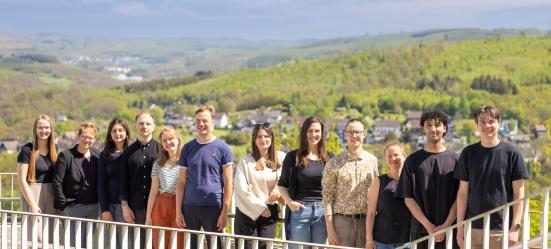
Social Sciences Pedagogy Team

Teamfoto Didaktik der Sozialwissenschaften

From left to right: Maria Thielmann, Sylvia Seibert, Lina Hachi, Steffen Pelzel, Hanna Butterer, Prof. Dr. Alexander Wohnig, Dana Grebner, Julia Steuber, Max Barnewitz, Georgia Vassiliadou, Yamma Bahser, Jan-Niklas Kellermann

[Optional section: Further sections as required]